Edged Wpns Help identifying a saber

Jonl51

Corporal
Joined
Apr 10, 2018
Location
Northern Illinois
Greetings All,
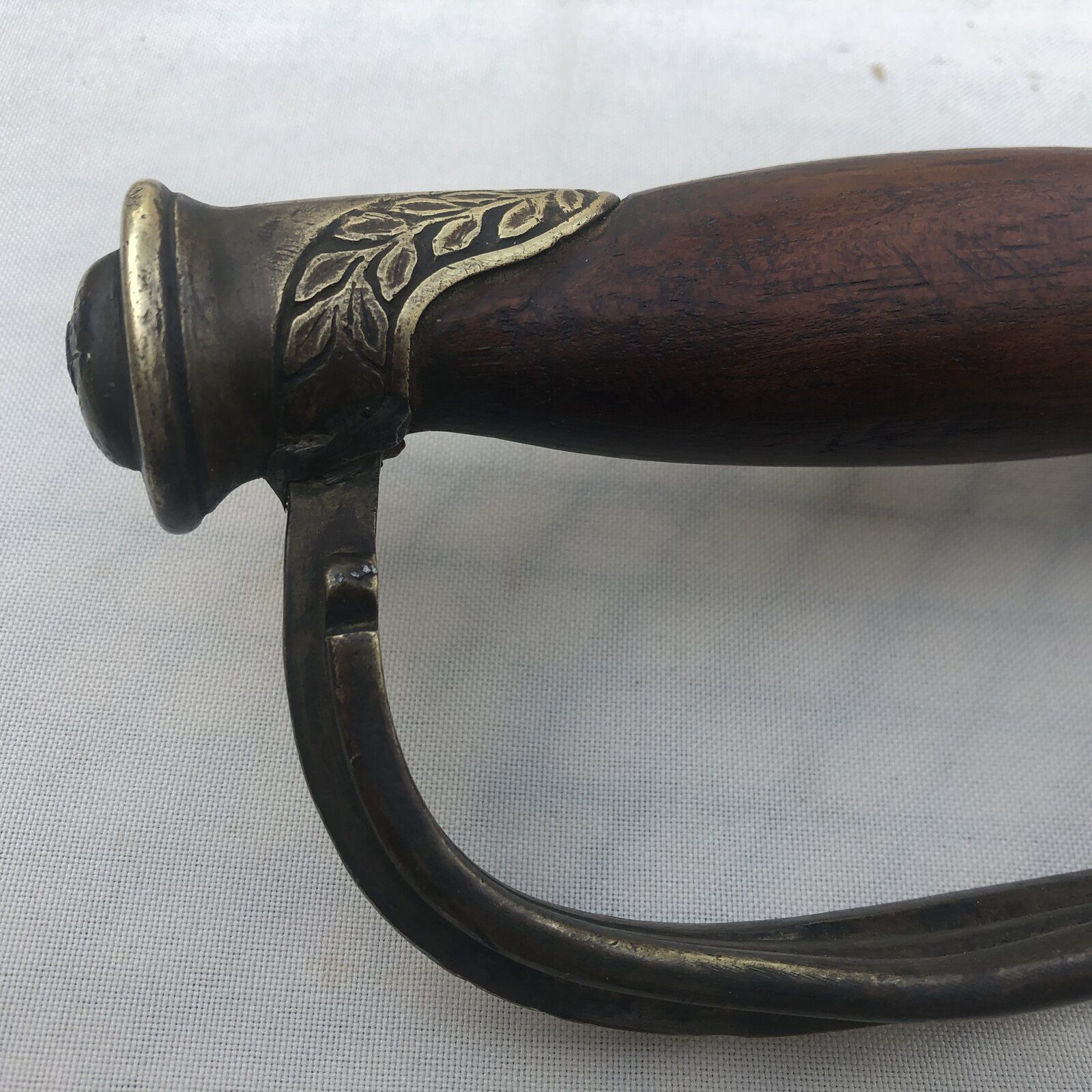
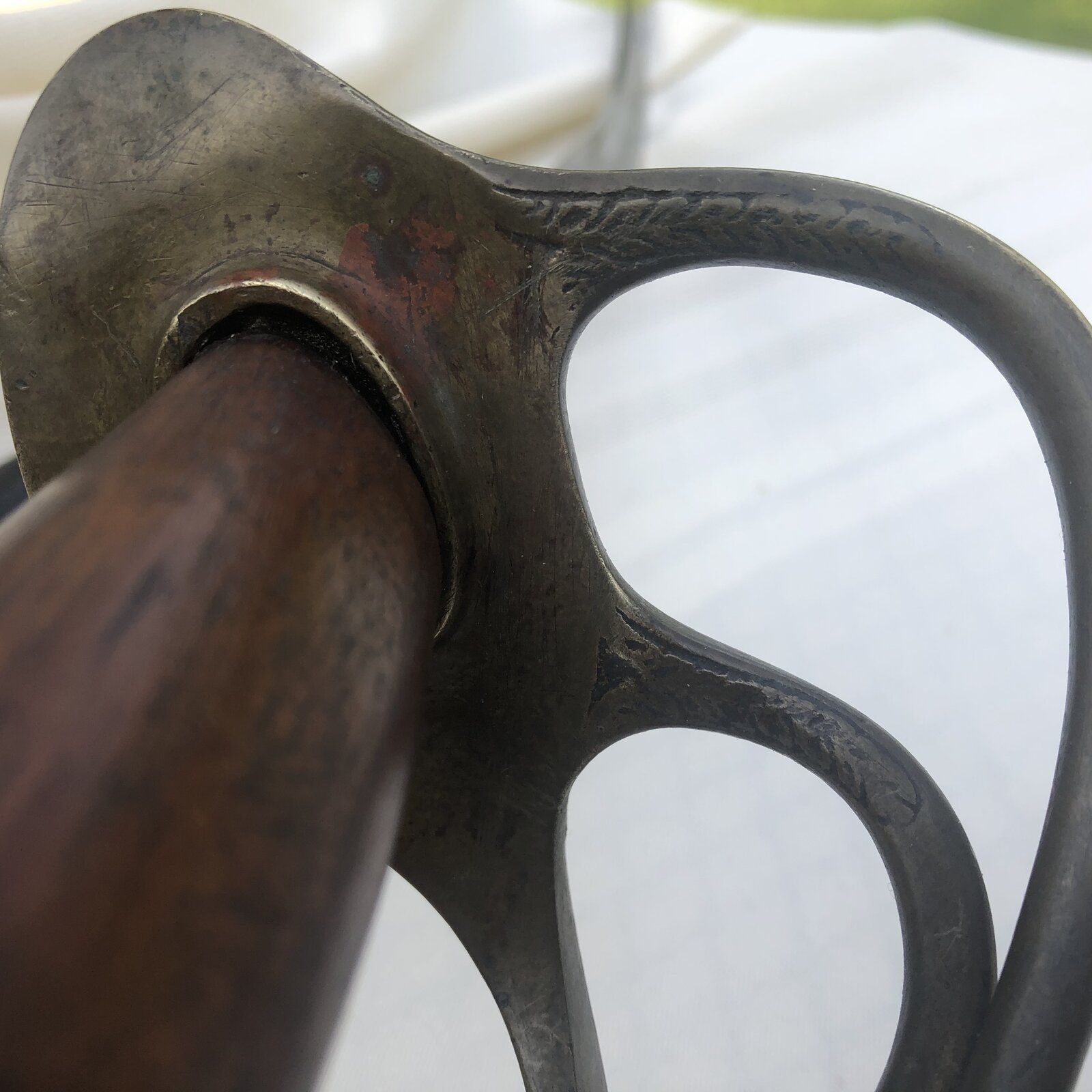
Any help identifying this saber is much appreciated. Features: Stopped fuller with short ricasso. Both the obverse and reverse sides of ricasso have indented line(s) with possible lettering/ makers marks which are
indistinguishable now. Pen knife type start to blade, no identifying marks visible, flat blade back/ spine. Crude quality workmanship on brass guard. Two piece pommel, very well fitted stained wood grip.
Local repair ( solder ) to guard at pommel and
blade at washer location. Scabbard has fine brass bottom seam, iron ring mounts,
rings and drag with the exception of 1 brass ring ( repair?). The throat is not held by screws and has opposing blade guides.
Saber is overall 38 inches long and the blade is 32 inches. Thank you!!

4439116E-6F1E-4DB5-8A16-48EC39A684E7.jpeg


F65F27AE-920B-4F28-AC95-EBB4AE1D8798.jpeg


6CA4CCC8-CE60-42C2-ACF6-5F1CE46E12FD.jpeg


92228B0F-75A2-4F30-BB73-99E9E52DB059.jpeg


36961717-D08C-4E36-8E91-0B54193550F6.jpeg


EE1445CA-18D9-4035-AE7B-E6BDBC46E6B3.jpeg


262FE89E-3D5E-4C13-88AD-EBE9B1F124E6.jpeg


3B627DFA-760D-4856-B6E4-71BBD77C9B8D.jpeg


94D64BCC-92E2-4ADD-9209-FBBE0D61D48E.jpeg


5D2EB702-820D-4DEB-8F25-530476C28408.jpeg
 
Although I have no idea of the manufacturer, the sword itself is a M.1860 Saber For Cavalry Officers, most likely a German-made import from around the time of the war. It's obviously intended to resemble a M.1860 instead of the earlier M.1840 because of the swell in the center of the wooden grip; it's an officer's saber because of the laurel leaf designs on the pommel cap and branches of the hilt. (Enlisted men's swords were plain.) Though in relatively poor condition, the blades of these were most often decorated with etched designs incorporating more leaves, flowers, eagles, and the letters U. S. Compared to the enlisted varieties, cavalry officers' swords are uncommon, making this a desirable piece despite its condition.
 
Last edited:
Thank you. Agreed it is a cavalry officer's saber. In my limited knowledge and experience I presumed the relatively poor
quality ( very shallow) of the laurel leaves on the hilt branches as well as absence of any
corresponding scroll work was not up to European quality, but that was a guess.
Thanks again. Jonl51
 
I would saythat it was manufactured by Horstmann. Amongst the several varieties of cavalry officer sabers they made, they made a short bladed version with a 31 7/8 inch blade and no engraving. Despite having an 1840 style flat back blade, it had a grip with a swell like an 1860. Like yours, there was no decoration on the quillion and instead of the usual ancathus leaves where the knucklebow joins the pommel, there is a notch design for the saber knot. Many had a two line impressed maker stamp at the ricasso that said "Horstmann &Sons" which may be what is obliterated on yours. Actually, they didn't make, they imported and sold.
 
There are definitely Confederate characteristics, however. The split pommel and crude casting of the hilt for example. The scabbard is definitely Confederate -- not only the lapped seam but also the blade guides are diagnostic. The small die stamping on both sides of the ricasso is enigmatic to me. I do not know enough about US swords to make anything of the pen knife style of a stopped blade. There are several a handful Confederate swords with this feature, most notably College Hill. I am unaware of any College Hill swords with die stamping on the ricasso, however.
 
Very interesting and I see the similarities. Especially the pattern on the guard branches. The pommel style and laurel leaf
pattern look to be about the same.
Thank you! Jonl51
 
There are definitely Confederate characteristics, however. The split pommel and crude casting of the hilt for example. The scabbard is definitely Confederate -- not only the lapped seam but also the blade guides are diagnostic. The small die stamping on both sides of the ricasso is enigmatic to me. I do not know enough about US swords to make anything of the pen knife style of a stopped blade. There are several a handful Confederate swords with this feature, most notably College Hill. I am unaware of any College Hill swords with die stamping on the ricasso, however.
The wood grip shape and pommel style seemed to match College Hill's swords. Also the angle of the guard to the sword blade. The crudeness of the brass work, red pigmentation in the brass and brass solder on scabbard made me think possible Southern made saber. As did the
very crude solder work at the pommel. As you mentioned College Hill also used the pen knife styled blade. There was a predecessor to Nashville Plow works known as Sharp and Hamilton and they had die stamping on very short ricassos too. If I can tease out any lettering on the
ricasso....... Thank you! Jonl51
 
Your scabbard seam and style look very close. Is soldered on the seam with brass?
Can't tell if it was soldered with brass as the seam is very fine and the scabbard sppears to have plated at some point. In my opinion the solder on yours where the knucklebow joins the pommel and where the blade joins the hilt are not of crude Confederate manufacture. I suspect the hilt was removed at some later point (it looks like the pommel tang dome may be ground down a bit) and the wooden grip may be a replacement. Looks pretty big to also have had cord and either leather or sharkskin wrapped around it at one point, as an original wood grip that has no grooves would have had both on top of it. I think the solder is to make everything tight again.
 
Can't tell if it was soldered with brass as the seam is very fine and the scabbard sppears to have plated at some point. In my opinion the solder on yours where the knucklebow joins the pommel and where the blade joins the hilt are not of crude Confederate manufacture. I suspect the hilt was removed at some later point (it looks like the pommel tang dome may be ground down a bit) and the wooden grip may be a replacement. Looks pretty big to also have had cord and either leather or sharkskin wrapped around it at one point, as an original wood grip that has no grooves would have had both on top of it. I think the solder is to make everything tight again.
I think you are correct that the solder was not original but either a quick and dirty repair or as you say to tighten everything up again perhaps after replacing the original grip. If this wood grip is a replacement it is very well fitted and shaped. I was judging the solder repairs,
brass ring replacement and plain wood
handle to be done out of expediency and
with what materials were available possibly
indicating southern usage/conditions.
This could very well be a Horstman saber as you suggest. Appreciate all the help and
pictures. I'm still hopeful I can tease out some letters on the ricasso. Best regards. Jonl51
 

Learn About Us
About CivilWarTalk
Contact the Webmaster
Meet the Staff
Link to CivilWarTalk
Join Our Community
Register
Browse Forums
View Today's Discussions
Search the Forum
Get Help
FAQ
Student Guide
Forum Rules & Etiquette
Copyright / DMCA

     Contact Us CivilwarTalk on Facebook CivilWarTalk on YouTube CivilWarTalk on Twitter RSS Feed

Bringing the American Civil War and More to Life.
© 1999 - , CIVILWARTALK, LLC - Site Version 10.0

SlaveryTalk.com - SecessionTalk.com - CivilWarTalk.com - ReconstructionTalk.com
Back
Top