Hand made sword

hink441

Private
Joined
Jul 25, 2017
Hi,
I found this hand made sword recently. I wanted to post it here in order to hear your thoughts.

image.jpeg

It has a bayonet handle with a serial number on the top handle flat. That is the only marking I have been able to find. The original bayo blade has been replaced by a crudely manufactured sabre like blade. It has a fuller that runs most of the blade and is very tight and sturdy. Heavy corrosion, blade nicks, and bends adorn this beauty. The shape is cattywhompus and still retains a surprisingly sharp edge and is nicely balanced.

Here are a few photos.
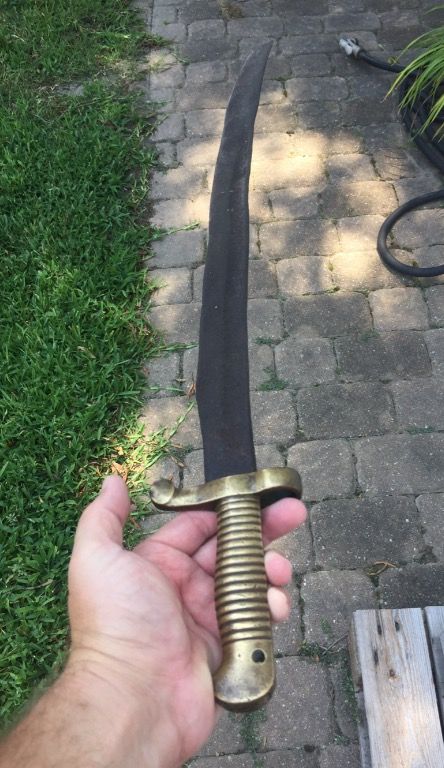
image.jpeg
 
Interesting piece as the blade is way out of place with the handle. The handle looks like a it could be a Whitney. What is the diameter of the inside of the barrel socket? Can you post a photo of the end of the handle.
 
A farmer could have definitely made this blade, but why take the extra effort to make it like a sword with a fuller on the blade, when a simple machete blade would be easier to make and work just as well.

This brings me to my main question;

Could this be a Civil War used, field made modification using available parts?

I have had some collectors say it is very possible that it was done during the war and could be a Confederate piece. I am sure that we will likely never be able to say one way or another ( farmer made or ACW used) because both scenarios are possible.

Has anyone seen documented use of hand made weapons during the Civil War? If you have, would you please post some examples

Chris
 
Reminds me of the French Gras sword bayonet, one which has been remodeled as a machete for all those jungle colonies the French had circa late 1800's like Indo China, Madagascar, Guinea. If so, it may be a semi official repurposing by some army artificers.
 
The reason the handle and blade are different is likely that a soldier or officer wanted to keep as much of their weaponry as possible after the war was over. They likely removed the original blade so that they could hide the handle in their sack. This was done with larger pieces as well such as rifles. They were split in two so they could fit in their sack. Soldiers in the Confederate army needed their firearms once they returned home. I have pictures of rifles like this somewhere I will try to find.
 
The reason the handle and blade are different is likely that a soldier or officer wanted to keep as much of their weaponry as possible after the war was over. They likely removed the original blade so that they could hide the handle in their sack. This was done with larger pieces as well such as rifles. They were split in two so they could fit in their sack. Soldiers in the Confederate army needed their firearms once they returned home. I have pictures of rifles like this somewhere I will try to find.
Or, the regiment in French Indo-China needed forty machetes and rather than order them from France and wait six months to get them took forty gras sword bayonets to the artificer and told him to make machete blades and attach them to the by now obsolete bayonet mounts, some of which were seventy years later brought back from Vietnam as souvenirs.
 
The handle on my bayonet/sword matches the type used on the M1859 Sharps rifle. The slot cut into the top flat is a match to the M1859 Sharps bayonet handle.

What I consider unique about this piece is the hand forged blade.
 
The handle on my bayonet/sword matches the type used on the M1859 Sharps rifle. The slot cut into the top flat is a match to the M1859 Sharps bayonet handle.

What I consider unique about this piece is the hand forged blade.

hink441,

Looks like I was wrong about your home-made sword being a former Enfield rifle bayonet.

I went and found my copy of Echoes Of Glory: Arms And Equipment Of The Union, by the Editors of Time-Life Books, and found on page 31 a picture of a saber bayonet for the U.S. Model 1855 Percussion Rifle. It has the same pattern/ribbed brass handle as your picture above.

If you have or can obtain this book, I think you might see how similar it is to your own.

Sincerely,
Unionblue
 
1. Most likely the blade was used and abused, and that resulted in its appearance.
2. The myth that hand forged means that an item looks like it was made by a 6-year-old... makes my head hurt. How do you think nice swords were made if they were not forged by hand?
 
1. Most likely the blade was used and abused, and that resulted in its appearance.
2. The myth that hand forged means that an item looks like it was made by a 6-year-old... makes my head hurt. How do you think nice swords were made if they were not forged by hand?

Well to be honest with you, I thought companies like Ames used machinery in their manufacturing process in order to churn out 300,000 swords. I thought machined produced swords started around 1853.
 
The blade is original to the handle, look closely at the ricasso end of the blade, although someone has made a crude attempt to forge it into a different shape for reasons unknown today. The "Corn Knife" suggestion is not out of the realm! It was originally produced for the Sharps Navy Rifle, and the large font numbers and serial number range are correct for the others I have seen.
J.
 
Original blade to the handle. That is interesting, I had not really considered that idea before. The blade on mine is 22 inches long and the original M1859 blade is 23 inches long. So i think it is possible my blade could be original, but I think the two blades look very different. Here is a comparison.

Here is an original M1859 bayonet;

image.jpeg


And here is my sword.

image.jpeg
 

Learn About Us
About CivilWarTalk
Contact the Webmaster
Meet the Staff
Link to CivilWarTalk
Join Our Community
Register
Browse Forums
View Today's Discussions
Search the Forum
Get Help
FAQ
Student Guide
Forum Rules & Etiquette
Copyright / DMCA

     Contact Us CivilwarTalk on Facebook CivilWarTalk on YouTube CivilWarTalk on Twitter RSS Feed

Bringing the American Civil War and More to Life.
© 1999 - , CIVILWARTALK, LLC - Site Version 10.0

SlaveryTalk.com - SecessionTalk.com - CivilWarTalk.com - ReconstructionTalk.com
Back
Top