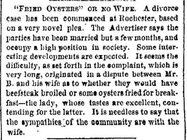
Fried Oysters

Thanks for this posting. As a kid we had both raw oysters and fried oysters every Friday night from a nearby ouster house that my father would stop at on his way home from work in Philadelphia. I still can't decide which tasted better, the raw ones right out of the shell or the deep fried ones. As a docent and researcher at a colonial site in South Jersey (then, it was West Jersey) we have found that in the middens ( trash dumps) of homes and taverns that the two most commonly found items are the stump ends of white clay tobacco pipes and shells of clams and oysters, which, if these shells are accurate representation of what was available circa 1750, show that the shell fish were much larger than today, some of them the size of dinner plates.
 
The best fried oysters I've ever had are prepared by the volunteers of the Heidlersburg Fire Company in Adams County, Pennsylvania, (whose county seat is Gettysburg). The oysters, along with roast beef and shrimp, are a regular feature at a monthly public supper held throughout the winter to support the all-volunteer fire company. I once met people there who had come from Baltimore, more than an hour away, just for that supper. I'm specifically mentioning Heidlersburg's oysters here because the next supper, scheduled for Nov. 17, may be of interest to any CWT members who will be attending the annual Remembrance Day and Dedication Day ceremonies at Gettysburg. These just might be the best fried oysters you've ever eaten, too.
 
Interesting information about oysters in this letter, written by John R. North, at the time a Sergeant in Company B, 16th Georgia Infantry. The letter is dated Camp Bryan, Va [Yorktown], October 22, 1861:

.....We are encamped in a clover field and are surrounded by a forest full of ripe chestnuts, chinquepins, summer grapes, muscadines, and walnuts. Wild turkeys are heard around our camp every morning. Cobb's Legion is encamped three miles from us, towards Newport News.
We have oysters here in the greatest abundance. The men are generally very fond of them. They go down to the creek a few hundred yards off, and to the river about a half a mile distant, and gather their haversacks full, and bring them back to shell at their leisure. The first day we were here [October 20, 1861] , it was a novel sight to see men huddled about in squads all over the encampment, cracking oysters. They prepare them in various ways. Some roast them in the shell, others make soup of them; some season them and eat them raw, others mix them in cornmeal dough and fry the mixture..... Source: Southern Banner, Nov. 6, 1861, page 1.

John R. North b. 1836 had been an editor for the Athens, GA Southern Banner prior to his enlistment. He enlisted June 14, 1861. On September 14, 1862, the 16th Georgia was among the regiments sent to Crampton's Gap (South Mountain) to dispute the advance of the Union VI Corp. 52 members of the regiment were killed/mortally wounded in the engagement that day. John R. North, age 26, was among those killed.
 
Last edited:
The basics from Allen Bacon, of Atwood and Bacon's Oyster Restaurant in Boston, in the Boston Traveller, July 7, 1865:
The Atwood & Bacon establishment is currently known as the Union Oyster House. Located very near Faneuil Hall, it is a designated National Historic Landmark, as the oldest continuously operated restaurant in the country.
The building dates back at least to 1742, and had an intriguing colonial and Revolutionary history, but became an oyster restaurant in 1826, and has had only three owners since. From Daniel Webster (who daily drank a tall tumbler of brandy and water with each half-dozen oysters, seldom having less than six plates)' to John F. Kennedy (who entertained in a favorite booth, still preserved in his honor, in the upstairs private dining-room), everybody who was anybody in Boston dined there, as well as famous visitors from around the world, including political figures, writers, actors, musicians, and artists.

Notice also from Boston Herald, March 26, 1858:
Boston_Herald_1858-03-26_4.jpg
 
Last edited by a moderator:

Learn About Us
About CivilWarTalk
Contact the Webmaster
Meet the Staff
Link to CivilWarTalk
Join Our Community
Register
Browse Forums
View Today's Discussions
Search the Forum
Get Help
FAQ
Student Guide
Forum Rules & Etiquette
Copyright / DMCA

     Contact Us CivilwarTalk on Facebook CivilWarTalk on YouTube CivilWarTalk on Twitter RSS Feed

Bringing the American Civil War and More to Life.
© 1999 - , CIVILWARTALK, LLC - Site Version 10.0

SlaveryTalk.com - SecessionTalk.com - CivilWarTalk.com - ReconstructionTalk.com
Back
Top