Natural Resource Condition Assessment: Fort Sumter National Monument and Charles Pinckney National Historic Site, South Carolina
2012-04
Dorr, Jessica / Palmer, David / Schneider, Rebecca / Galbraith, John M. / Killar, Myles / Klopfer, Scott D. / Marr, Linsey C. / Wolf, Eric
National Park Service
Reports, Conservation Management Institute
Abstract The goal of this assessment is to provide an overview of natural resource condition status to allow Fort Sumter National Monument (NM) and Charles Pinckney National Historic Site (NHS) to effectively manage National Park Service (NPS) trust resources through Resource Stewardship Strategies (RSS) and General Management Plans. An ancillary benefit is that it will aid the park in meeting government reporting requirements, such as the land health goals under the Government Performance Results Act (GPRA). This assessment is primarily based on existing data and information from the NPS Inventory & Monitoring Program, and from other Federal and State natural resource agencies.
UNITED STATES DEPARTMENT OF THE INTERIOR
This publication is one of a series of handbooks describing the historical and archeological areas in the National Park System administered by the National Park Service of the United States Department of the Interior. lt is printed by the Government Printing Office and may be purchased from the Superintendent of Documents, Washington, D.C. 20402. Stock Number 024-005-00163-8
FORT SUMTER
Frank Barnes
NATIONAL PARK SERVICE HISTORICAL HANDBOOK SERIES NO. 12
WASHINGTON, D. C., 1952 (Revised 1962)
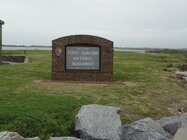
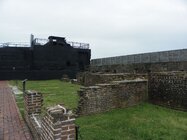
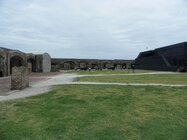
APRIL 12, 1861, a mortar battery at Fort Johnson fired a shell that burst directly over Fort Sumter. This was the signal for a general bombardment by the Confederate batteries about Charleston Harbor. For 34 hours, April 12 and 13, Fort Sumter was battered with shot and shell. Then the Federal commander, Maj. Robert Anderson, agreed to evacuate; and, on April 14, he and his small garrison departed with the full honors of war. On the following day, President Abraham Lincoln issued a call for 75,000 militia. The tragedy of the American Civil War had begun. Two years later, Fort Sumter, now a Confederate stronghold, became the scene of a stubborn defense. From April 1863 to February 1865 its garrison withstood a series of devastating bombardments and direct attacks by Federal forces from land and sea. Fort Sumter was evacuated only when Federal forces bypassed Charleston from the rear. At the end, buttressed with sand and cotton as well as its own fallen brick and masonry, it was stronger than ever militarily. And it had become a symbol of resistance and courage for the entire South. Both the "first shot" of April 1861 and the long siege of 1863-65 are commemorated today by Fort Sumter National Monument.




 Forum Host


 Bringing the