Custer Forrest or Custer

Forrest or Custer

  • Custer

    Votes: 9 9.2%
  • Forrest

    Votes: 89 90.8%

  • Total voters
    98
Status
Not open for further replies.
And add to that Forrest's conduct against black soldiers.

That's a fair question.

We even asked Mike ( @civilwartalk ) to create a sub forum within the main Forrest forum for that discussion. I invite you to check out our Fort Pillow section:
http://civilwartalk.com/forums/ft-pillow.177/

However, I feel that's irrelevant to the original question.

If we consider Forrest's treatment of Black troops, should we not include Custer's views of Native American Tribes ?
Neither question adds anything to who was the better General.
 
Last edited:
Forrest after the war goes on to rebuild his fortune and business, Custer continues his quest for glory for another decade and gets himself and his command (including his two brothers Tom and Boston and a brother-in-law) killed at the Little Big Horn. Not that I'm picking sides, mind you, just stirring the pot on this little conversation......:wink:
Forrest did have a good time with that good old boys social club of his
 
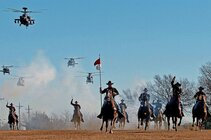
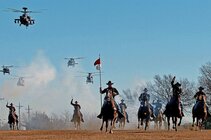
If anything, I believe an argument can be made that Forrest may be the father of 20th century air cavalry.

I like your thought process here!

That's a great way to add even more depth to Air Cav history.

I was an Air Cav trooper... 3rd/4th Battalion, 227th Aviation Regiment - 1st Cavalry Division.

Ever seen 'We Were Soldiers'?
That's where my unit drew its direct lineage from.

(Sorry for the horrible picture - I tried to adjust the contrast and think I washed out the patch details worse!)

image.jpeg
 
Last edited:
Forrest was the devil in a saddle. He certainly was a cavalryman. I forget what battle is was in Mississippi when Stephen Lee was in charge and attacked 11,000 well entrenched Yankees with his 8,000 man force, against Forrest's advice. After the battle Forrest said to Lee "Don't feel bad general, if I had me a West Point education the Yankees would be whipping me too." Maybe it because Forrest had no military training that some folks say he was not a cavalry officer. He certainly rewrote the book. Erwin Rommel studied Forrest, so did George Patton.
 
I like your thought process here!

That's a great way to add even more depth to Air Cav history.

I was an Air Cav trooper... 3rd/4th Battalion, 227th Aviation Regiment - 1st Cavalry Division.

Ever seen 'We Were Soldiers'?
That's where my unit drew its direct lineage from.

(Sorry for the horrible picture - I tried to adjust the contrast and think I washed out the patch details worse!)

View attachment 91836
Did Hal Moore study Forrest as well as Custer?
 
Forrest was the devil in a saddle. He certainly was a cavalryman. I forget what battle is was in Mississippi when Stephen Lee was in charge and attacked 11,000 well entrenched Yankees with his 8,000 man force, against Forrest's advice. After the battle Forrest said to Lee "Don't feel bad general, if I had me a West Point education the Yankees would be whipping me too." Maybe it because Forrest had no military training that some folks say he was not a cavalry officer. He certainly rewrote the book. Erwin Rommel studied Forrest, so did George Patton.
I think Forrest just rewrote the 'How to be a Cavalry Officer' book and threw away the old one. Whatever he was it seemed tohave worked really well. I doubt any other officer with the exception of Sherman caused so much damage during the war.
 
Interesting thought comes to mind. Would Forrest have abandoned his missing troopers after the Washita? Would Forrest have ignored Terry's orders just before the Little Big Horn? Would Forrest have split his command at the Little Big Horn? In my opinion Custer had "luck" (for a while). Forrest had common sense. If I am one of his troopers I prefer the latter.
 
Interesting thought comes to mind. Would Forrest have abandoned his missing troopers after the Washita? Would Forrest have ignored Terry's orders just before the Little Big Horn? Would Forrest have split his command at the Little Big Horn? In my opinion Custer had "luck" (for a while). Forrest had common sense. If I am one of his troopers I prefer the latter.
Absolutely agree. I'm not saying Custer didn't exhibit some skill in a few engagements but I don't see any evidence of him showing the mastery that Forrest showed. Forrest had his unique ways that sets him aside from the rest.
 
Forrest was the devil in a saddle. He certainly was a cavalryman. I forget what battle is was in Mississippi when Stephen Lee was in charge and attacked 11,000 well entrenched Yankees with his 8,000 man force, against Forrest's advice. After the battle Forrest said to Lee "Don't feel bad general, if I had me a West Point education the Yankees would be whipping me too." Maybe it because Forrest had no military training that some folks say he was not a cavalry officer. He certainly rewrote the book. Erwin Rommel studied Forrest, so did George Patton.

That was Tupelo - Forrest was plenty mad at S D Lee as he was against the battle. Got to say, though, Forrest made a serious error that probably finished the battle for a loss. He also noted West Point again when talking to a couple of Wilson's aides before the battle of Selma - Col Parkhurst and Capt Hosea. Forrest offered a 'nice little place' for a fight between him and Wilson, any time Wilson thought he was ready, and remarked he carried 'nary a saber' in his command. Hosea pointed out that as a graduate of West Point he believed in using them. Forrest replied, "I ain't no graduate of West point, and never rubbed my back up against no college, but Wilson may take his sabers and I'll take my six shooters, and agree to whip the fight with any cavalry he can bring."

Methinks he doth protest too much! The old 'sour grapes' harumph. I think if Forrest had been able, he would have gone to West Point and happily learned how to soldier. Every time he got the chance, from teen years on, he would join a military operation if there was one. Born that way!

Custer on the other hand kept skating as close to the edge of getting kicked out of the place as he could. He'd collect demerits right up to the last one, then straighten up and work them off. That was one of the reasons he ended up in the cavalry...which was right where he wanted to be. There's some speculation he might have been a bad boy deliberately so he wouldn't end up an engineer.

Since the Little Big Horn was mentioned earlier, I'm not sure that proves Custer was a lousy commander. Definitely had a bad day! There seemed to be problems with his command that were similar to some Bragg faced - subordinates who were undermining him or passive-aggressive about obeying. And, Custer didn't know what had happened to Crook just before over there on the Rosebud. A head's up that every Indian on the Northern Plains was sitting down in that gully would have been appreciated! Truth is, Custer didn't exactly lead his men to their deaths from his own vanity but from a fatal underestimation of the enemy he faced. Crazy Horse was one of the best generals of the day but Custer saw him as a nekkid savage with no discipline leading other nekkid savages. Fatal mistake.

The whole situation of the Little Big Horn would not have existed if Forrest had been the commander. He was such a completely different person it's really hard to compare the two commanders. I do believe Forrest had a better understanding of the capabilities of Natives. He had Cherokee relations and had several Indians among his troops. I don't think he would have thought Crazy Horse, Sitting Bull, Gall or the rest of the Plains war chiefs were any sort of a piece of cake.
 
Forrest was the devil in a saddle. He certainly was a cavalryman. I forget what battle is was in Mississippi when Stephen Lee was in charge and attacked 11,000 well entrenched Yankees with his 8,000 man force, against Forrest's advice. After the battle Forrest said to Lee "Don't feel bad general, if I had me a West Point education the Yankees would be whipping me too." Maybe it because Forrest had no military training that some folks say he was not a cavalry officer. He certainly rewrote the book. Erwin Rommel studied Forrest, so did George Patton.

The idea that Rommel studied Forrest comes from a work of fiction. Patton studied everyone, so saying he studied Forrest doesn't really mean that much.

What, other than he and his men rode horses, makes you say he was a cavalryman?

In which campaigns did he perform reconnaissance, and what was the outcome of his work? How well did he perform?
In which campaigns did he screen confederate forces from opposing cavalry, and what was the outcome of his work? How well did he perform?
In which campaigns did he act as an advance scout for the confederate army, and what was the outcome of his work? How well did her perform?
In which battle was Forrest used to charge infantry to break their lines during an attack, in which battle was Forrest used to pursue a defeated enemy, and what were the outcomes of those battles? How well did he perform in those roles?
 
Perhaps the discussion would go better if we defined cavalry somewhat more than soldiers riding horses. Possibly Forrest was better as heavy cavalry, Custer at light cavalry. If we define and consider the role and function of cavalry, whatever that turns out to be, we could then see who better fits the definition.
 
Perhaps the discussion would go better if we defined cavalry somewhat more than soldiers riding horses. Possibly Forrest was better as heavy cavalry, Custer at light cavalry. If we define and consider the role and function of cavalry, whatever that turns out to be, we could then see who better fits the definition.

All of which brings me back to my original point the last time someone tried to make this comparison: it's comparing apples and oranges and really is kind of dumb.
 
The idea that Rommel studied Forrest comes from a work of fiction. Patton studied everyone, so saying he studied Forrest doesn't really mean that much.

What, other than he and his men rode horses, makes you say he was a cavalryman?

In which campaigns did he perform reconnaissance, and what was the outcome of his work? How well did he perform?
In which campaigns did he screen confederate forces from opposing cavalry, and what was the outcome of his work? How well did he perform?
In which campaigns did he act as an advance scout for the confederate army, and what was the outcome of his work? How well did her perform?
In which battle was Forrest used to charge infantry to break their lines during an attack, in which battle was Forrest used to pursue a defeated enemy, and what were the outcomes of those battles? How well did he perform in those roles?

I'm not going to write a thesis on Forrest to prove a point on an internet forum. I can just say that the term Forrest's cavalry is a term so common in History books that I cannot imagine anyone disputing whether or not Forest was a cavalry leader. I also have no proof that Erwin Rommel studied Forrest but I can say you and I have read some of the same books.
I think most war colleges study Forrest, or should, but I haven ever been to a war college either.
As for Custer, he was a dashing aggressive cavalry leader. Not the brightest light in the house but he certainly had great courage.
 
Status
Not open for further replies.

Learn About Us
About CivilWarTalk
Contact the Webmaster
Meet the Staff
Link to CivilWarTalk
Join Our Community
Register
Browse Forums
View Today's Discussions
Search the Forum
Get Help
FAQ
Student Guide
Forum Rules & Etiquette
Copyright / DMCA

     Contact Us CivilwarTalk on Facebook CivilWarTalk on YouTube CivilWarTalk on Twitter RSS Feed

Bringing the American Civil War and More to Life.
© 1999 - , CIVILWARTALK, LLC - Site Version 10.0

SlaveryTalk.com - SecessionTalk.com - CivilWarTalk.com - ReconstructionTalk.com
Back
Top