Enfield Bayonet

JimN

Private
Joined
Dec 3, 2014
I recently bought an 1866 trapdoor and it came with an enfield bayonet and scabbard.

I'm not very knowledgeable about these things so I posted in a Facebook group and got an answer that it's an enfield, some said possibly confederate thru blockade but finally someone said it's probably Canadian use.

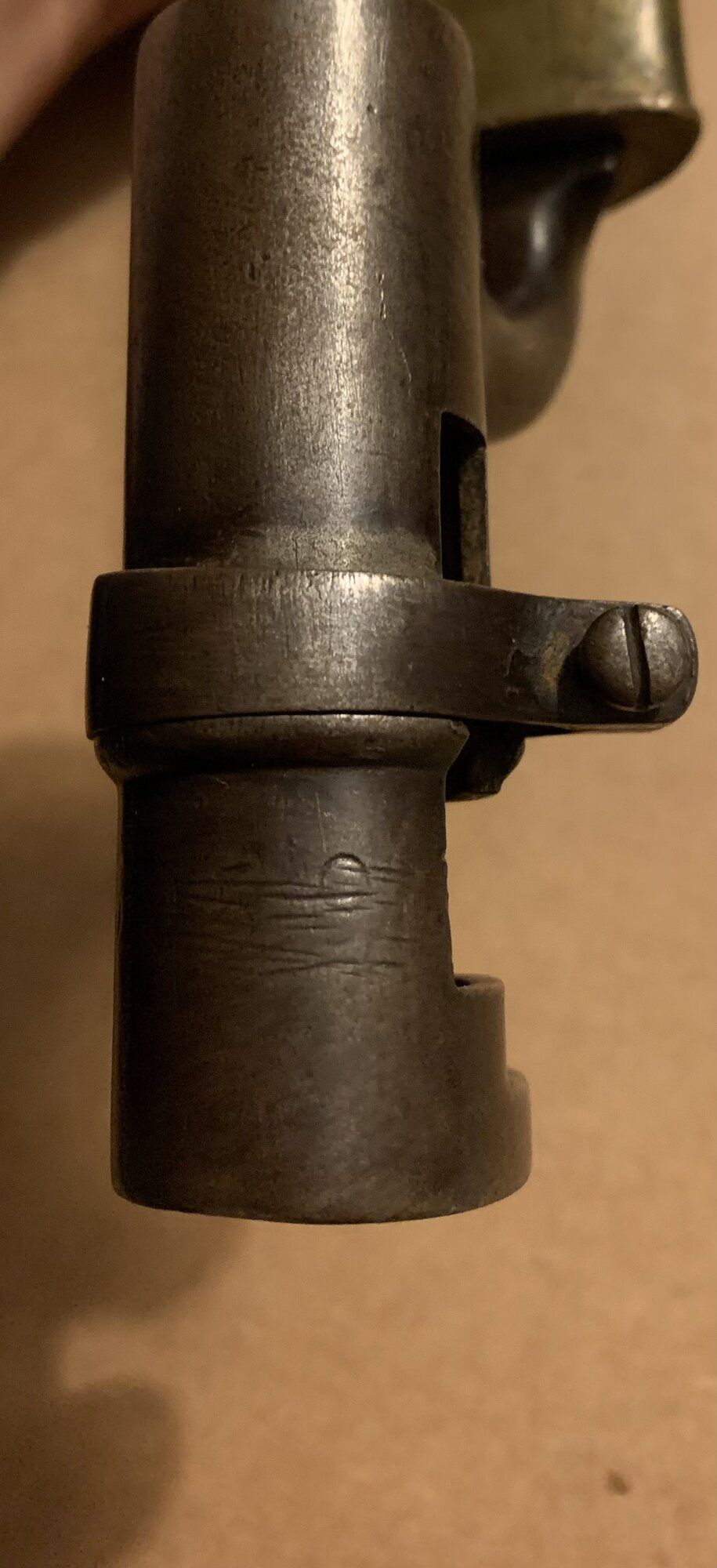
It has a bunch of markings at base of blade. On the socket in big numbers are 3059 (with lines going through) and next to those numbers going sideways are 33 scratched in.

I haven't gotten a definitive answer what it actually is. Would anyone know?
Here's some pics and thank you for your time.

1650375571427.png


D6EFDD71-8A02-472C-B0DF-80EC8AE8BEFB.jpeg


039C0C14-DA31-4E03-BBB2-07145EFF6722.jpeg


19CA3B42-E42A-4438-BD30-EA24AD7249B1.jpeg


5C53021E-8897-465F-B430-00E3355C9F15.jpeg


F699C005-0712-4EF0-AA61-9BFA028DE374.jpeg


E278B782-3BEB-4720-B4E5-AA770F6709E7.jpeg
 
There are a couple of similarly marked Enfield bayonets on-line, which I looked into late last year.


The socket diameter on them, however, indicates that they are for the Enfield Pattern 1859 India Service .65 cal. smoothbore musket, intended for issue to Indian sepoys after the mutiny of 1857.

The markings on your blade are not like anything I've ever seen for issue in America. HOWEVER...the lateral number etched into the socket (3059) is very similar to a Confedertate inventory number. @Lanyard Puller would be the one to give a more definite opinion on that.


If you have a means to do so, measure the interior diameter, bore end. If it comes to about .80 inch, it's a Pattern 1859. I have found no indication at all that these muskets were imported for the Civil War, although it would seem possible that a few slipped in.
So....check the diameter. It might tell us much.

Your scabbard appears to be British War Department marked, which should not be with a Civil War-imported bayonet.
 
Last edited:
The 'crown over 53' is a British military inspection mark. The mark on the blade LOOKS like VMR = Volunteer Militia Regiment (Canada) and Canada at this time were supplied from Britain. At first glance, the '313' looks like a Hindi or Arabic numeral which would tie in with the Indian diameter but the inspection mark would rule this out.
 
While it looks like VMR, it is probably FMA. Here is another example, but more readable:

I believe the crown over number is a non-military inspector's mark. In that time period, WD would be the British military mark.
The 'arrow WD' is the acceptance mark. The inspector was usually a civilian certifying that the item was 'to pattern'. There seems to be a lot of 'wear' around the ricasso and even the inspectors mark is hard to read. This seems to have occurred with a number of Confederate bayonets. The number on the socket also seems to be of a similar style to other bayonets in Confederate service. One of which was advertised some time ago (same source as above) with the following photo.
Bayonet markings.jpg

The ricasso looks to be in the same state as the subject one (filed down to remove any WD markings?). On the subject of serial numbers, my research tells me that it could fit the Confederate serialling system. The initial group was numbered from 1-9999, and the two subsequent groups were numbered in the same range, with the suffix "A" added to the second 10,000 and "B" added to the third 10,000. So 3059 means that it is likely that this bayonet (and its accompanying rifle musket) were part of the initial deliveries of arms to the Confederacy during late 1861.
 
The one you posted just now is the same one I posted above. I bought it from College Hill Arsenal several years ago. I must admit that Tim Prince's photography is much better than mine.

The four etched numbers on JimN's bayonet definitely appear to be Confederate. I would still like to get @Lanyard Puller's evaluation, but IF they are indeed Confederate, JimN has a treasure.

@JimN - Can you provide a measurement of the interior diameter of the socket (bore end)? I'm very interested in that.
 
The one you posted just now is the same one I posted above. I bought it from College Hill Arsenal several years ago. I must admit that Tim Prince's photography is much better than mine.

The four etched numbers on JimN's bayonet definitely appear to be Confederate. I would still like to get @Lanyard Puller's evaluation, but IF they are indeed Confederate, JimN has a treasure.

@JimN - Can you provide a measurement of the interior diameter of the socket (bore end)? I'm very interested in that.
A lot of info on that site too. BTW - I was more interested in the ricasso and the state that was in.
 
The 'arrow WD' is the acceptance mark. The inspector was usually a civilian certifying that the item was 'to pattern'. There seems to be a lot of 'wear' around the ricasso and even the inspectors mark is hard to read. This seems to have occurred with a number of Confederate bayonets. The number on the socket also seems to be of a similar style to other bayonets in Confederate service. One of which was advertised some time ago (same source as above) with the following photo.
View attachment 438131
The ricasso looks to be in the same state as the subject one (filed down to remove any WD markings?). On the subject of serial numbers, my research tells me that it could fit the Confederate serialling system. The initial group was numbered from 1-9999, and the two subsequent groups were numbered in the same range, with the suffix "A" added to the second 10,000 and "B" added to the third 10,000. So 3059 means that it is likely that this bayonet (and its accompanying rifle musket) were part of the initial deliveries of arms to the Confederacy during late 1861.
Are saying some of the P53 bayonets that made it over here for the ACW had the WD (War Department-Brit govt marking)removed or attempts to remove were made?
 
Are saying some of the P53 bayonets that made it over here for the ACW had the WD (War Department-Brit govt marking)removed or attempts to remove were made?
Yes. Anything with the WD and arrow would suggest that the GOVERNMENT was supplying - a definite no-no!!!

There was a flourishing industry for the rifles for the Rifle Volunteers in the UK at the time, hence the 'civilian' rifles, but that did not extend so much to bayonets as the Volunteers were trained in marksmanship with their rifles, not military tactics particularly (boys' club really!). The civilian rifles were not sold with bayonets. The new bayonets were really intended for the army. There were plenty spare since the older versions of the P1853 rifle musket had been superseded and the volunteers bought their own as they did their rifles, but I suspect there were few spare. The bayonet was still the same Pattern 1853. For export, they would have to remove any markings that suggested military use.

All the military bayonets would have an inspections stamp followed by a 'arrow over WD'. The makers name would be at the shoulder of the ricasso, but you will see bayonets with no makers name. Here is one that appeared on this forum last year and shows a good, almost mint ricasso
1650566298481.png

It is made for the civilian market with one inspectors stamp. Now compare that with the bayonets above and below and you will see that a LOT of metal has vanished from that part of the blade. Polishing would not do that! BTW - the inspectors stamp could appear on any side of that triangle at the top of the blade.

This is a fairly typical British army P53 bayonet. No makers name, but inspectors Stamp, arrow WD and possibly a unit marking. The -X- mark is the 'sold out of service' mark.

1650566910201.png


Note the rough finish. This may indicate a 'filing' to accommodate a new unit mark . A quick check (but not 100%) is to lay a steel ruler along the ricasso and see if it runs parallel to the base or the first inch or two of the blade seen from the side.
 
bayonet.jpg
I posted this before but I had this P53 bayonet over 25-30 years mounted on my Reb Enfield. I just can't make out if it is a WD below the J.D or not. No Crown markings anywhere. Can't make out that other marking either.
 
Just looked at that photo and, in a pasted and reduced version (attached) it DOES look like a WD arrow under the J.D, but the originals were CURVED and this shows no sign of a curve and there is no sign of the WD at all. It is just a trace in the metal and invisible under normal light. It MAY be the remains of the stamp but it is not very clear at all, even when magnified and enhanced. The strange marking below the J.D may be the remains of the inspectors stamp and the marking at the bottom looks like a makers name, possibly beginning with, or including, 'S'. (Filing with a linear file tends to take away the sides rather than the centre.)

Bayonet analysis.jpg
 
Just looked at that photo and, in a pasted and reduced version (attached) it DOES look like a WD arrow under the J.D, but the originals were CURVED and this shows no sign of a curve and there is no sign of the WD at all. It is just a trace in the metal and invisible under normal light. It MAY be the remains of the stamp but it is not very clear at all, even when magnified and enhanced. The strange marking below the J.D may be the remains of the inspectors stamp and the marking at the bottom looks like a makers name, possibly beginning with, or including, 'S'. (Filing with a linear file tends to take away the sides rather than the centre.)

View attachment 438208
Strange I thought the J.D was an Inspectors initials. But then again if that is a Broad Arrow why would he stamp his initials over it?
 
Strange I thought the J.D was an Inspectors initials. But then again if that is a Broad Arrow why would he stamp his initials over it?
The inspectors marks are always crown over (letter) and (number) "B" marks originate at RSAF Birmingham, "E" from Enfield "S" from Solingen (pre 1885) or Sheffield (Post 1885), "L" from Liege. They vary in form but the crown is usually at the top. More research reveals that the 'J.D' MAY be a Liege makers mark. These were sold privately by British gunmakers so the bottom marks may be the remains of a gunmakers name!

IF it is from Liege, there may well be a source stamp (letter inside circle, square or lozenge) on the locking ring as well as assemblers marks (combinations of V or I or 'parts of') on the socket rear edge.

So many variations and exceptions. Thanks for testing my knowledge and research skills!
 
The inspectors marks are always crown over (letter) and (number) "B" marks originate at RSAF Birmingham, "E" from Enfield "S" from Solingen (pre 1885) or Sheffield (Post 1885), "L" from Liege. They vary in form but the crown is usually at the top. More research reveals that the 'J.D' MAY be a Liege makers mark. These were sold privately by British gunmakers so the bottom marks may be the remains of a gunmakers name!

IF it is from Liege, there may well be a source stamp (letter inside circle, square or lozenge) on the locking ring as well as assemblers marks (combinations of V or I or 'parts of') on the socket rear edge.

So many variations and exceptions. Thanks for testing my knowledge and research skills!
Nah no markings on the socket or locking ring.
 
Here are a few more goodies just to show how difficult this all is. First, some 'standards', but even those have questions:
View attachment 438286
And to follow up, some oddities to confuse even more:

View attachment 438287
None of these has any 'arrow WD' which indicates they were not issue to the British army, but there were imports from Liege and Portugal.
I think I'll just leave it mounted on the Enfield on the wall where it's been for 25-30 years or more. By the way what would a Reb Enfield bayonet go for if one can be found?
 
By the way what would a Reb Enfield bayonet go for if one can be found?
Markings, condition and any further provenance can contribute to wildly different values.

As @Old Soldier previously noted, inventory numbered bayonets were limited in number. Mine is in pretty nice condition and I paid about $1200 for it four years ago.
Many more were imported for Confederate use after they stopped numbering them in 1862. Some, although it seems few, have state markings.
Additional provenance is sometimes weak and at other times strong. Weighing that up is a matter of judgement.

Once again, @johan_steele or @Lanyard Puller could give a more complete opinion on values.
 
I too am interested in what our resident expert @Lanyard Puller has to say. I don't have good news for you, the numbers on the socket don't look like 3's to me but more like some of the script I've seen on Nepal or Afghan bring backs. Unfortunately, I'm too familiar with the unscrupulous practices of a few who have bought Afghan and Nepal Enfields and "corrected" them to ACW standard then sold them on to the unsuspecting for a quick profit. It's the main reason I'm very leery of buying anything English related.

My own original P53 bayonet supposedly came out of Wisconsin purchased in a WiNG surplus auction around WW1 and is marked only with 290 on the socket and locking ring and a crown on the flat. Studying the various markings on British military arms is a research project all it's own.

A year or two ago I was sorely tempted by what I thought was a reasonably priced Windsor and upon close inspection I came to the conclusion it was a Nepal P53 that had been artfully "cleaned" and (IMO) fraudulently made up as a Windsor. It had all the hallmarks of Brit issue weapon that had been removed from service but the brass had been thinned a bit in places and the wood didn't feel right for American Black Walnut. The JS anchor stamp that seemed just a little too crisp had me hand it back to the seller at the gun show and walk away. That he also had two Nepal Sharps rifles for sale didn't help. So a Windsor I can afford continues to elude me.

It wasn't uncommon for GI's in Afghanistan to pick up a nice looking P53 and send it home. So much so they somewhat flooded the market. Some were legitimate P53's lost by the Brits others were made up to look 150 years old to sell to GI's. It wasn't always dishonesty on display, it was people realizing what was wanted and filling a need. A friend of mine paid $50 at the Kabul bazaar for a box of unissued P53 musket tools. He knew I collected musket tools and thought he would sell one on to me only to have the seller hand him the whole box. I'm since convinced they were P53 tools either altered for or made up for the Martini Henry as the worm is too small to fit any P53 ramrod but it fits a later Martini cleaning rod perfectly. In that case Zac did not get robbed and I have little to complain of just because of his story of how he got it. Zac also told me about purchasing a Broomhandle Mauser in the poppy country that had Mauser spelled as "Mouser" but he figured at $100 US he wasn't robbed and as he says it shoots quite well he has no complaints.
 

Learn About Us
About CivilWarTalk
Contact the Webmaster
Meet the Staff
Link to CivilWarTalk
Join Our Community
Register
Browse Forums
View Today's Discussions
Search the Forum
Get Help
FAQ
Student Guide
Forum Rules & Etiquette
Copyright / DMCA

     Contact Us CivilwarTalk on Facebook CivilWarTalk on YouTube CivilWarTalk on Twitter RSS Feed

Bringing the American Civil War and More to Life.
© 1999 - , CIVILWARTALK, LLC - Site Version 10.0

SlaveryTalk.com - SecessionTalk.com - CivilWarTalk.com - ReconstructionTalk.com
Back
Top