
OldSarge79
Sergeant
- Joined
- Jul 12, 2017
- Location
- Brevard, North Carolina
It's not widely known, but the Confederacy imported some British-made bayonet blades and put them on Confederate-made sockets. I read of this in Confederate Odyssey (p.226) by Jones, and asked Paul Johnson about it at the Marietta CW show in 2024. He said that he was aware of such examples with blades made in England by Preston and Salter.
Not long afterward, I plucked one off Ebay that very much fit the bill (for all of 73 bucks.) At first glance, one can see why it was so cheap. The interior of the socket had been bored out, and accidentally went through the side of the socket, making an ugly hole. All-in-all, it just looked like a mis-used Pattern 1853 bayonet.
With a blade made in England by Reeves & Co and a socket that is clearly NOT British-made but with characteristics that appear Confederate, I was hopeful.
At the next show, I showed it to Paul Johnson. After a careful inspection, he said, and I quote, "If it was mine, I would put it in my collection." Needless to say, I was very pleased.
The problem was that with the socket bored out, it wouldn't fit on a Pattern 53 musket, but wobbled all over the place. So, I just put it in my display case.
One day last week, I thought I would try it on other guns in my collection. It was too small for my US Model 1795, and too small for my Model 1812 as well.
Then came the Model 1816. Perfect fit! And I mean perfect.
What this tells me is that the Confederates must have had a shortage of bayonets for Model 1816's somewhere, most of which had been converted to percussion, and someone got the assignment to alter this one, and maybe others, to fit. Not a professional job but it works.
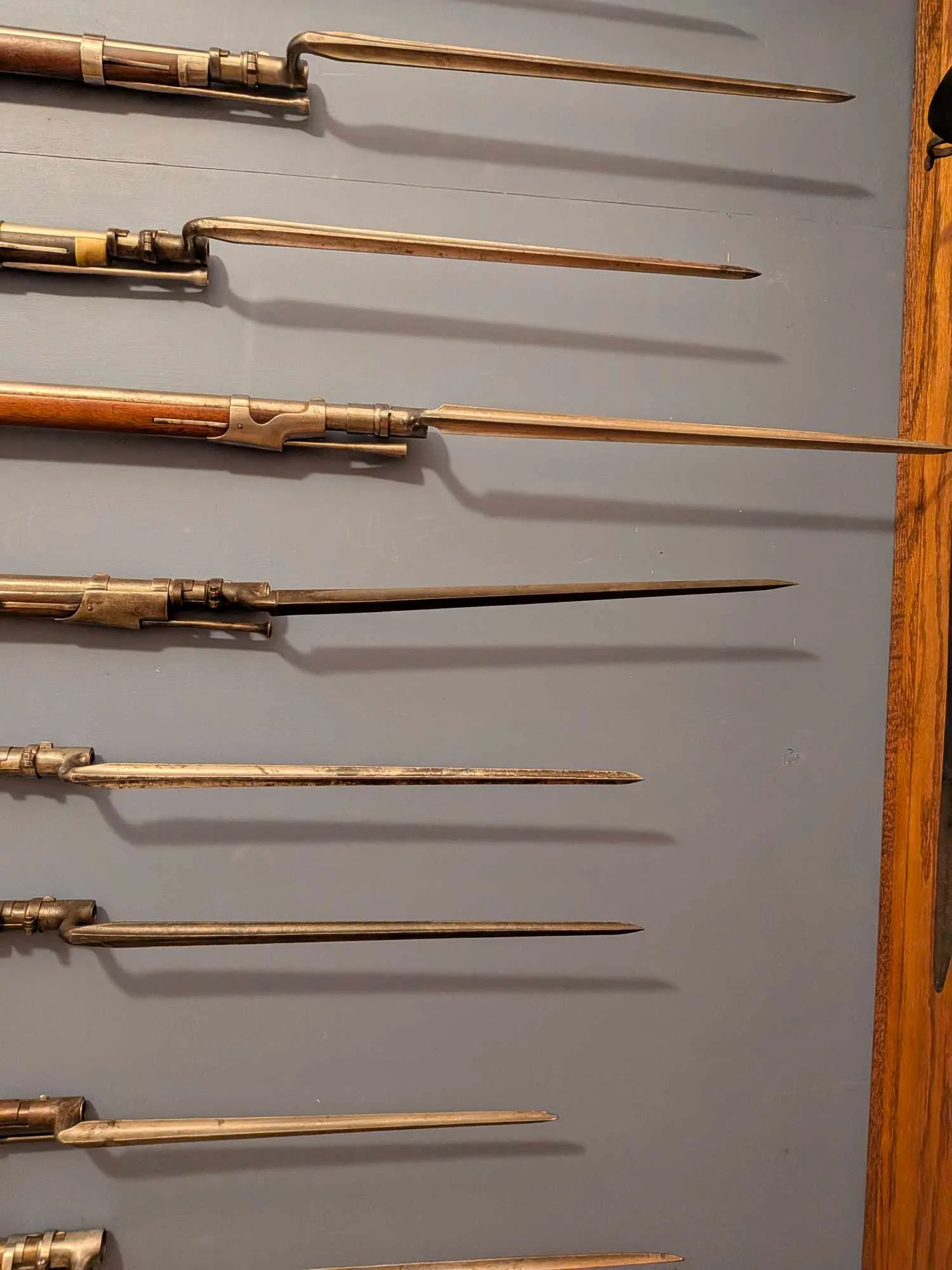
It's now displayed on my DC Hodgkins Georgia-altered Model 1816. The attachment of the blade to the socket was done so far out of alignment that it really looks bad on the gun, but it is what it is.
Personally, I wouldn't want to carry it in a bayonet charge. No wonder the South lost the war!
Hopefully, some will find this not only interesting but useful.



Not long afterward, I plucked one off Ebay that very much fit the bill (for all of 73 bucks.) At first glance, one can see why it was so cheap. The interior of the socket had been bored out, and accidentally went through the side of the socket, making an ugly hole. All-in-all, it just looked like a mis-used Pattern 1853 bayonet.
With a blade made in England by Reeves & Co and a socket that is clearly NOT British-made but with characteristics that appear Confederate, I was hopeful.
At the next show, I showed it to Paul Johnson. After a careful inspection, he said, and I quote, "If it was mine, I would put it in my collection." Needless to say, I was very pleased.
The problem was that with the socket bored out, it wouldn't fit on a Pattern 53 musket, but wobbled all over the place. So, I just put it in my display case.
One day last week, I thought I would try it on other guns in my collection. It was too small for my US Model 1795, and too small for my Model 1812 as well.
Then came the Model 1816. Perfect fit! And I mean perfect.
What this tells me is that the Confederates must have had a shortage of bayonets for Model 1816's somewhere, most of which had been converted to percussion, and someone got the assignment to alter this one, and maybe others, to fit. Not a professional job but it works.
It's now displayed on my DC Hodgkins Georgia-altered Model 1816. The attachment of the blade to the socket was done so far out of alignment that it really looks bad on the gun, but it is what it is.
Personally, I wouldn't want to carry it in a bayonet charge. No wonder the South lost the war!
Hopefully, some will find this not only interesting but useful.
Last edited:


 Bringing the