BCD
Private
- Joined
- Aug 31, 2026
- Location
- Connecticut
I've always found Rosecrans to be one of the most interesting generals of the Civil War, and recently did a deep study of his Tullahoma and Chickamauga campaigns. I came away with my earlier impressions completely reversed: his performance in Tullahoma was far less impressive than I thought, while his performance in Chickamauga (up to the battle itself) was remarkable given the enormous challenges he faced.
In this thread I want to discuss the former. In particular, Rosecrans failed to exploit two crucial windows of opportunity. The first came after the battles for the gaps, while second came after he seized a position on Bragg's flank around Manchester.
To briefly summarize Rosecrans' scheme of maneuver, the plan on 23-24 June was for:
1. Reserve Corps and Cavalry Corp on the Union right to conduct a demonstration in front of Shelbyville
2. XX Corps on the center-right to feint against Liberty Gap
3. XIV Corps on the center-left to frontally attack Hoover's Gap
4. XXI Corps on the left to conduct a flanking maneuver towards Manchester

The diversions of #1 and #2, combined with the very real threat posed by #4, would eventually allow #3 to break through and establish direct lines of communication with Manchester, whereupon Rosecrans could fall upon Bragg's base of operations at Tullahoma.
As it happened, however, #2 & #3 proved unexpectedly successful, thanks in no small part to the mounted infantry of Wilder's Brigade and 39th Indiana. By the end of the 24th, XX & XIV Corps mostly controlled Liberty & Hoover's, leading us to...
Decision Point 1: Actions around the gaps
Rosecrans is often credited with flexible thinking for pressing on ahead on the 26th, sending all of XIV and XX Corps through Hoover's Gap to Manchester.

Yet by this point, he had about 37,000 men against ~15,000 effectives of Hardee's Corps (actually less - Hardee had detached some troops to guard the rear areas). He had also overcome the most difficult defensive obstacles and could attack Hardee from two directions. This was about as favorable a tactical situation as could be asked for, giving him the opportunity not just to crush Hardee, but to cut off the rail spur from Wartrace to Shelbyville. Given the muddy roads, his original plan would be much harder to implement, while the Confederates held a clear route to withdraw by rail and more direct interior lines.
There are a few points in Rosecrans' defense. By sticking to the original plan, he hoped to win a much greater victory by bagging the entire Army of Tennessee - he didn't yet know that XXI Corps was currently stuck in the mud at Gillie's Gap and would take several more days to reach Manchester. XX Corps only had a single division in Liberty Gap (it was, after all, intended as a feint) and would have to guard its own flank against a possible counterattack by remaining Confederate forces. But none of these objections were insuperable, and it is hard to imagine a more aggressive general passing over so ripe an opportunity.
Decision Point 2: Actions against Tullahoma
By 29 June, XIV and XX Corps were pushing forward from Manchester toward Tullahoma while two divisions of XXI Corps finally joined up behind them. The forward divisions advanced along three parallel roads in a slow and deliberate manner, trying to avoid exposing flanks while remaining on heightened alert for Confederate units to their front. By the end of the day, they had reached within about 3 miles of Tullahoma. Wilder's Brigade, which had been sent over the swollen Elk River to rip up the railroad, was meanwhile being chased by Forrest's cavalry.
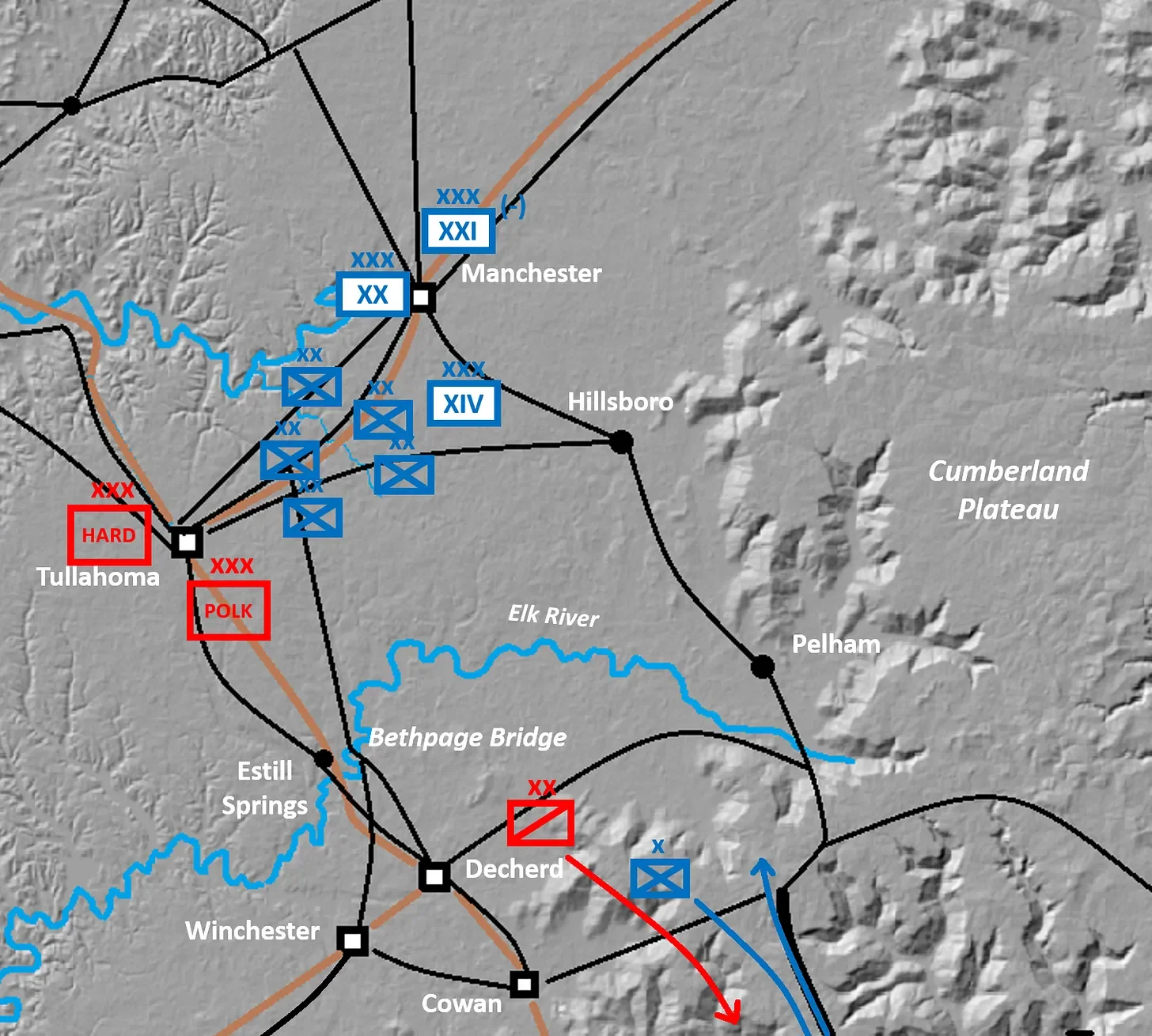
Only on the following day did XXI Corps come up on the flank to move to cut off Bragg's line of retreat: Bethpage bridge and the bridges at Estill Springs. But by this point, Bragg had already made up his mind to retreat: a reconnaissance in that direction the previous day by a pair of XIV Corps regiments spooked him, and he realized that it would be unwise to remain in the fortifications of Tullahoma while he was at risk of being cut off.
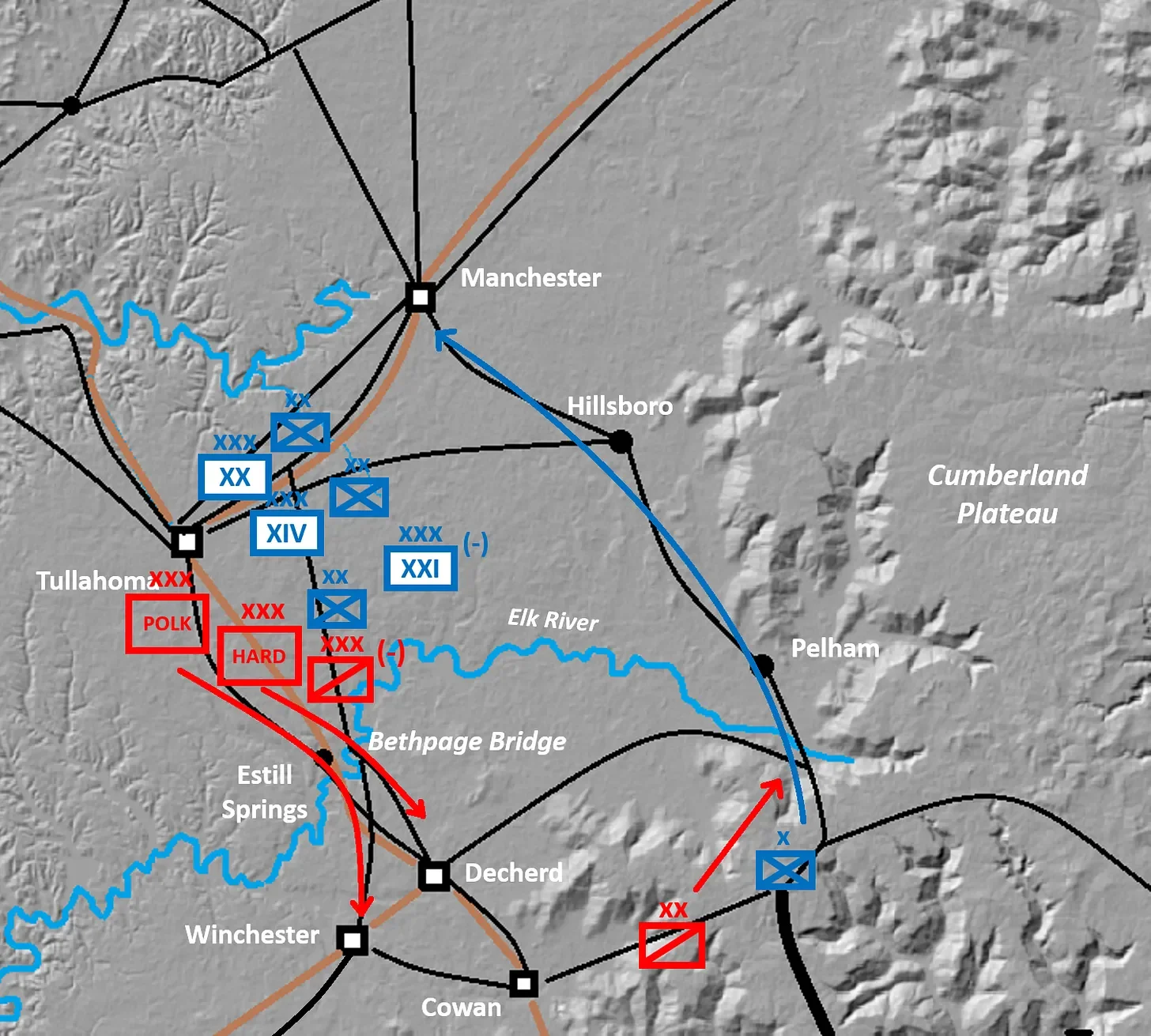
In other words, Rosecrans turned his previous logic on its head. Instead of immediately moving around Bragg's flank to entrap the AoT, he focused his efforts on a frontal assault against the fortifications of Tullahoma itself - a much less favorable tactical scenario than what he faced with Hardee. His extreme caution in front of Tullahoma also reflected an unwillingness to take considered risks: the mud hindered Confederate movements just as much as his own, and their forces were in disarray following a hasty retreat.
Decision Point 2.a: The Employment of Wilder's Brigade
This is also reflected in his use of Wilder's Brigade. The folly of using mounted infantry in the enemy's strategic depth had been demonstrated in May, when Streight's entire brigade was captured during its raid on Rome. Its use in a tactical role had proven wildly successful at Hoover's Gap: Wilder's men not only managed to storm the gap itself, but held it against a much larger counterattacking force until relieved by the rest of XIV Corps.
On 28 June, Rosecrans tried to split the difference by using Wilder's Brigade in an independent operational role, sending it over the river to rip up the railroad. A single regiment was detached to scout out the bridges around Bethpage and Estill Springs, but had to turn back in the presence of a much stronger force.

Despite the much shorter distances, this was a lot more like Streight's Raid than the battle for the gaps. Wilder had no nearby infantry to support him or exploit his successes, and was nearly caught by a pursuing division of true cavalry - it was by incredible fortune that he made it back to Manchester without losing a man. This came at the cost of making his excursion completely ineffectual, and the little damage he did to the railroad was quickly repaired. Why not, given the circumstances, use Wilder to storm a bridge over the Elk with a XIV Corps division following in support? This would not only have been much more useful operationally, but would afford the rest of the army mounted troopers that could scout out Confederate movements around Tullahoma.
So in summary, Rosecrans passed over an incredible tactical advantage early on, then attempted a difficult frontal assault instead of an operational maneuver that could have trapped the entire Army of Tennessee. While his expulsion of Bragg from Middle Tennessee was a major accomplishment won at little cost, the campaign can only be seen as a disappointment considering his advantage in manpower/transportation and the long preparation it required.
In this thread I want to discuss the former. In particular, Rosecrans failed to exploit two crucial windows of opportunity. The first came after the battles for the gaps, while second came after he seized a position on Bragg's flank around Manchester.
To briefly summarize Rosecrans' scheme of maneuver, the plan on 23-24 June was for:
1. Reserve Corps and Cavalry Corp on the Union right to conduct a demonstration in front of Shelbyville
2. XX Corps on the center-right to feint against Liberty Gap
3. XIV Corps on the center-left to frontally attack Hoover's Gap
4. XXI Corps on the left to conduct a flanking maneuver towards Manchester
The diversions of #1 and #2, combined with the very real threat posed by #4, would eventually allow #3 to break through and establish direct lines of communication with Manchester, whereupon Rosecrans could fall upon Bragg's base of operations at Tullahoma.
As it happened, however, #2 & #3 proved unexpectedly successful, thanks in no small part to the mounted infantry of Wilder's Brigade and 39th Indiana. By the end of the 24th, XX & XIV Corps mostly controlled Liberty & Hoover's, leading us to...
Decision Point 1: Actions around the gaps
Rosecrans is often credited with flexible thinking for pressing on ahead on the 26th, sending all of XIV and XX Corps through Hoover's Gap to Manchester.
Yet by this point, he had about 37,000 men against ~15,000 effectives of Hardee's Corps (actually less - Hardee had detached some troops to guard the rear areas). He had also overcome the most difficult defensive obstacles and could attack Hardee from two directions. This was about as favorable a tactical situation as could be asked for, giving him the opportunity not just to crush Hardee, but to cut off the rail spur from Wartrace to Shelbyville. Given the muddy roads, his original plan would be much harder to implement, while the Confederates held a clear route to withdraw by rail and more direct interior lines.
There are a few points in Rosecrans' defense. By sticking to the original plan, he hoped to win a much greater victory by bagging the entire Army of Tennessee - he didn't yet know that XXI Corps was currently stuck in the mud at Gillie's Gap and would take several more days to reach Manchester. XX Corps only had a single division in Liberty Gap (it was, after all, intended as a feint) and would have to guard its own flank against a possible counterattack by remaining Confederate forces. But none of these objections were insuperable, and it is hard to imagine a more aggressive general passing over so ripe an opportunity.
Decision Point 2: Actions against Tullahoma
By 29 June, XIV and XX Corps were pushing forward from Manchester toward Tullahoma while two divisions of XXI Corps finally joined up behind them. The forward divisions advanced along three parallel roads in a slow and deliberate manner, trying to avoid exposing flanks while remaining on heightened alert for Confederate units to their front. By the end of the day, they had reached within about 3 miles of Tullahoma. Wilder's Brigade, which had been sent over the swollen Elk River to rip up the railroad, was meanwhile being chased by Forrest's cavalry.
Only on the following day did XXI Corps come up on the flank to move to cut off Bragg's line of retreat: Bethpage bridge and the bridges at Estill Springs. But by this point, Bragg had already made up his mind to retreat: a reconnaissance in that direction the previous day by a pair of XIV Corps regiments spooked him, and he realized that it would be unwise to remain in the fortifications of Tullahoma while he was at risk of being cut off.
In other words, Rosecrans turned his previous logic on its head. Instead of immediately moving around Bragg's flank to entrap the AoT, he focused his efforts on a frontal assault against the fortifications of Tullahoma itself - a much less favorable tactical scenario than what he faced with Hardee. His extreme caution in front of Tullahoma also reflected an unwillingness to take considered risks: the mud hindered Confederate movements just as much as his own, and their forces were in disarray following a hasty retreat.
Decision Point 2.a: The Employment of Wilder's Brigade
This is also reflected in his use of Wilder's Brigade. The folly of using mounted infantry in the enemy's strategic depth had been demonstrated in May, when Streight's entire brigade was captured during its raid on Rome. Its use in a tactical role had proven wildly successful at Hoover's Gap: Wilder's men not only managed to storm the gap itself, but held it against a much larger counterattacking force until relieved by the rest of XIV Corps.
On 28 June, Rosecrans tried to split the difference by using Wilder's Brigade in an independent operational role, sending it over the river to rip up the railroad. A single regiment was detached to scout out the bridges around Bethpage and Estill Springs, but had to turn back in the presence of a much stronger force.
Despite the much shorter distances, this was a lot more like Streight's Raid than the battle for the gaps. Wilder had no nearby infantry to support him or exploit his successes, and was nearly caught by a pursuing division of true cavalry - it was by incredible fortune that he made it back to Manchester without losing a man. This came at the cost of making his excursion completely ineffectual, and the little damage he did to the railroad was quickly repaired. Why not, given the circumstances, use Wilder to storm a bridge over the Elk with a XIV Corps division following in support? This would not only have been much more useful operationally, but would afford the rest of the army mounted troopers that could scout out Confederate movements around Tullahoma.
So in summary, Rosecrans passed over an incredible tactical advantage early on, then attempted a difficult frontal assault instead of an operational maneuver that could have trapped the entire Army of Tennessee. While his expulsion of Bragg from Middle Tennessee was a major accomplishment won at little cost, the campaign can only be seen as a disappointment considering his advantage in manpower/transportation and the long preparation it required.


 Bringing the