
rebelatsea
Captain
- Joined
- Mar 30, 2013
- Location
- Kent ,England.
CSS LOUISIANA ONCE AGAIN
In a previous thread I produced a history of this vessel from conception to destruction as it appeared to me at the time. In subsequent conversations, and in re- reading my manuscript (now version 15!) and appraising the material which was incorporated, it became apparent that I had left major inconsistencies present in the documentation, notably concerning her stated weight and draught, also the final condition of her power plant and propulsion.
Firstly, the question of her weight and the stated draught. Try as I might, using every calculation I could find that my calculator could handle I could not reconcile E.C. Murray's stated launch weight with the draught claimed.
Secondly, there are conflicting statements regarding her reported in ability to move and the intention by her temporary Captain to attempt a run to Mobile.
CSS Louisiana is one of the most difficult ironclads to unravel the history, details and appearance of despite there being an apparent abundance of accounts and drawing of her. The difficulty being that most of those are contradictory and don't always make sense.
I hope that what follows is logical and provides a possible indeed probable answer to both the above questions.
This piece should be regarded as updating and replacing the previous thread.
The ship began started as a proposal and model by E.C. Murray, an accomplished shipbuilder. Secretary Mallory approved and gave the contract to Murray to arrange construction. Murray contracted to have one of John Hughes's yards at Jefferson City New Orleans as his construction site.
Murray's plans and proposal have not survived so what follows is a reconstruction from the available contemporary materiel
Type: Ironclad Frigate. Paddles: 2 x 27ft diameter, 19ft wide, tandem centre line. Crew: 300+
Dimensions: 264ft (OA) x 62ft(EX) x 6ft (D). 1,403 tons speed 16 nots (proposed), 8.5 knots calculated.
Guns: 2 -11" SB, 16 -9"SB, 4-32pdrs SB, also a cast iron ram which it appears was not designed
Armour: Hull and casemate to 2ft below waterline, 3.5" interlocking T rail, fore and aft decks 2" plate. Timber backing for the casemate was 28" angled at 38 degrees.

Note that there is no mention of steering engines in the original proposal, and I have not incorporated them in the reconstruction.
The Contract was let 18th September 1861, to be completed by 25 January 1862
John L Porter assigned Acting Naval Constructor Joseph Pierce to produce the specification and working plans and supervise construction at the same time as he was overseeing the construction of CSS Mississippi at the new yard on the neighbouring plot of land.
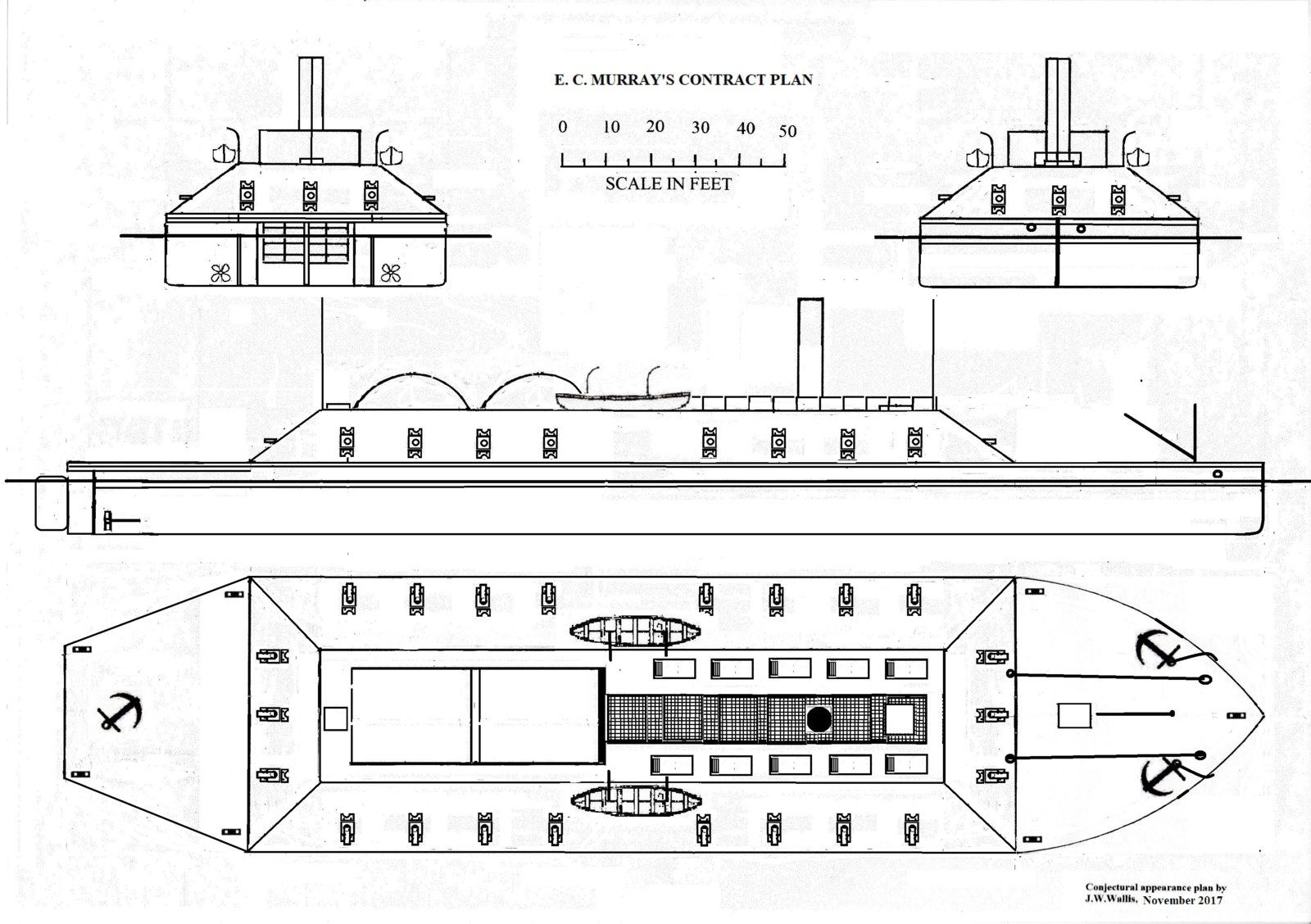
In the contract plan the casemate itself has been shortened to reduce weight, and now encloses only 16 guns, protected by hinged "half and half" covers frigate style. The two hatches, often quoted as closed gun ports, are more probably connected with access to the paddlewheel cranks, because of their position. There were two be two anchors and capstans on the foredeck, with an anchor handling davit, one anchor and capstan aft. The steering screws were intended to be 4ft in diameter, but there is no mention of engines to drive them in the contract. The most major change is to the draught. E.C. Murray's calculations showed the launching weight to be 2,751 tons, but we could not reconcile that with the proposed 6ft draught. Calculations of the weight of timber and iron needed, together with Murray's carried weight table, resulted in an actual draught of 11.5ft, at which the weight would be 2,750 tons, as near as makes no difference. The oft quoted 6ft therefore actually being the intended immersion of the paddle floats
.
We do not know what Pierce's intended battery was to be, but taking his CSS Mississippi as an example, 4 – heavy rifled guns and 12 smoothbores would see most likely.
Possibly initially, locally produced rifled and banded 42 and 32pdrs may have been considered. The refusal of New Orleans gun founders to band their rifled weapons in accordance with the CSN requirement meant that her battery was made up with whatever weapons were available, which certainly added to the confusion in her inexperienced gun crews drawn from army units with no experience of naval guns.
With construction under way, Joseph Pierce concentrated all his attention on CSS Mississippi in the yard alongside, for which he was also responsible. He has been criticized for this, in my view unfairly. E.C. Murray, and John Hughes' shipbuilders were experienced whereas the Tift brothers were not, and thus would need more time and attention spent on their vessel.
With many delays to both vessels due to labour disputes, army interference with the workforce and difficulties obtaining and transporting materials, Louisiana, laid down on 15/10/1861, was not launched until 6/02/1862.

When launched she was found to draw 2ft more than intended so that she now measured: 270ft OA x 62ft B x 13.5ft D, 3,228 tons.
Instead of the intended purpose-built machinery, the paddle wheel engines were two single-cylinder, inclined direct acting, one powering each wheel, taken from the steamer Ingomar. Steam was supplied by six 32.5 ft x 3.5ft cylindrical boilers. It is said that no provision had apparently been made to power the screws, however the addition of the two engines described below and the change to larger diameter screws before launching may well wholly or partially account for the increase in draught. Two 500hp engines constructed by Kirk & Co of New Orleans powered the steering screws, which had been increased to 7ft diameter. Despite Engineer Youngblood's comments these were not connected fully when the ship was moved down to the forts.
Yet more changes and omissions are apparent in her appearance at launch. The forward 27ft wheel had been changed to one of 20ft diameter and capstans to handle the anchors.
John Roy, who had experimented on his own centrewheel vessel and designed centre wheel gunboats as previously described, was aboard at her launch and had some comments to make, including that the aft wheel well was too low, and will not allow easy passage of water. The ship was reported as being very buoyant and rode the water easily.
Her appointed Captain, Charles McIntosh, is said to have insisted that the gun ports be made oval adding another five-day delay. This is another piece of received wisdom as the sketch by John K. Mitchell of the ship shows the ports to be as originally designed.
She never received her full 5ft deep armour belt, gun port covers nor apparently the forward and after conning towers.
McIntosh evidently was the wrong choice for this command as his brother officers commented that he didn't believe in anything new, let alone ironclads, yet here he was expected to take charge of a brand new untried and untested ironclad, prepare it for action and engage the enemy. In fairness it probably didn't help that J.K. Mitchell had been appointed Flag Officer and chose to take Louisiana as his flagship. When put under steam for the first time she could keep up with the current going down stream but could not steer or breast the current upstream. Chief Engineer Youngblood said that the forward wheel merely pushed water into the blades of the aft wheel, and both caused eddies around the rudders rendering them ineffective, It did not help that the wheel well had not been properly caulked consequently flooding the gun deck and after magazine.
Her engineers made valiant efforts to make the machinery effective once she was moored at the forts, of which more later.
This plan shows her in the condition in which she engaged the Union fleet.

When taken down to the forts, her battery, 3 -9"SB ,4 -8" SB 1-7" MLR and 7 -32pdr MLR were on board but not mounted, one 7" MLR had been left behind on the quay. Attempts were made to get these mounted, but some were put on wrong carriages and others not completed when she went into action with only the bow and starboard side weapons available for service.
The artist William Waud saw and sketched her at the forts. It is probable that he actually saw her in the final condition as completed after the forts surrender and before she was scuttled as he depicts her with all ordnance except one gun mounted and interestingly seems to confirm her ports were indeed square. Can we trust this sketch?
I believe we can as he depicts the ship with only two guns aft, and we know that one gun was left behind on the quay when the ship left for the forts. The sketch appears to show two offset but equal wheelhouses, but we believe this was due the viewing angle.
Also of note is that Waud did not depict the 4ft plate bulwark, but instead shows a low stanchion and rope barrier. He also shows what appears to be a casing around the funnel, but no conning towers Cdr McIntosh was allegedly wounded whilst behind the plate barrier, A sketch by J.K. Mitchell shows some form of screen at the fore end of the casemate, (as well as the plate bulwark) and it may be that it was this behind which McIntosh was standing when wounded.
Mitchell's sketch also shows the low bulwark on the aft deck, which Waud omits.

The final appearance plan above is therefore something of a compromise between Waud, McIntosh and Mitchell.
Commissioned on 24/4/1862, and employed as a stationary floating battery, her forward and starboard batteries engaged in close action on the night of 25/4/1862 but were unable to depress far enough to inflict below water damage on her opponents due to the point-blank range. Receiving in return heavy fire to which her casemate was impervious.
She was burned and sunk on the 28/4/1862 after the forts had surrendered. This leads to the final mystery.
Her temporary Captain Lt John Wilkinson, seriously considered making a run for Mobile, which begs the question – what had been done to the machinery that hadn't been done before to make Wilkinson think he could do that? The documentation shows that the battery had been mounted and the two screws connected in the four days between the 24th and 28th.
I asked for advice from a steam (railway) engineer with an interest in the American Civil War to get an outside but knowledgeable perspective.
His view, having been shown the history, is that the paddle wheels had probably been disconnected allowing them to freewheel, and the steam supply from the six boilers entirely redirected to the screw engines, which should give her motive power. Logical, and perhaps I should have seen it for myself.
One historian and researcher, Allessandro Massignani, believes the real reason why the attempt was not made was because there weren't enough crew to fully man her guns.
==========================================================================
In a previous thread I produced a history of this vessel from conception to destruction as it appeared to me at the time. In subsequent conversations, and in re- reading my manuscript (now version 15!) and appraising the material which was incorporated, it became apparent that I had left major inconsistencies present in the documentation, notably concerning her stated weight and draught, also the final condition of her power plant and propulsion.
Firstly, the question of her weight and the stated draught. Try as I might, using every calculation I could find that my calculator could handle I could not reconcile E.C. Murray's stated launch weight with the draught claimed.
Secondly, there are conflicting statements regarding her reported in ability to move and the intention by her temporary Captain to attempt a run to Mobile.
CSS Louisiana is one of the most difficult ironclads to unravel the history, details and appearance of despite there being an apparent abundance of accounts and drawing of her. The difficulty being that most of those are contradictory and don't always make sense.
I hope that what follows is logical and provides a possible indeed probable answer to both the above questions.
This piece should be regarded as updating and replacing the previous thread.
The ship began started as a proposal and model by E.C. Murray, an accomplished shipbuilder. Secretary Mallory approved and gave the contract to Murray to arrange construction. Murray contracted to have one of John Hughes's yards at Jefferson City New Orleans as his construction site.
Murray's plans and proposal have not survived so what follows is a reconstruction from the available contemporary materiel
Type: Ironclad Frigate. Paddles: 2 x 27ft diameter, 19ft wide, tandem centre line. Crew: 300+
Dimensions: 264ft (OA) x 62ft(EX) x 6ft (D). 1,403 tons speed 16 nots (proposed), 8.5 knots calculated.
Guns: 2 -11" SB, 16 -9"SB, 4-32pdrs SB, also a cast iron ram which it appears was not designed
Armour: Hull and casemate to 2ft below waterline, 3.5" interlocking T rail, fore and aft decks 2" plate. Timber backing for the casemate was 28" angled at 38 degrees.
Note that there is no mention of steering engines in the original proposal, and I have not incorporated them in the reconstruction.
The Contract was let 18th September 1861, to be completed by 25 January 1862
John L Porter assigned Acting Naval Constructor Joseph Pierce to produce the specification and working plans and supervise construction at the same time as he was overseeing the construction of CSS Mississippi at the new yard on the neighbouring plot of land.
In the contract plan the casemate itself has been shortened to reduce weight, and now encloses only 16 guns, protected by hinged "half and half" covers frigate style. The two hatches, often quoted as closed gun ports, are more probably connected with access to the paddlewheel cranks, because of their position. There were two be two anchors and capstans on the foredeck, with an anchor handling davit, one anchor and capstan aft. The steering screws were intended to be 4ft in diameter, but there is no mention of engines to drive them in the contract. The most major change is to the draught. E.C. Murray's calculations showed the launching weight to be 2,751 tons, but we could not reconcile that with the proposed 6ft draught. Calculations of the weight of timber and iron needed, together with Murray's carried weight table, resulted in an actual draught of 11.5ft, at which the weight would be 2,750 tons, as near as makes no difference. The oft quoted 6ft therefore actually being the intended immersion of the paddle floats
.
We do not know what Pierce's intended battery was to be, but taking his CSS Mississippi as an example, 4 – heavy rifled guns and 12 smoothbores would see most likely.
Possibly initially, locally produced rifled and banded 42 and 32pdrs may have been considered. The refusal of New Orleans gun founders to band their rifled weapons in accordance with the CSN requirement meant that her battery was made up with whatever weapons were available, which certainly added to the confusion in her inexperienced gun crews drawn from army units with no experience of naval guns.
With construction under way, Joseph Pierce concentrated all his attention on CSS Mississippi in the yard alongside, for which he was also responsible. He has been criticized for this, in my view unfairly. E.C. Murray, and John Hughes' shipbuilders were experienced whereas the Tift brothers were not, and thus would need more time and attention spent on their vessel.
With many delays to both vessels due to labour disputes, army interference with the workforce and difficulties obtaining and transporting materials, Louisiana, laid down on 15/10/1861, was not launched until 6/02/1862.
When launched she was found to draw 2ft more than intended so that she now measured: 270ft OA x 62ft B x 13.5ft D, 3,228 tons.
Instead of the intended purpose-built machinery, the paddle wheel engines were two single-cylinder, inclined direct acting, one powering each wheel, taken from the steamer Ingomar. Steam was supplied by six 32.5 ft x 3.5ft cylindrical boilers. It is said that no provision had apparently been made to power the screws, however the addition of the two engines described below and the change to larger diameter screws before launching may well wholly or partially account for the increase in draught. Two 500hp engines constructed by Kirk & Co of New Orleans powered the steering screws, which had been increased to 7ft diameter. Despite Engineer Youngblood's comments these were not connected fully when the ship was moved down to the forts.
Yet more changes and omissions are apparent in her appearance at launch. The forward 27ft wheel had been changed to one of 20ft diameter and capstans to handle the anchors.
John Roy, who had experimented on his own centrewheel vessel and designed centre wheel gunboats as previously described, was aboard at her launch and had some comments to make, including that the aft wheel well was too low, and will not allow easy passage of water. The ship was reported as being very buoyant and rode the water easily.
Her appointed Captain, Charles McIntosh, is said to have insisted that the gun ports be made oval adding another five-day delay. This is another piece of received wisdom as the sketch by John K. Mitchell of the ship shows the ports to be as originally designed.
She never received her full 5ft deep armour belt, gun port covers nor apparently the forward and after conning towers.
McIntosh evidently was the wrong choice for this command as his brother officers commented that he didn't believe in anything new, let alone ironclads, yet here he was expected to take charge of a brand new untried and untested ironclad, prepare it for action and engage the enemy. In fairness it probably didn't help that J.K. Mitchell had been appointed Flag Officer and chose to take Louisiana as his flagship. When put under steam for the first time she could keep up with the current going down stream but could not steer or breast the current upstream. Chief Engineer Youngblood said that the forward wheel merely pushed water into the blades of the aft wheel, and both caused eddies around the rudders rendering them ineffective, It did not help that the wheel well had not been properly caulked consequently flooding the gun deck and after magazine.
Her engineers made valiant efforts to make the machinery effective once she was moored at the forts, of which more later.
This plan shows her in the condition in which she engaged the Union fleet.
When taken down to the forts, her battery, 3 -9"SB ,4 -8" SB 1-7" MLR and 7 -32pdr MLR were on board but not mounted, one 7" MLR had been left behind on the quay. Attempts were made to get these mounted, but some were put on wrong carriages and others not completed when she went into action with only the bow and starboard side weapons available for service.
The artist William Waud saw and sketched her at the forts. It is probable that he actually saw her in the final condition as completed after the forts surrender and before she was scuttled as he depicts her with all ordnance except one gun mounted and interestingly seems to confirm her ports were indeed square. Can we trust this sketch?
I believe we can as he depicts the ship with only two guns aft, and we know that one gun was left behind on the quay when the ship left for the forts. The sketch appears to show two offset but equal wheelhouses, but we believe this was due the viewing angle.
Also of note is that Waud did not depict the 4ft plate bulwark, but instead shows a low stanchion and rope barrier. He also shows what appears to be a casing around the funnel, but no conning towers Cdr McIntosh was allegedly wounded whilst behind the plate barrier, A sketch by J.K. Mitchell shows some form of screen at the fore end of the casemate, (as well as the plate bulwark) and it may be that it was this behind which McIntosh was standing when wounded.
Mitchell's sketch also shows the low bulwark on the aft deck, which Waud omits.
The final appearance plan above is therefore something of a compromise between Waud, McIntosh and Mitchell.
Commissioned on 24/4/1862, and employed as a stationary floating battery, her forward and starboard batteries engaged in close action on the night of 25/4/1862 but were unable to depress far enough to inflict below water damage on her opponents due to the point-blank range. Receiving in return heavy fire to which her casemate was impervious.
She was burned and sunk on the 28/4/1862 after the forts had surrendered. This leads to the final mystery.
Her temporary Captain Lt John Wilkinson, seriously considered making a run for Mobile, which begs the question – what had been done to the machinery that hadn't been done before to make Wilkinson think he could do that? The documentation shows that the battery had been mounted and the two screws connected in the four days between the 24th and 28th.
I asked for advice from a steam (railway) engineer with an interest in the American Civil War to get an outside but knowledgeable perspective.
His view, having been shown the history, is that the paddle wheels had probably been disconnected allowing them to freewheel, and the steam supply from the six boilers entirely redirected to the screw engines, which should give her motive power. Logical, and perhaps I should have seen it for myself.
One historian and researcher, Allessandro Massignani, believes the real reason why the attempt was not made was because there weren't enough crew to fully man her guns.
==========================================================================


 Bringing the