Civil War Era Road Construction & Engineering

Bee

Captain
Asst. Regtl. Quartermaster Gettysburg 2017
Joined
Dec 21, 2015
.

upload_2017-8-3_22-42-22.png

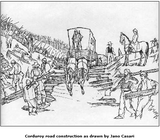
A corduroy road or log road is a type of road made by placing logs, perpendicular to the direction of the road over a low or swampy area. The result is an improvement over impassable mud or dirt roads, yet rough in the best of conditions and a hazard to horses due to shifting loose logs. Source

It seems that one cannot pick up a Civil War era campaign book without mention of road types. The most common that I have encountered is the "Corduroy" road, described and pictured above. They were used extensively during Sherman's march through the Carolinas. The other, more durable choice is the "Macadam", as seen below:

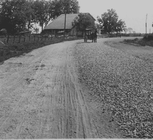
Macadamized Road During the Civil War, almost all roads were of dirt that became quagmires of mud after heavy rains. Only a few hard-surface all-weather roads existed. These were called "macadamized" roads after their inventor, Scottish civil engineer John Loudon McAdam, who in turn was indebted to the road builders of the ancient Roman empire. The pavement (from Latin pavinientum) was made of compressed layers of gravel set on a cement bed with limestone shoulders. Ditches at the sides of the road provided necessary drainage. After the advent of the automobile, it became standard to bind the gravel with tar or asphalt for greater durability and to reduce dust. http://clevelandcivilwarroundtable.com/articles/means/civil_war_roads.htm

upload_2017-8-3_22-44-38.png

Macademized road, 1850​

It is interesting to note that at the time of the Civil War, macadamized roads were not all that common, However the first macadam roads were in the vicinity of the Civil War, and they were an advantage to those troops who were able to use them.

The first macadam surface in the United States was laid on the "Boonsborough Turnpike Road" between Hagerstown and Boonsboro, Maryland. By 1822, this section was the last unimproved gap in the great road leading from Baltimore on the Chesapeake Bay to Wheeling on the Ohio River. Stagecoaches using the road in winter needed 5 to 7 hours of travel to cover 10 miles. http://curbstone.com/_macadam.htm
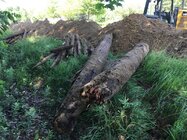
Both the corduroy and macadam roads have proved to be enduring, as remnants of both are still discovered in modern times. Most recent was this Civil War era road found in Michigan:

"Corduroy Road" From the Civil War Era Found in Michigan


20117205_1464845956886939_1872813868619766669_o.jpg

Logs discovered under 168th Avenue in Grand Haven Township, Michigan (Grand Haven Charter Township/Facebook)

By Brigit Katz
smithsonian.com
August 3, 2017 8:00AM

Before the invention of modern concrete, travelers were able to cross muddy, swampy grounds by building "corduroy roads"—paths that were constructed of logs laid perpendicular to the direction of the route. While digging up a street in Michigan's Grand Haven Township, a team of construction workers recently unearthed 100 feet of a corduroy road that dates to the Civil War era, as Brandon Champion reports for MLive.

The road was discovered beneath 168th Avenue, which is under redevelopment as part of an extensive "capital improvement plan." According to the Grand Haven Township Facebook page, local officials believe that the road was built in approximately 1855, when the area was a logging town.

Read more: http://www.smithsonianmag.com/smart...found-michigan-180964229/#tmyOB74b9S03sdIm.99
 

Attachments
  • upload_2017-8-3_21-58-37.png
    upload_2017-8-3_21-58-37.png
    66.2 KB · Views: 266
  • upload_2017-8-3_22-16-46.png
    upload_2017-8-3_22-16-46.png
    66.2 KB · Views: 94
  • 20117205_1464845956886939_1872813868619766669_o.jpg
    20117205_1464845956886939_1872813868619766669_o.jpg
    149.4 KB · Views: 74
Last edited by a moderator:
There were some plank road where I lived in North Missouri. They were abandoned for a reason. They warped, and they threw gravel on each end, to hold it down. So they just kept throwing gravel on the planks, and pretty soon they became gravel roads. Many of these roads are still in use in the rural county I lived in. Sometimes the plank name stuck on roads. One which comes to mind is the Jerusalem Plank Road.
 
I will have to politely but strongly disagree. :happy:
View attachment 151925

A corduroy road or log road is a type of road made by placing logs, perpendicular to the direction of the road over a low or swampy area. The result is an improvement over impassable mud or dirt roads, yet rough in the best of conditions and a hazard to horses due to shifting loose logs. Source

20775v.jpg


Building corderoy [sic] roads from Belle Plain to Frederickburgh [sic] - By Arthur Lumley.
https://www.loc.gov/item/2004661303/


The other, more durable choice is the "Macadam", as seen below:

...
It is interesting to note that at the time of the Civil War, macadamized roads were not all that common, However the first macadam roads were in the vicinity of the Civil War, and they were an advantage to those troops who were able to use them.
I don't think I have ever seen an account of a macadam road during the Civil War. People were still being impressed by macadam roads during the World's Columbian Exposition in the 1890s.

Also, related trivia. "Tarmac" is derived from combining "tar" and "macadam". It's actually a shortening of the word tarmacadam. This didn't come around until after the Civil War, but it is a bit of trivia I knew and thus must be worked into conversations.
 
don't think I have ever seen an account of a macadam road during the Civil War. People were still being impressed by macadam roads during the World's Columbian Exposition in the 1890s..

I have...unfortunately I cannot remember where.

What I do remember is that many Confederates encountered them for the first time when they marched north in either or both of the 1862 and 1863 invasions. Apparently the roads where not friendly to bare feet.
 
I will have to politely but strongly disagree. :happy:


View attachment 151928

Building corderoy [sic] roads from Belle Plain to Frederickburgh [sic] - By Arthur Lumley.
https://www.loc.gov/item/2004661303/


I don't think I have ever seen an account of a macadam road during the Civil War. People were still being impressed by macadam roads during the World's Columbian Exposition in the 1890s.

Also, related trivia. "Tarmac" is derived from combining "tar" and "macadam". It's actually a shortening of the word tarmacadam. This didn't come around until after the Civil War, but it is a bit of trivia I knew and thus must be worked into conversations.
I believe the Valley Pike was macadamized. I'll look it up and post a link.
 
Since the topic has been broached, I have a rather (hopefully) simple question: How does one pronounce macadamized?

I've never heard the word said aloud, and read it as mak-a-dam-ized, like macadamia nut. Seeing that they were built by a MacAdams, I wonder if it should be mack-adam-ized.

Any clarity on offer?
 
Since the topic has been broached, I have a rather (hopefully) simple question: How does one pronounce macadamized?

I've never heard the word said aloud, and read it as mak-a-dam-ized, like macadamia nut. Seeing that they were built by a MacAdams, I wonder if it should be mack-adam-ized.

Any clarity on offer?
mac·ad·am·ize
məˈkadəˌmīz/
verb
past tense: macadamized; past participle: macadamized

If you google macadamized the pronunciation will pop up with a demo speaker phone which you can press and hear a female voice say the word.
 
In reading different accounts of these roads, as a defense against quagmires, I wondered how bad a quagmire could actually be. Sherman says that he saw a mule actually drown in one, since it was over 4 feet deep (and I'm sure very broad, but he didn't state the width). However, he used exclamation points when writing about it, so it must have made a big impression on him.
 
Interesting post @Bee. The federal troops pursuing Lee's army after Gettysburg used what is now the National Rd US 40. I assume it was a macadamized. It was the most improved roadway of the era allowing the AOP to travel an incrdable distances in a short time. The torrential rains that fell made using the same roads Lee used impractical. Shermans forces on the other hand became masters of Corduroy road construction allowing his army to cross swampy land in amazing rapid time. Fascinating topic. I've always said Mother Nature was a Confederate. The wheather hampered the AOP as badly as Lee himself did :smile:
 
Last edited:
I know nothing of horses but it seems a difficult thing for hoofs to manage the spaces between the logs used to cordoroy a road. Pulling a heavy load it would seem the horses would have to dig in pretty good . How was this managed or am I way off base here.
 
I know nothing of horses but it seems a difficult thing for hoofs to manage the spaces between the logs used to cordoroy a road. Pulling a heavy load it would seem the horses would have to dig in pretty good . How was this managed or am I way off base here.
The roads were packed with mud which made them useless in bad wheather. Very difficult to manage. In good whether situations they were a real asset.
 
I know nothing of horses but it seems a difficult thing for hoofs to manage the spaces between the logs used to cordoroy a road. Pulling a heavy load it would seem the horses would have to dig in pretty good . How was this managed or am I way off base here.

One of the methods that I read about last night was that they would stuff small branches, peat, boughs in the crevasses to help alleviate this problem.
 
View attachment 151925
A corduroy road or log road is a type of road made by placing logs, perpendicular to the direction of the road over a low or swampy area. The result is an improvement over impassable mud or dirt roads, yet rough in the best of conditions and a hazard to horses due to shifting loose logs. Source

It seems that one cannot pick up a Civil War era campaign book without mention of road types. The most common that I have encountered is the "Corduroy" road, described and pictured above. They were used extensively during Sherman's march through the Carolinas. The other, more durable choice is the "Macadam", as seen below:

Macadamized Road During the Civil War, almost all roads were of dirt that became quagmires of mud after heavy rains. Only a few hard-surface all-weather roads existed. These were called "macadamized" roads after their inventor, Scottish civil engineer John Loudon McAdam, who in turn was indebted to the road builders of the ancient Roman empire. The pavement (from Latin pavinientum) was made of compressed layers of gravel set on a cement bed with limestone shoulders. Ditches at the sides of the road provided necessary drainage. After the advent of the automobile, it became standard to bind the gravel with tar or asphalt for greater durability and to reduce dust. http://clevelandcivilwarroundtable.com/articles/means/civil_war_roads.htm

View attachment 151926
Macademized road, 1850​

It is interesting to note that at the time of the Civil War, macadamized roads were not all that common, However the first macadam roads were in the vicinity of the Civil War, and they were an advantage to those troops who were able to use them.

The first macadam surface in the United States was laid on the "Boonsborough Turnpike Road" between Hagerstown and Boonsboro, Maryland. By 1822, this section was the last unimproved gap in the great road leading from Baltimore on the Chesapeake Bay to Wheeling on the Ohio River. Stagecoaches using the road in winter needed 5 to 7 hours of travel to cover 10 miles. http://curbstone.com/_macadam.htm
Both the corduroy and macadam roads have proved to be enduring, as remnants of both are still discovered in modern times. Most recent was this Civil War era road found in Michigan:

"Corduroy Road" From the Civil War Era Found in Michigan


View attachment 151927
Logs discovered under 168th Avenue in Grand Haven Township, Michigan (Grand Haven Charter Township/Facebook)

By Brigit Katz
smithsonian.com
August 3, 2017 8:00AM

Before the invention of modern concrete, travelers were able to cross muddy, swampy grounds by building "corduroy roads"—paths that were constructed of logs laid perpendicular to the direction of the route. While digging up a street in Michigan's Grand Haven Township, a team of construction workers recently unearthed 100 feet of a corduroy road that dates to the Civil War era, as Brandon Champion reports for MLive.

The road was discovered beneath 168th Avenue, which is under redevelopment as part of an extensive "capital improvement plan." According to the Grand Haven Township Facebook page, local officials believe that the road was built in approximately 1855, when the area was a logging town.

Read more: http://www.smithsonianmag.com/smart...found-michigan-180964229/#tmyOB74b9S03sdIm.99


I know nothing of horses but it seems a difficult thing for hoofs to manage the spaces between the logs used to cordoroy a road. Pulling a heavy load it would seem the horses would have to dig in pretty good . How was this managed or am I way off base here.


Both corduroy and macadamized roads were used in the U.S. beginning as early as the 1820-1840 time period. Macadamized roads were much more expensive to build but also much more comfortable to traverse. Wood was cheaper and more readily available. I think that by the time of the Civil War, existing corduroy roads were still in use in some areas, but new ones were built by the military only where the way was otherwise impassable, such as low, swampy areas. They built them as they went with little or no intention of using them again except in a retreat. Horses would have had a difficult time but a swamp would be even worse.
 
Last edited:
There was a great story in the North South Trader Magazine a ways back that discussed the finding of not only a corduroy road fully intact, but dozens of brogans and the remains of a supply wagon complete I think with ammunition crates and mule skeletons. I believe Mike O'Donnell and some others were relic hunting (near Richmond?) and came upon the unbelievable finds. What is truly amazing is that the pine logs were still green, since they had been encased in mud for over 140+ years.

The wagon was thought to have been a victim of artillery fire, the brogans, some complete with socks, were pulled off feet in the sucking mud. The wagon was found in a bog type area where there was most likely a log bridge.

I'll see if I can find it.
 
There was a great story in the North South Trader Magazine a ways back that discussed the finding of not only a corduroy road fully intact, but dozens of brogans and the remains of a supply wagon complete I think with ammunition crates and mule skeletons. I believe Mike O'Donnell and some others were relic hunting (near Richmond?) and came upon the unbelievable finds. What is truly amazing is that the pine logs were still green, since they had been encased in mud for over 140+ years.

The wagon was thought to have been a victim of artillery fire, the brogans, some complete with socks, were pulled off feet in the sucking mud. The wagon was found in a bog type area where there was most likely a log bridge.

I'll see if I can find it.

I would be very interested in this article -- I hope you find it!
 
I will have to politely but strongly disagree. :happy:


View attachment 151928

Building corderoy [sic] roads from Belle Plain to Frederickburgh [sic] - By Arthur Lumley.
https://www.loc.gov/item/2004661303/


I don't think I have ever seen an account of a macadam road during the Civil War. People were still being impressed by macadam roads during the World's Columbian Exposition in the 1890s.

Also, related trivia. "Tarmac" is derived from combining "tar" and "macadam". It's actually a shortening of the word tarmacadam. This didn't come around until after the Civil War, but it is a bit of trivia I knew and thus must be worked into conversations.
Macadam roads were in use during the Civil War and before. The first two macadam roads in the US were the Boonsborough Turnpike (from Boonsborough, MD to Hagerstown) in 1822 and the Cumberland Road or National Pike also in Maryland, current day Rt 40. The Valley Road Shenandoah Valley was also macadam during the war.
 

Learn About Us
About CivilWarTalk
Contact the Webmaster
Meet the Staff
Link to CivilWarTalk
Join Our Community
Register
Browse Forums
View Today's Discussions
Search the Forum
Get Help
FAQ
Student Guide
Forum Rules & Etiquette
Copyright / DMCA

     Contact Us CivilwarTalk on Facebook CivilWarTalk on YouTube CivilWarTalk on Twitter RSS Feed

Bringing the American Civil War and More to Life.
© 1999 - , CIVILWARTALK, LLC - Site Version 10.0

SlaveryTalk.com - SecessionTalk.com - CivilWarTalk.com - ReconstructionTalk.com
Back
Top