Challenging Sword Identification/Authentication

Joined
Oct 29, 2017
Location
Houston, Texas
Back again with a bit of a mystery this time!

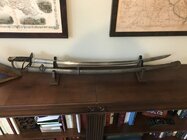
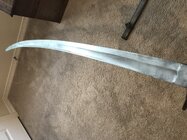
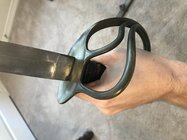
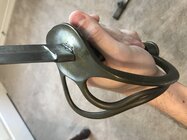
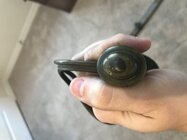
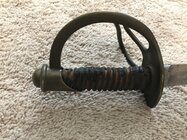
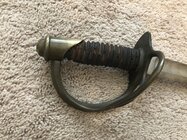
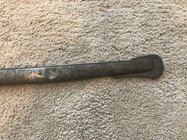
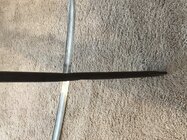
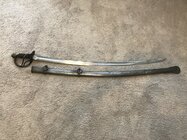
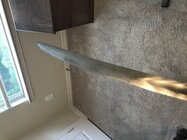
This cavalry saber is totally unmarked. Absolutely no stamps of any kind. It once had leather with a wire wrap over it, but now all that is left are some leather fragments, some wood with slight splitting, and the very end of the wire. Blade has a few nicks in it (character). Hilt is tight and not loose in the least, and the peen on the end of the guard appears to never have been adjusted.

Note where the blade meets the guard. On one side I see a line of metal like a crude weld or solder was done. Is this typical?

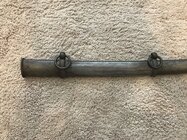
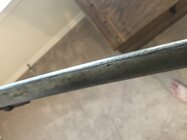
The sheathe is quite heavy, and has some pitting to it. Unfortunately it has two dents in it, but is somewhat straight. I bet I COULD put the sword into it, but it might bend the blade? I'd plan to display it out of the sheathe anyway. The sheathe shows signs of being folded metal with a rough seam where the metal was joined (which I think? is favorable).

It appears similar to some Ames cavalry sabres I've seen, but obviously no markings.

My questions are as follows (and my feelings won't be hurt if it's bad news):
1. Is this likely to be authentic?
2. Is the lack of markings on it indicative of it being an import during the war? Clearly hard to substantiate something as Confederate, but if this were a Federal manufactured sword I would think we would see stamp marks.
3. What should be done about the handle in order to be respectful to the sword? Can anything even be done about the handle?

For those curious I paid $200 and realize I assumed some risk here. Even if it's fake I think it's a neat piece to display. IMG_6509.jpeg IMG_6507.jpeg IMG_6508.jpeg IMG_6506.jpeg IMG_6505.jpeg IMG_6504.jpeg IMG_6503.jpeg IMG_6502.jpeg IMG_6501.jpeg IMG_6500.jpeg IMG_6499.jpeg IMG_6498.jpeg IMG_6497.jpeg
 
It certainly has the look and there were imported swords that were unmarked but I'm not an expert at it. I'm sure someone will know for sure before long. For the money I think it's a nice show piece either way, enjoy.
 
The dimple near the bottom of the scabbard is often said to be correct as it is said that it would be placed there to keep the sword from making noise (rattles).
 
Welcome From The Heart Of Dixie. What you have is a classic imported model 1840 cavalry sword. The lack of markings tells me it an import. The blade has been off the guard and who ever soldered the blade to the guard should have the sword used on him. For $200 you did well.
 
Welcome From The Heart Of Dixie. What you have is a classic imported model 1840 cavalry sword. The lack of markings tells me it an import. The blade has been off the guard and who ever soldered the blade to the guard should have the sword used on him. For $200 you did well.
So I think what I'm hearing is this is authentic, but that the soldering is NOT a good sign. Would you do anything about the grip or soldering?

Curious what "fair" price would be since you think $200 was ok.
 
I would just leave it as is but that's just me. I have several friends that restore swords but I will cost more than the sword cost and would really not increase the value. I don't like to give appraisals based on photos but your not upside down in it. I would keep it as a good starter and then just work my way up.
 
Last edited:
I would just leave it as is but that's just me. I have several friends that restore swords but I will cost more then the sword cost and would really increase the value. I don't like to give appraisals based on photos but your not upside down in it. I would keep it as a good starter and then just work my way up.
I'm perfectly fine with leaving it as-is. Glad to know I didn't (1) buy a fake and (2) probably didn't overpay.

I've got a musician's sword (yes, I know they are dime a dozen) so I wanted something that was a curved cavalry blade for my meager collection.
 
I love it! Think it's a home run for what you paid. And if you like it it's definitely worth it then! But my advice from my own experience....... you can take chances and come out ok but don't make a habit out of it! You will get burned! Especially with this site available many experts!
 
Welcome From The Heart Of Dixie. What you have is a classic imported model 1840 cavalry sword. The lack of markings tells me it an import. The blade has been off the guard and who ever soldered the blade to the guard should have the sword used on him. For $200 you did well.

Agree with ucvrelics' assessment. This is a typical CW-era import M1840 cavalry saber, probably made in Solingen, Germany. Although many were marked, many other are totally unmarked. As for the solder, my guess would be that as a result of the loss of the leather buffer at the base of the blade, there was a little rattle. so someone soldered the blade to the hilt to stop it. I'm not sure whether the tang was re-peened or not. It sort of looks like it, but if so, based on the evenness of the patina, it must of been a long time ago. As for restoring the grip, it would definitely improve the appearance. Some people like to restore the sword to its original appearance, others prefer to retain the authenticity of the sword as is. Your call. The top person for restorations like this is Tom Nardi. His fee for the M1840 imports is $145. (http://swordrestorationtn.com)
 
The top person for restorations like this is Tom Nardi. His fee for the M1840 imports is $145. (http://swordrestorationtn.com)

The $145 is about right but that just for the grip resto and in order to do it the solder has to come off as well and the tang. Tom does do good work but my friend Sandi Standard in IMHO is just as good if not better, and he closer to me in Georgia. Here is his email ([email protected]) be sure to mention my name and he will charge you double.:D
 
Agree with ucvrelics' assessment. This is a typical CW-era import M1840 cavalry saber, probably made in Solingen, Germany. Although many were marked, many other are totally unmarked. As for the solder, my guess would be that as a result of the loss of the leather buffer at the base of the blade, there was a little rattle. so someone soldered the blade to the hilt to stop it. I'm not sure whether the tang was re-peened or not. It sort of looks like it, but if so, based on the evenness of the patina, it must of been a long time ago. As for restoring the grip, it would definitely improve the appearance. Some people like to restore the sword to its original appearance, others prefer to retain the authenticity of the sword as is. Your call. The top person for restorations like this is Tom Nardi. His fee for the M1840 imports is $145. (http://swordrestorationtn.com)
Any photos of his work? Is it going to make the handle look brand new? Or would it be a "respectful" restoration? Perhaps this sword isn't valuable enough to put another $145 into it? I'm not really sure what the true value of this sword would even be restored/unrestored.
 
IMHO if I was going to spend resto money on a sword it would be an Ames Roby Clemsford etc, a sword with a US makers mark.
 
IMHO if I was going to spend resto money on a sword it would be an Ames Roby Clemsford etc, a sword with a US makers mark.
Seems sensible to me. I think I will just hit it with some Renaissance Wax just to keep the wood sealed slightly. Any issues?

Thanks again for the identification everyone! Maybe this wasn't as hard as I thought.
 

Learn About Us
About CivilWarTalk
Contact the Webmaster
Meet the Staff
Link to CivilWarTalk
Join Our Community
Register
Browse Forums
View Today's Discussions
Search the Forum
Get Help
FAQ
Student Guide
Forum Rules & Etiquette
Copyright / DMCA

     Contact Us CivilwarTalk on Facebook CivilWarTalk on YouTube CivilWarTalk on Twitter RSS Feed

Bringing the American Civil War and More to Life.
© 1999 - , CIVILWARTALK, LLC - Site Version 10.0

SlaveryTalk.com - SecessionTalk.com - CivilWarTalk.com - ReconstructionTalk.com
Back
Top