-
Welcome to CivilWarTalk, a forum about the American Civil War! - Join today! It's fast, simple, and FREE!
You are using an out of date browser. It may not display this or other websites correctly.
You should upgrade or use an alternative browser.
You should upgrade or use an alternative browser.
Breaking Swords
- Thread starter toot
- Start date

- Joined
- Jun 19, 2013
- Location
- Canton, North Carolina
Good question but sorry I have no clue. But just wait for a little while and someone will be along to answer your questions.
Don Dixon
Sergeant
- Joined
- Oct 24, 2008
- Location
- Fairfax, VA, USA
The following is the proof given a sword blade as described by CPT James G. Benton in A Course of Instruction in Ordnance and Gunnery Compiled for the Use of the Cadets of the United States Military Academy which was published in 1862.
263. Proof of blade. The blade is proved: 1st. By confining the point by a staple, and bending the blade over a cylindrical block, the curvature of which is that of a circle 35 inches diameter, the curvature of the part next the tang being reduced by inserting a wedge 0.7
inches thick at the head, and 14 inches long; 2d. It is struck twice on each of the flat sides on a block of oak wood, the curvature of which is the same as the above; 3d. It is struck on the edge, and twice on the back across an oak block one foot in diameter; 4th. The
point is placed on the floor, and the blade bent until it describes an arc having a certain versed sine. After these trials, the blade is examined to see that it is free from flaws, cracks, or other imperfections, and that it is not set, that is to say, does not remain bent.
Do you think you could break it over your knee? An officer's dress sword would be another matter, but they were decorations not weapons.
Regards,
Don Dixon
263. Proof of blade. The blade is proved: 1st. By confining the point by a staple, and bending the blade over a cylindrical block, the curvature of which is that of a circle 35 inches diameter, the curvature of the part next the tang being reduced by inserting a wedge 0.7
inches thick at the head, and 14 inches long; 2d. It is struck twice on each of the flat sides on a block of oak wood, the curvature of which is the same as the above; 3d. It is struck on the edge, and twice on the back across an oak block one foot in diameter; 4th. The
point is placed on the floor, and the blade bent until it describes an arc having a certain versed sine. After these trials, the blade is examined to see that it is free from flaws, cracks, or other imperfections, and that it is not set, that is to say, does not remain bent.
Do you think you could break it over your knee? An officer's dress sword would be another matter, but they were decorations not weapons.
Regards,
Don Dixon

- Joined
- Feb 23, 2013
- Location
- East Texas
you hear of officer's breaking them over there knee's rather than surrendering then to the concurring general. did it rely happen and will a sword rely break that easily when hit / struck across a knee?
Contrary to the old Chuck Connors TV show Branded, the answer is NO - and even the 1" wide blades on NCO's, musicians', and 1860 Staff & Field swords are still steel, so wouldn't either. About the best anyone could hope to do is bend one!... Do you think you could break it over your knee? An officer's dress sword would be another matter, but they were decorations not weapons.

gjpratt
Sergeant Major
- Joined
- Apr 14, 2019
- Location
- Central Florida and WNC
I do not have access to the book right now, but I have a vivid recollection of a broken sword featured in Steve Sylvia's and Michael O'Donnell's classic Illustrated History of American Civil War Relics. As I recall, Michael O'Donnell read an account of the surrender that mentioned a staff officer of John Gordon (?) who was bitterly weeping and broke his sword over his knee and hurled it away. He then worked out where Gordon's line was at the time of surrender (marked by the pulled bullets) and searched the area around it. He found a Froelich staff & field sword (the one with the cutout CSA cast in the guard) and scabbard. I think it was bent at around a 90 degree angle. I believe this was in the 1970s.
I can add more later tonight or tomorrow after I can consult the book. It is still one of the neatest relic find stories I have ever read. Right up there with a fortuitous finding of a worn KGK staff and field sword over a mantle, taking it home and cleaning it to discover the presentation etching to General Joseph B. Kershaw. That was a NSCWT article a long time ago.
I can add more later tonight or tomorrow after I can consult the book. It is still one of the neatest relic find stories I have ever read. Right up there with a fortuitous finding of a worn KGK staff and field sword over a mantle, taking it home and cleaning it to discover the presentation etching to General Joseph B. Kershaw. That was a NSCWT article a long time ago.

Jeff in Ohio
Sergeant Major
- Joined
- Oct 17, 2015
I think the only way to bend a real sword would be to heat it red hot first.
I have seen relic swords broken short, but I am sure they were not just bent over a person's knee.
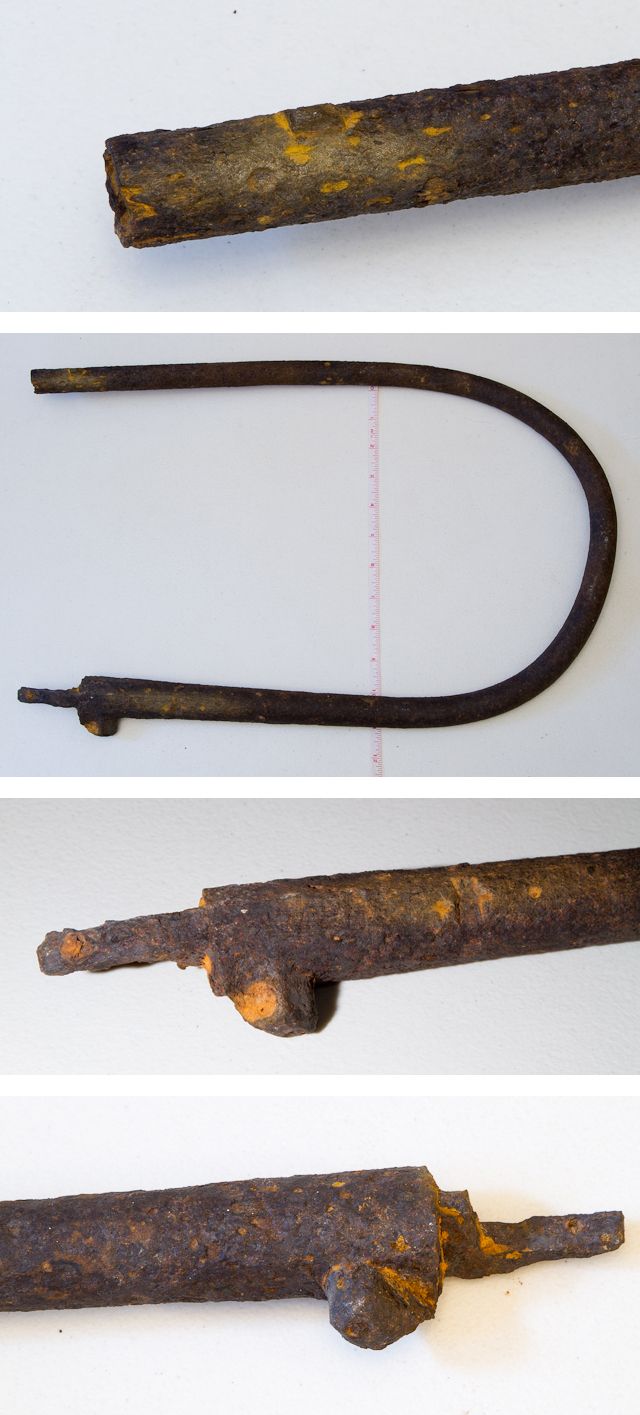
I once had a neat relic full length musket barrel (from the rear sign notch, either a model 1855 or a Richmond barrel) bent into a horse shoe, and I always believed it must have been heated and then bent - sort of like railroad iron heated red hot and then bent around trees (Sherman's Neckties).
By the way, this barrel, which I bought on eBay twenty years ago without any history of where it came from, and I sold it as without any history of where came from, I saw the same barrel in an on-line "museum" as being dug from Fredericksburg. I emailed the owner and sent him photos that showed this was the identical barrel, pointed out the steady pin notch as the rear sight that identified this as a model 1855 or Richmond barrel, and told him there was not known history of where it came from - his description added the steady pin info, but still retains to this day the Fredericksburg claim. Perhaps the owner did a forensic investigation of the old mud in the barrel?
I have seen relic swords broken short, but I am sure they were not just bent over a person's knee.
I once had a neat relic full length musket barrel (from the rear sign notch, either a model 1855 or a Richmond barrel) bent into a horse shoe, and I always believed it must have been heated and then bent - sort of like railroad iron heated red hot and then bent around trees (Sherman's Neckties).
By the way, this barrel, which I bought on eBay twenty years ago without any history of where it came from, and I sold it as without any history of where came from, I saw the same barrel in an on-line "museum" as being dug from Fredericksburg. I emailed the owner and sent him photos that showed this was the identical barrel, pointed out the steady pin notch as the rear sight that identified this as a model 1855 or Richmond barrel, and told him there was not known history of where it came from - his description added the steady pin info, but still retains to this day the Fredericksburg claim. Perhaps the owner did a forensic investigation of the old mud in the barrel?
Last edited:

 Forum Host
- Joined
- Apr 18, 2019
- Location
- Upstate New York
I have this image of someone who has heard stories of breaking a sword over their knee trying and getting a really wicked bruise.

Rhea Cole
Colonel
- Joined
- Nov 2, 2019
- Location
- Murfreesboro, Tennessee
From a metallurgists point of view, there are a few conditions that would facilitate breaking a sword. It is counterintuitive, but when steel reaches black heat it has the same physical characteristics as hundreds of degrees below zero. When stressed by bending or hammering, it breaks, shatters even. Black heat is when the metal cools from honey brown to black. That is why blacksmiths pass the back of their hand over a piece they are working before picking it up.
The metallurgy of CW era ironware was all over the map. At zero degrees F armor plate would enter a state that resulted in it shattering like glass, exactly like glass. A sword that had been cold soaked during Bragg's retreat from Perryville could have easily been broken.
The barrels of muskets were naturalized. That involves heating the metal to a uniform yellow color & allowing it to cool naturally. This process creates a barrel that can both withstand the shock of the round being fired & the passage of the ball. Any area of the barrel that was harder than another would create a boundary that would crack. For that reason, it is not very difficult to bend a CW era musket barrel.
It is off topic, but a thousand years before the CW it was common for Vikings to bend & twist swords. Doing so was a way to destroy its spiritual status. A standard Viking battle tactic was to set up a forge to refurbish weapons that had been bent or broken during the fighting.
To directly answer the question, whether or not a CW era sword could be broken would depend on metallurgy & what the temperature was. On a warm sunny day it could bend. At about freezing it could break. At either black heat or 100 degrees below zero, it could shatter like glass.
If you know a blacksmith, they will be able to explain the colors we look for when working metal. Metalworkers & professional cooks use the back of their hand to judge the temperature of hot metal. There are relatively few nerve endings on the palm. When you accidentally touch a hot object, there is a reflexive tendency to make a fist. Needless to say, reflexively grasping a price of hot metal is not a good thing.
The metallurgy of CW era ironware was all over the map. At zero degrees F armor plate would enter a state that resulted in it shattering like glass, exactly like glass. A sword that had been cold soaked during Bragg's retreat from Perryville could have easily been broken.
The barrels of muskets were naturalized. That involves heating the metal to a uniform yellow color & allowing it to cool naturally. This process creates a barrel that can both withstand the shock of the round being fired & the passage of the ball. Any area of the barrel that was harder than another would create a boundary that would crack. For that reason, it is not very difficult to bend a CW era musket barrel.
It is off topic, but a thousand years before the CW it was common for Vikings to bend & twist swords. Doing so was a way to destroy its spiritual status. A standard Viking battle tactic was to set up a forge to refurbish weapons that had been bent or broken during the fighting.
To directly answer the question, whether or not a CW era sword could be broken would depend on metallurgy & what the temperature was. On a warm sunny day it could bend. At about freezing it could break. At either black heat or 100 degrees below zero, it could shatter like glass.
If you know a blacksmith, they will be able to explain the colors we look for when working metal. Metalworkers & professional cooks use the back of their hand to judge the temperature of hot metal. There are relatively few nerve endings on the palm. When you accidentally touch a hot object, there is a reflexive tendency to make a fist. Needless to say, reflexively grasping a price of hot metal is not a good thing.

OldSarge79
Sergeant
- Joined
- Jul 12, 2017
- Location
- Brevard, North Carolina
My great grandfather, who served in the Spanish-American war, passed down a story (probably a joke from the period) of the different quality of Spanish and American swords. Spanish swords were supposedly made with high quality Toledo steel.
As the story goes, when the Spanish officer surrendered, he he looked into the American's eye, plunged the tip of his sword into a table, bent it till the handle was also on the table, let it go and it immediately sprung upright, perfectly straight.
The American officer, not to be outdone, likewise stuck his sword into the table, bent the handle to the table and let go. The handle stayed on the table.
Fact or exaggeration? I have no idea.
I have that great grandfather's sword. Maybe I should try it.
As the story goes, when the Spanish officer surrendered, he he looked into the American's eye, plunged the tip of his sword into a table, bent it till the handle was also on the table, let it go and it immediately sprung upright, perfectly straight.
The American officer, not to be outdone, likewise stuck his sword into the table, bent the handle to the table and let go. The handle stayed on the table.
Fact or exaggeration? I have no idea.
I have that great grandfather's sword. Maybe I should try it.
Rhea Cole
Colonel
- Joined
- Nov 2, 2019
- Location
- Murfreesboro, Tennessee
From a metallurgical point of view, what you have described is possible. You can do exactly the same thing with a vice, a piece of spring steel & cold rolled steel. The one will come back & pop you on the chops, the other hold it's shape. As to the veracity of the story… as a Southern story teller I can't let facts get into the way of a good tale.My great grandfather, who served in the Spanish-American war, passed down a story (probably a joke from the period) of the different quality of Spanish and American swords. Spanish swords were supposedly made with high quality Toledo steel.
As the story goes, when the Spanish officer surrendered, he he looked into the American's eye, plunged the tip of his sword into a table, bent it till the handle was also on the table, let it go and it immediately sprung upright, perfectly straight.
The American officer, not to be outdone, likewise stuck his sword into the table, bent the handle to the table and let go. The handle stayed on the table.
Fact or exaggeration? I have no idea.
I have that great grandfather's sword. Maybe I should try it.
Jeff in Ohio
Sergeant Major
- Joined
- Oct 17, 2015
From a metallurgists point of view, there are a few conditions that would facilitate breaking a sword. It is counterintuitive, but when steel reaches black heat it has the same physical characteristics as hundreds of degrees below zero. When stressed by bending or hammering, it breaks, shatters even. Black heat is when the metal cools from honey brown to black. That is why blacksmiths pass the back of their hand over a piece they are working before picking it up.
The metallurgy of CW era ironware was all over the map. At zero degrees F armor plate would enter a state that resulted in it shattering like glass, exactly like glass. A sword that had been cold soaked during Bragg's retreat from Perryville could have easily been broken.
The barrels of muskets were naturalized. That involves heating the metal to a uniform yellow color & allowing it to cool naturally. This process creates a barrel that can both withstand the shock of the round being fired & the passage of the ball. Any area of the barrel that was harder than another would create a boundary that would crack. For that reason, it is not very difficult to bend a CW era musket barrel.
It is off topic, but a thousand years before the CW it was common for Vikings to bend & twist swords. Doing so was a way to destroy its spiritual status. A standard Viking battle tactic was to set up a forge to refurbish weapons that had been bent or broken during the fighting.
To directly answer the question, whether or not a CW era sword could be broken would depend on metallurgy & what the temperature was. On a warm sunny day it could bend. At about freezing it could break. At either black heat or 100 degrees below zero, it could shatter like glass.
If you know a blacksmith, they will be able to explain the colors we look for when working metal. Metalworkers & professional cooks use the back of their hand to judge the temperature of hot metal. There are relatively few nerve endings on the palm. When you accidentally touch a hot object, there is a reflexive tendency to make a fist. Needless to say, reflexively grasping a price of hot metal is not a good thing.
Excellent posting, and thanks.
Since we're talking about swords pulled from the user's scabbard at a time when their blade would not be at "black heat" or "100 degrees below zero," the stories that the user just broke a sword over his knee would not be literally true, eh?
Rhea Cole
Colonel
- Joined
- Nov 2, 2019
- Location
- Murfreesboro, Tennessee
It could easily be true when very cold. Also, 19th Century metallurgy was hit or miss. A sword could easily have an inclusion or been improperly heat treated both of which would make the metal brittle.Excellent posting, and thanks.
Since we're talking about swords pulled from the user's scabbard at a time when their blade would not be at "black heat" or "100 degrees below zero," the stories that the user just broke a sword over his knee would not be literally true, eh?
- Joined
- Feb 23, 2013
- Location
- East Texas
I remember that article or story - the significant part about it relating to the topic of this thread is that, despite his best efforts, the sword failed to break but only bent.I do not have access to the book right now, but I have a vivid recollection of a broken sword featured in Steve Sylvia's and Michael O'Donnell's classic Illustrated History of American Civil War Relics. As I recall, Michael O'Donnell read an account of the surrender that mentioned a staff officer of John Gordon (?) who was bitterly weeping and broke his sword over his knee and hurled it away. He then worked out where Gordon's line was at the time of surrender (marked by the pulled bullets) and searched the area around it. He found a Froelich staff & field sword (the one with the cutout CSA cast in the guard) and scabbard. I think it was bent at around a 90 degree angle. I believe this was in the 1970s.
I can add more later tonight or tomorrow after I can consult the book. It is still one of the neatest relic find stories I have ever read. Right up there with a fortuitous finding of a worn KGK staff and field sword over a mantle, taking it home and cleaning it to discover the presentation etching to General Joseph B. Kershaw. That was a NSCWT article a long time ago.
Rhea Cole
Colonel
- Joined
- Nov 2, 2019
- Location
- Murfreesboro, Tennessee
It should bend. A sword has to absorb a blow, so is inherently flexible. Put a worn out drill bit on an anvil, don face mask, gauntlets & apron. Whack the drill bit with a hammer & watch the sizzling hot, razor sharp shards zing off in all directions. The unprotected are in for a painful lesson. Hard tool steel like a drill bit doesn't flex.I remember that article or story - the significant part about it relating to the topic of this thread is that, despite his best efforts, the sword failed to break but only bent.
Very sophisticated blades such as samurai swords have a hardened edge & naturalized back, The hard side holds a fine cutting edge & the flexible back absorbs the shock of a blow.
Don Dixon
Sergeant
- Joined
- Oct 24, 2008
- Location
- Fairfax, VA, USA
As I said above, I don't believe that one could break a properly manufactured and tested sword intended for use in the field. I did draw a possible distinction for a dress saber, however. The following drawing illustrates the humiliation of Alfred Dreyfus by the French Army after his courts martial, to include breaking his sword. In addition to the drawing it is described in news reports of the period.

Perhaps the sword was heat treated prior to the event to permit/produce the desired effect?
Regards,
Don Dixon
Perhaps the sword was heat treated prior to the event to permit/produce the desired effect?
Regards,
Don Dixon

FedericoFCavada
First Sergeant
- Joined
- Jan 27, 2015
- Location
- San Antonio, Texas
Certainly in Cuba during the so-called "Guerra grande" or Ten Years' War, 1868-1878, the decision by the Spaniards resident there to insist on the execution of eight medical students for supposedly profaning the tomb of a pro-Spanish journalist 27 Nov. 1871 resulted in a Spanish army officer breaking his sword--over his knee or with the heel of his boot, I do not know which or how, and resigning his commission... So swords can be broken. Recall that hardness of steel promotes sharpness, but also makes the blade brittle. So a sword has to be tempered carefully. The most famous sword smiths of all, those of Japan, mastered the arts of "folding" steel to ensure that the blade of the vaunted katana was very hard and sharp, but the back portions of the blade were not as rigid and more pliant so the sword would not break. Even so, I think some Japanese swords have shattered and broken under certain circumstances.My great grandfather, who served in the Spanish-American war, passed down a story (probably a joke from the period) of the different quality of Spanish and American swords. Spanish swords were supposedly made with high quality Toledo steel.
As the story goes, when the Spanish officer surrendered, he he looked into the American's eye, plunged the tip of his sword into a table, bent it till the handle was also on the table, let it go and it immediately sprung upright, perfectly straight.
The American officer, not to be outdone, likewise stuck his sword into the table, bent the handle to the table and let go. The handle stayed on the table.
Fact or exaggeration? I have no idea.
I have that great grandfather's sword. Maybe I should try it.
European-style swords might be different, and of course, the actual arm of service might make a big difference too... I mean, some heavy cavalry swords or sabers strike me as particularly robust... Other swords, like the NCO sword used in the Civil War... Not so much. The only sword I own is a cheap, Indian-made reproduction of a hanger, and it is absolutely impossible to imagine breaking it over one's knee, but I haven't tried either. I have handled a hideously lethal very sharp Gladius Hispaniensis copy, and while I think it would be exceedingly formidable in trained hands, I'm not entirely sure it couldn't be broken under particular circumstances?
gjpratt
Sergeant Major
- Joined
- Apr 14, 2019
- Location
- Central Florida and WNC
Coming back full circle, this is exactly the Branded scenario.As I said above, I don't believe that one could break a properly manufactured and tested sword intended for use in the field. I did draw a possible distinction for a dress saber, however. The following drawing illustrates the humiliation of Alfred Dreyfus by the French Army after his courts martial, to include breaking his sword. In addition to the drawing it is described in news reports of the period.
View attachment 400690
Perhaps the sword was heat treated prior to the event to permit/produce the desired effect?
Regards,
Don Dixon
gjpratt
Sergeant Major
- Joined
- Apr 14, 2019
- Location
- Central Florida and WNC
I have seen several Confederate swords with the last 10-25% of the lower tip of the blade missing and apparently broken off.
Similar threads

- Replies
- 15
- Views
- 313
- Replies
- 0
- Views
- 97

Similar threads

- Replies
- 0
- Views
- 1
- Replies
- 4
- Views
- 5

- Learn About Us
- ►About CivilWarTalk
- ►Contact the Webmaster
- ►Meet the Staff
- ►Link to CivilWarTalk
- Join Our Community
- ►Register
- ►Browse Forums
- ►View Today's Discussions
- ►Search the Forum
- Get Help
- ►FAQ
- ►Student Guide
- ►Forum Rules & Etiquette
- ►Copyright / DMCA
 Bringing the