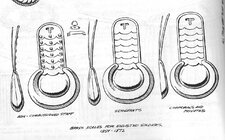
Brass shoulder scales (Union)

Kipling

Private
Joined
Jan 20, 2015
This may be a very basic question so I hope I am not being too ignorant, but who wore brass shoulder scales? I have seen references to the fact that they were only issued to Federal cavalry troopers to provide some protection against blows from enemy sabers but I don't think that can be correct (!). I am sure that was the original intent hundreds of years ago (just as gorgets evolved from old protective armor) but any protection would seem to be pretty minimal. There are other references to them being worn (as part of dress uniform) by privates and NCOs in other branches. Some of the staff NCOs scales seem to have brass rivets in a pattern (?) but what are the differences? I believe the undersides were left unfinished for privates but those issued to NCOs were finished (?) but there doesn't seem to be a lot of info out there.

I would appreciate any information, thanks.
 
Brass scales, officially called "metallic scales", but often seen in Quartermaster correspondence as "shoulder scales " (brass)" (nicknamed 'frying pans') were issued to other enlisted men in addition to cavalry starting in 1854. Up to that time the scales were only issued to mounted troops. From 1851 to 1855 the shoulder scales were issued in to styles, one for non-commissioned officers staff personnel and one for dragoons and light artillery. In 1854-1872 they came in three styles, one for staff non-commissioned officers, one for sergeants and one for privates.

scales 2.jpg
 

Attachments

  • scals.jpg
    scals.jpg
    216.4 KB · Views: 434
No problem. Where I seem to see the shoulder scales worn in Civil War photos the most is in Cavalry and heavy artillery.
 
I would love to go to that museum. One day I'll get there. Thanks for posting the pic of the Cavalry Sergeant, it's a good one!
 
The Civil War era U.S. marines also wore shoulder scale straps. These came with detachable yellow worsted bullion fringe plate. In photographs the marine shoulder scales with out the fringe plate looks a lot like the army shoulder scales. Does anyone know if U.S. Marines ever wore these shoulder scales without the fringe plate attached? Has anyone seen any photographs of marines wearing the shoulder scales without the fringe plates attached? Below is a Civil War era U.S. Marine shoulder scale with the fringe plate detached.

marie sh.jpg
 
But weren't they also worn by officers? I'm sure that I've seen pictures. Didn't the rank insignia get placed right on them?
 
But weren't they also worn by officers? I'm sure that I've seen pictures. Didn't the rank insignia get placed right on them?

No these are enlisted shoulder scales. Officers wore something a bit similar but there was no "scales" on them.
 
Brass scales, officially called "metallic scales", but often seen in Quartermaster correspondence as "shoulder scales " (brass)" (nicknamed 'frying pans') were issued to other enlisted men in addition to cavalry starting in 1854. Up to that time the scales were only issued to mounted troops. From 1851 to 1855 the shoulder scales were issued in to styles, one for non-commissioned officers staff personnel and one for dragoons and light artillery. In 1854-1872 they came in three styles, one for staff non-commissioned officers, one for sergeants and one for privates.

View attachment 85268
I can't tell the difference between sergeants and corporals and privates.
N.C.S. shoulder scales seem much rarer than the others.
Screen Shot 2017-03-05 at 8.15.54 PM.png

Annual Report of the Quartermaster- General of the State of New Jersey, for the year 1861
https://archive.org/stream/annualreportofqu1861offi#page/102/mode/2up/search/shoulder+scales
 
This may be a very basic question so I hope I am not being too ignorant, but who wore brass shoulder scales? I have seen references to the fact that they were only issued to Federal cavalry troopers to provide some protection against blows from enemy sabers but I don't think that can be correct (!). I am sure that was the original intent hundreds of years ago (just as gorgets evolved from old protective armor) but any protection would seem to be pretty minimal. There are other references to them being worn (as part of dress uniform) by privates and NCOs in other branches. Some of the staff NCOs scales seem to have brass rivets in a pattern (?) but what are the differences? I believe the undersides were left unfinished for privates but those issued to NCOs were finished (?) but there doesn't seem to be a lot of info out there.

I would appreciate any information, thanks.
The most common and deadly stroke from somebody mounted on a horse and wielding a saber would be a downward stroke. The assistance of gravity adds speed and power to the blow. The areas of the body most vulnerable to such an attack are the shoulders, head and arms with the shoulders being the most vulnerable since the head and arms are more mobile and the brain is much more quick in reaction to threats to the head and face. Shoulder scales added a layers of brass protection to the area most vulnerable to downward blows.

In the 1700s-1800s thought on protective military equipment was shifting away from the fully armored suits of the medieval period in favor of armor which centered mainly around being lighter, mobile and most important of all (since governments now kept standing, uniformed militaries), cheaper. The realization was that rather than trying to protect everything, you only need to protect the areas most vulnerable and you still have some critical protection at drastically reduced cost.

Thus Cavalry uniforms often featured reinforcement at the shoulders such as shoulder scales.
 
One oddity of War of 1812-era/Napoleonic-era was the so-called "boarding cap." It was a heavy boiled-leather hat, a bit like an old-time fire helmet, but without the protective flap or skirt at the back. Bands of wrought iron were added, looking a bit like barrel staves with upturned ends to catch cutlass blades that glanced off the helmet proper from falling on the shoulder. I suspect that in certain circumstances, these may have been worn as fire helmets, what with the risk of falling spars, pieces of rigging, or blocks and tackle...

The heavy and uncomfortable leather shako was often substituted by felt or fabric, but one old saw has it that the leather shako's use was defended as a protection against cavalry sword blows, as was the silliest-of-all-military-headgear, the pickelhaube that was once de rigeur for national militaries aping the Prussians in the late 19th-early 20th century.

How did the shoulder scale attach to the dress frock coat, or round about jacket exactly? I see it has a "keyed" aperture that affixes to some metal tab of some sort, but how does the metal tab fit into the woolen jacket material? Is that a permanent feature, or only temporary?

The 1820s U.S. uniforms had a shoulder roll arrangement that at least helped prevent the equipment straps from sliding off the shoulder...
 
... How did the shoulder scale attach to the dress frock coat, or round about jacket exactly? I see it has a "keyed" aperture that affixes to some metal tab of some sort, but how does the metal tab fit into the woolen jacket material? Is that a permanent feature, or only temporary?

The 1820s U.S. uniforms had a shoulder roll arrangement that at least helped prevent the equipment straps from sliding off the shoulder...
You almost never see them in period photographs, but there were two different securing devices sewn to the shoulders of the frock coats (for infantry and foot artillery) and shell jackets (for cavalry and mounted artillery): one was nothing more than a flat brass strip or "loop" sewn directly over the sleeve seam beneath which a flat tongue or strip soldered to the back of the scale was inserted; the other was a more involved brass "key" held in place near the collar seam by a round piece of blue uniform cloth. This last engaged the slots cut into the top of the soldered strip and the scale and was articulated so that it could be turned, thereby fastening the scale in place. It was therefore easy to mount and remount the scales which more and more, despite their utilitarian original purpose, were items worn in full dress if at all. Naturally most soldiers thought them merely more useless uniform brass to have to polish!
 
Here's what the fasteners look like--sutlers sell them for reenactors. They are sewn onto the shoulders of the coat and unless you wear the scales all the time, they just sit there, because once you put them on, they're on for good. I've had people look at them without the scales attached and ask me what rank they represent.

FEU-006A-2T.jpg


When my wife sewed them on my frock coat and attached the scales, she said, "So, what are you now, a general?" People really don't think of infantry privates as having that much brass on their shoulders.

The US Regulars (whom I often portray) probably wore them more frequently than others. When we recreated the Regulars at the Battle of First Manassas we wore them onto the field because that's what they did back in the day. They are good for dressing up for parades and other ceremonies. Mostly, though they sit on the shelf.

Here's a picture of me and my sons at Remembrance Day in Gettysburg almost 20 years ago wearing frocks with scales, except for my son the drummer, who was more comfortable wearing a sack coat.

001.jpg
 
Last edited:

Learn About Us
About CivilWarTalk
Contact the Webmaster
Meet the Staff
Link to CivilWarTalk
Join Our Community
Register
Browse Forums
View Today's Discussions
Search the Forum
Get Help
FAQ
Student Guide
Forum Rules & Etiquette
Copyright / DMCA

     Contact Us CivilwarTalk on Facebook CivilWarTalk on YouTube CivilWarTalk on Twitter RSS Feed

Bringing the American Civil War and More to Life.
© 1999 - , CIVILWARTALK, LLC - Site Version 10.0

SlaveryTalk.com - SecessionTalk.com - CivilWarTalk.com - ReconstructionTalk.com
Back
Top