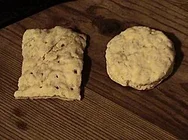
Authentic Biscuits

Biscuit.—Take one quart of flour, three teaspoonfuls of cream of tartar, mixed well through the flour two tablespoonfuls of shortening, one teaspoonful of soda, dissolved in warm water, of a sufficient quantity to mould the quart of flour. For large families the amount can be doubled.
Recipe from Confederate Receipt Book,
West & Johnson Publishers, Richmond, Virginia, 1863.
what temperature do you bake them and how long?
 
Biscuits? In the field (and afloat) it was 'hard tack' - still is. Allegedly a 'biscuit', but just flour and water, with those distinctive holes through the top, baked forever and hard. It was the cause of many a broken tooth, requiring a hot drink or sloppy stew dip to make it edible. Common fare for servicemen in the field. The German soldiers called them Panzerplatten - armor plates. They lasted a long time and certain weevils found them tasty and a good home. Troops discovering this found an extra source of protein.

During the Civil War, three-by-three-inch hardtack was shipped from Union and Confederate storehouses. Civil War soldiers generally found their rations to be unappealing; hardtack's ability to host worms earned it the "worm castles" nickname, and soldiers joked about the poor quality of the hardtack describing the hardtack rations as being 'old and very wormy' and causing many 'stomachs sore'. John Billings, a soldier in the 10th Massachusetts Battery, outlines many details on how hardtack was utilized during the war in his book "Hard Tack and Coffee".

rmy_and_Navy_hard_tack.jpg?utm_source=en.wikipedia.webpReproduction CivilWar-era army (left) and navy (right) hardtack.
#Note the shape, as army hardtack was shipped in boxes and shipboard navy provisions were shipped in barrels.


With insect infestation common in improperly stored provisions, soldiers would break up the hardtack and drop it into their morning coffee. This would not only soften the hardtack but the insects, mostly weevil larvae, would float to the top, and the soldiers could skim them off and eat the biscuits. The grubs "left no distinctive flavor behind." Some men turned hardtack into a mush by breaking it up with blows from their rifle butts, then adding water. If the men had a frying pan, they could cook the mush into a lumpy pancake; otherwise they dropped the mush directly on the coals of their campfire. They also mixed hardtack with brown sugar, hot water, and sometimes whiskey to create what they called a pudding, to serve as dessert.
 

Learn About Us
About CivilWarTalk
Contact the Webmaster
Meet the Staff
Link to CivilWarTalk
Join Our Community
Register
Browse Forums
View Today's Discussions
Search the Forum
Get Help
FAQ
Student Guide
Forum Rules & Etiquette
Copyright / DMCA

     Contact Us CivilwarTalk on Facebook CivilWarTalk on YouTube CivilWarTalk on Twitter RSS Feed

Bringing the American Civil War and More to Life.
© 1999 - , CIVILWARTALK, LLC - Site Version 10.0

SlaveryTalk.com - SecessionTalk.com - CivilWarTalk.com - ReconstructionTalk.com
Back
Top