Benjamin Butler

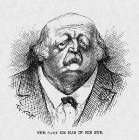
101184p06785w.jpg


Thomas Nast again. In later life...
 

Attachments

  • 101184p06785w.jpg
    101184p06785w.jpg
    63.5 KB · Views: 340
Butler by declaring slaves to be contraband, cut the Gordian Knot of the legality of ending slavery by agreeing with slave owners that blacks were property and then confiscating them as contraband of war.

I was amused by a phrase quoted by an earlier post that said that Butler had been a politician before becoming a general. While correct in a sense, the wording implies that he had stopped being a politician (and lawyer), and I think it's quite clear that he never stopped that...

"Contraband" was Butler's legal sense at its most acute. In his legal practice, frequently as a criminal defense attorney, he had been known as a "sharp," one that could get his clients acquitted by clever legal maneuvers regardless of their guilt or innocence. In one of his more celebrated cases, when he was defending a man who had taken a shop's key and used it to burglarize the shop, he bargained the prosecution down to specifically the theft of the key... because he had realized that there was a legal loophole in the prosecution's case he could exploit: a key was at that time considered a part of real estate, and the specific statute the defendant was charged under did not cover real estate. As a result, Butler successfully got the case tossed out and his defendant off the hook.
 
Butler had an inventive mind.

After the war, he started a company to manufacture ammunition for the Army. He made a fortune.

 
One of my favorite Butler stories is of how he purchased the famous racing yacht America, namesake of the America's Cup (after it had been used briefly as a Confederate blockade runner, then sunk as an obstruction, then used as a blockader), restored it, and sailed it around the Bay area in the postwar period. He kept it till his death. His son was not as enthusiastic a sailor, though, and sold it.
 
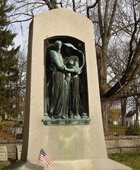
General_Butler%27s_Monument_%28Rear%29.jpg


I am clueless as to the allegorical intention, but this memorial to Butler at his grave site is just beautiful.
 

Attachments

  • General_Butler%27s_Monument_%28Rear%29.jpg
    General_Butler%27s_Monument_%28Rear%29.jpg
    79.3 KB · Views: 67
Don't know much about the man yet but thought I'd add this recent article to his thread...

June 5, 2016
The Virginian~Pilot

"More than two dozen people gathered in Chesapeake on Memorial Day to honor African American veterans of the Civil War."

"When Gen. Butler gave up command of the Army of the James in January 1865, he specifically honored the U.S.Colored Troops in his farewell address. Robert O. Johnson Jr. shared this passage from Butler's speech during the Memorial Day event:

To the Colored Troops of the Army of the James – In this army you have been treated not as laborers, but as soldiers. You have shown yourselves worthy of the uniform you wear. The best officers of the Union seek to command you. Your bravery has won the admiration even of those who would be your masters. Your patriotism, fidelity and courage have illustrated the best qualities of manhood. With the bayonet you have unlocked the iron-barred gates of prejudice, opening new fields of freedom, liberty and equality of rights to yourselves and to your race forever."
jiopilotonline.com
He also had a silver medal struck (by Tiffany) at his own expense, and presented it to 200 colored soldiers "For distinguished courage, Campaign before Richmond, 1864".
"I had the fullest reports made to me of the acts of individual bravery of colored men on that occasion (Battle of Newmarket Heights - outside Richmond, VA, September 29-30, 1864) and I had done for the negro soldiers, by my own order, what the government has never done for its white soldiers - I had a medal struck of like size, weight, quality, fabrication and intrinsic value with those which Queen Victoria gave with her own hand to her distinguished private soldiers of the Crimea.

The obverse of the medal shows a bastion fort charged upon by negro soldiers, and bears the inscription 'Freedom will be theirs by the sword.' The reverse bears the words, 'Campaign before Richmond,' encircling the words, 'Distinguished for Courage,' while there was plainly engraved upon the rim, before its presentation, the name of the soldier, his company and his regiment. The medal was suspended by a ribbon of red, white, and blue, attached to the clothing by a strong pin, having in front an d oak-leaf with the inscription in plain letters, "Army of the James." These I gave with my own hand, save where the recipient was in a distant hospital wounded, and by the commander of the colored corps after it was removed from my command, and I record with pride that in that single action there were so many deserving this it called for a presentation of nearly two hundred. Since the war I have been fully rewarded by seeing the beaming eye of many a colored comrade as he drew his medal from the innermost recesses of its concealment to show me". (Autobiography and Personal Reminiscences of Major-General Benj. F. Butler, 1892)

Three months after having the medals struck, Butler was relieved of command and African-American soldiers were forbidden from wearing the medal on their uniform.
 
Last edited:
Butler claimed that he had been a sickly boy until he was sent to sea on a fishing boat to improve his health. There was always a big drum of cod liver oil available, and he took to drinking a ladle of it each day; and he said that his robust health throughout his life was due to it.

Yeccchhhh..... :sick:
Also probably accounts for his often cranky disposition.
 
This is more of a general observation than a specific comment towards Butler. I have often wondered how negatively influenced people were by Butler's looks. I ask this because I have always felt that Mead suffered somewhat from the some negative perception based on looks alone, "Goggle-eyed snapping turtle" comes to mind. Not a very romantic view. Yet, it seems, far more is excused when the terms "dashing" "handsome" etc., precedes description of behavior that would otherwise be less accepted (Custer comes to mind).
 
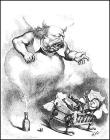
USAbutlerB2.jpg


I'm experimenting here with copying and enlarging images of different kinds.

This is an 1874 political cartoon from the inimitable Thomas Nast. The message here is a little obscure to me, despite the rather obvious disdain for Butler himself. Butler was a Congressman from Massachussetts in 1874 and deeply involved in national Republican Party politics, although he would later quit the party to run for for Governor of Mass. as a Democrat.
I am impressed with the tone of this thread ! Very fair and balanced.
Here is a view of Butler from Mark Moyar Director of Research at orbis Operation from his book " A question of command counterinsurgency from the Civil War to Iraq" Yale Library of Military History p.28-29

On p.28 Moyars discuss that Lincoln recruited Butler a popular Democratic politician in order to recruit men from Mass to the Union Army and to occupy Butler has Lincoln viewed Butler as a threat to his 1864 reelection .
On p.29 Moyars discuss that while most political generals including Butler where poor military commanders "Because of Butler's political experience and his considerable organizational talents, he served well in the roles of mayor and governor , taking the initiative with preventive measures that kept a major insurgency from arising. " Moyars argues that Butler's closing of hostile newspapers and his orders concerning women where effective in preventing an insurgency. Butler also was an effective recruiter of black men into the USCT.
Leftyhunter
 

Attachments

  • USAbutlerB2.jpg
    USAbutlerB2.jpg
    25.5 KB · Views: 61
Butler didnt always worry himself about what was allowed.


Butler does sounds unlikely: he was a Massachusetts politician who voted for Jefferson Davis to be the nominee at the 1860 Democratic Convention and voted for Breckenridge in the 1860 election.

In April 1861 when Butler commanded the troops in Annapolis Maryland, there was a rumor that there would be a slave uprising. Butler wrote to the Governor of Maryland to offer to help put down the uprising if it happened. The letter is in the Official Records and also in Butler's autobiography.
Hi Ned ,
You might find post #74 interesting.
Leftyhunter
 
On p.28 Moyars discuss that Lincoln recruited Butler a popular Democratic politician in order to recruit men from Mass to the Union Army and to occupy Butler has Lincoln viewed Butler as a threat to his 1864 reelection .

Was 1864 even a glimmer in anyone's eye in the spring of '61? Or was that a reference to some later recruitment.

Five consecutive presidents before Lincoln (excluding the two who died in office) either chose to only serve one term or failed to secure nomination to run for a second. There were also serious attempts to limit presidents to a single term--a proposal that made it into the Confederate Constitution. (http://www.whitehousetransitionproject.org/wp-content/uploads/2016/04/Terms-Tenure_101909-1.pdf)

Franz' character in NYPD Blue even had some of Butler's no nonsense traits

Whenever I read something about Butler I am clearly picturing Andy Sipowicz doing or saying it.
 
Was 1864 even a glimmer in anyone's eye in the spring of '61? Or was that a reference to some later recruitment.

Five consecutive presidents before Lincoln (excluding the two who died in office) either chose to only serve one term or failed to secure nomination to run for a second. There were also serious attempts to limit presidents to a single term--a proposal that made it into the Confederate Constitution. (http://www.whitehousetransitionproject.org/wp-content/uploads/2016/04/Terms-Tenure_101909-1.pdf)


Whenever I read something about Butler I am clearly picturing Andy Sipowicz doing or saying it.
I am merely relaying Moyar's discussion on Butler.
Leftyhunter
 
I am merely relaying Moyar's discussion on Butler.
Leftyhunter

I meant no attack against you personally. I do thank you for the information it was something I was not aware of.

I was and still am genuinely questioning the idea of Lincoln doing anything in 1861 with an towards 1864, but am more than happy to be corrected by anyone anywhere who knows more about the subject than I do.
 
I meant no attack against you personally. I do thank you for the information it was something I was not aware of.

I was and still am genuinely questioning the idea of Lincoln doing anything in 1861 with an towards 1864, but am more than happy to be corrected by anyone anywhere who knows more about the subject than I do.
I think Lincoln did a great deal in 1861 looking ahead to 1864. From Cabinet and other political appointments to the appointment of generals, he tried hard to assure that this wouldn't be a partisan war that the Democrats might play on in future elections. He was never NOT a politician. His canny politics, it should be pointed out, was also beneficial to the country.
 

Learn About Us
About CivilWarTalk
Contact the Webmaster
Meet the Staff
Link to CivilWarTalk
Join Our Community
Register
Browse Forums
View Today's Discussions
Search the Forum
Get Help
FAQ
Student Guide
Forum Rules & Etiquette
Copyright / DMCA

     Contact Us CivilwarTalk on Facebook CivilWarTalk on YouTube CivilWarTalk on Twitter RSS Feed

Bringing the American Civil War and More to Life.
© 1999 - , CIVILWARTALK, LLC - Site Version 10.0

SlaveryTalk.com - SecessionTalk.com - CivilWarTalk.com - ReconstructionTalk.com
Back
Top