1st Heavy Artillery ("The Jackass Regiment," "21st Indiana Infantry"): The regiment was organized at Indianapolis on 24 July 1861, as the 21st Indiana Infantry. In February 1863, the regiment was redesignated as the 1st Indiana Heavy Artillery. The regiment was mustered out of service on 10 January 1866.
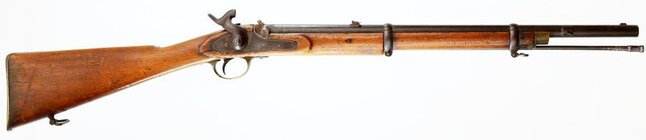
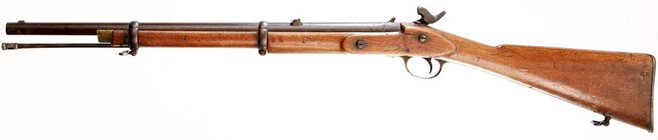
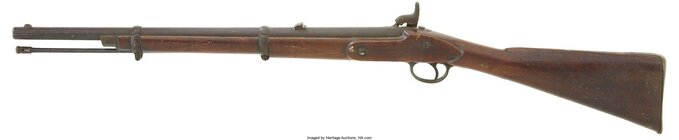
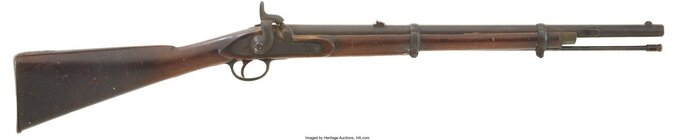
Two companies of the regiment were issued Enfield rifle muskets at Indianapolis, while the remaining eight companies were issued a mixed lot of converted smoothbore muskets. In October 1861 the defective Enfields and the smoothbore muskets were replaced with Austrian and Belgian rifled muskets in Baltimore, Maryland. Unsatisfied with the replacements provided by the Army, the men of Company K purchased their own Merrill .54 caliber breach loading rifles. In March 1862, while on shipboard to Ship Island, Mississippi, for the invasion of New Orleans, eight companies of the regiment were rearmed with a half and half mix of Enfield and Austrian rifle muskets.
Writing from Fort Williams in Baton Rouge, Louisiana, on 1 May 1864, Colonel John A. Keith complained to the chief of artillery, Department of the Gulf, that Major General Banks had ordered that his regiment be equipped as infantry. The regiment had been ordered outside its fortifications to relieve units ordered to the front, and one of the companies was performing provost duties. Regarding his arms, Colonel Keith wrote that "The guns furnished us are of the poorest description, being Austrian rifles, .54 caliber, many without bayonets, and those with bayonets without bayonet scabbards. The locks are very defective." Colonel Keith "begged" that the regiment be reequipped as artillery at the earliest possible time. In making his complaints about being issued infantry weapons Colonel Keith was flying the face of contemporary doctrine because heavy artillery units were supposed to be cross trained and equipped as infantry. Many heavy artillerymen discovered this fact when they were pulled out of the fortifications around Washington, DC, and burned up in Lieutenant General Grant's Overland Campaign and Siege of Petersburg in 1864 and 1865.
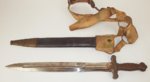
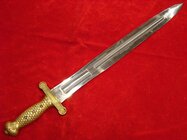
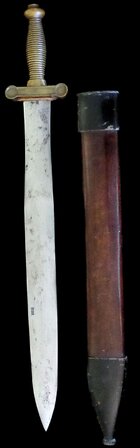
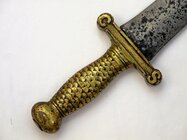
As for the artillery short swords, they were engineer tools used for clearing fields of fire and building field fortifications. They were only secondarily weapons. From a functional standpoint, think machete.
Regards,
Don Dixon





 Forum Host


 Bringing the