Southern Articifer
Private
- Joined
- May 4, 2014
Here are some pics and info to add to the knowledge bank. This is just a basic look. Hopefully this may inspire further study by the reader. The M.1816 musket saw much use with both sides during the length of the war. The M.1816 went through a number of changes in it service life. 3 distinct models, yet all classified as M.1816s. The earliest will have dates starting in 1818 going to 1822. These are true M1816's but are not yet standardize in there dimensions, interchangeability or method of manufacture. The 1822 is considered the first of the M1816s to get close to the goals set by the ordinance Dept. in the afore note sentence. In the times, these were indeed called model 1822 pattern muskets even thou they were still true M1816s. The other changes made from this point on are in the rear swivel and its attachment to the trigger bow, the size and style of the lettering on the lock and barrel. The eagle stamps also go thru some changes on the lock and barrel as well. All M1816s are 69 cal. and originally fired a 64 cal. round ball with 120 grain power charge. Buck and ball cartridges were issued as well. Flints were issued out 1 flint to 25 rounds. Each musket was issued with a socket bayonet with an average blade length of 15 1/2". The M1816 was made at the Springfield and Harpers Ferry armories. These muskets originally were issued to federal troops. The M.1816s made by contractors were scheduled for state militia as per the 1808 militia act. At the Springfield armory, the M.1816 was made until 1835. Here it was fazed out and replaced by the M.1840. At Harpers ferry, the M.1816 was made up to 1844. They went from the M.1816 right to the M.1842. The images: top a transitional M.1812/1816. Here the armories are using up the last of the M.1812 locks but stocking them on the new pattern. Note, on this original Springfield, the lock has the last of the integral iron flash pans and has a date of 1817 yet the barrel is dated 1818. This is how a transitional M.1816 should appear. 2nd musket : a first pattern M.1816 dated 1820. Note the large size lettering and the angular brass priming pan. The rear swivel is still attached like the M.1812 and earlier models. The one shown here is an Uberti I've re-worked to historical accuracy. Its nearly impossible to find an original flint M.1816 Harpers Ferry. 3rd musket : An original M.1816 dated 1842 from Harpers Ferry. Note the rear swivel is on a knuckle on the bow of the trigger guard. This example shows the classic cone and seat percussion alteration. These alterations were done at Springfield and Harpers Ferry. The alteration code on this one tells us this one was done at Harpers Ferry. The code can be seen as the sets of the letters such as AA and the number 4 stamped on the hammer on the wood next to the breech and right behind the cone. Last
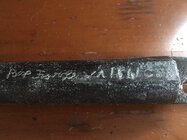
musket : A re-pro M.1842 by Armi-Sport. This musket has also been gone over to make it look historical correct. I put it in just as a comparison to the M.1816. All of the post transitional model M.1816's will have a lot or serial number on their breech such as a large case "Z" accompanied by a small case letter such as "c" followed by a number such as "28". Early M.1816's will have larger size characters after the 1820's. These letters and numbers become quite small. Hopefully this can be seen in the images I've added to this post. Mainly, I hope this will add to the knowledge of weapons used in the Civil War and how to interpret some of their details. If needed, I can give reference to
material found in this post.
Last edited by a moderator:



 Forum Host


 Bringing the