Whitney produced muskets

BBurkett

Private
Joined
Jan 10, 2019
Location
Virginia
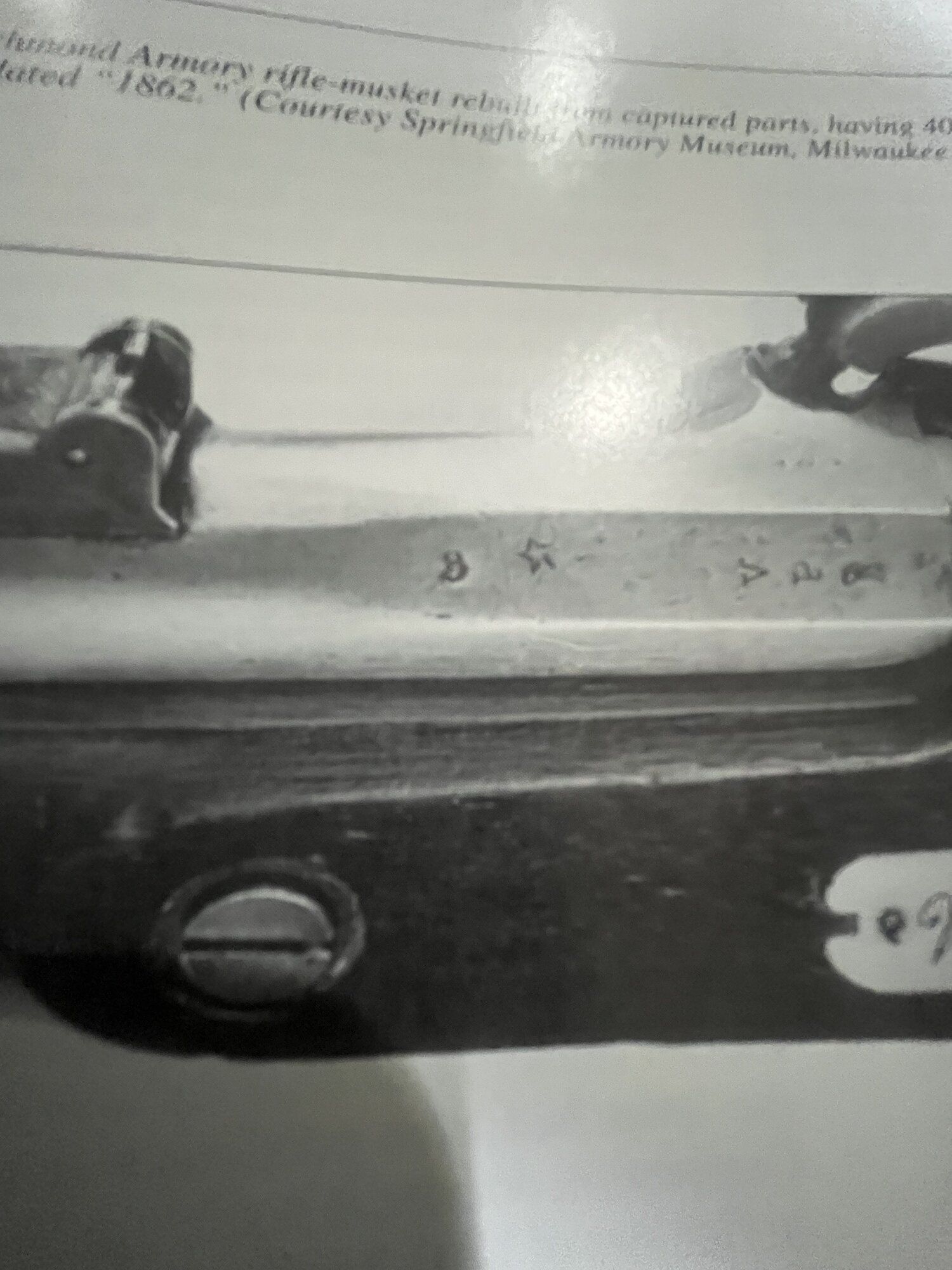
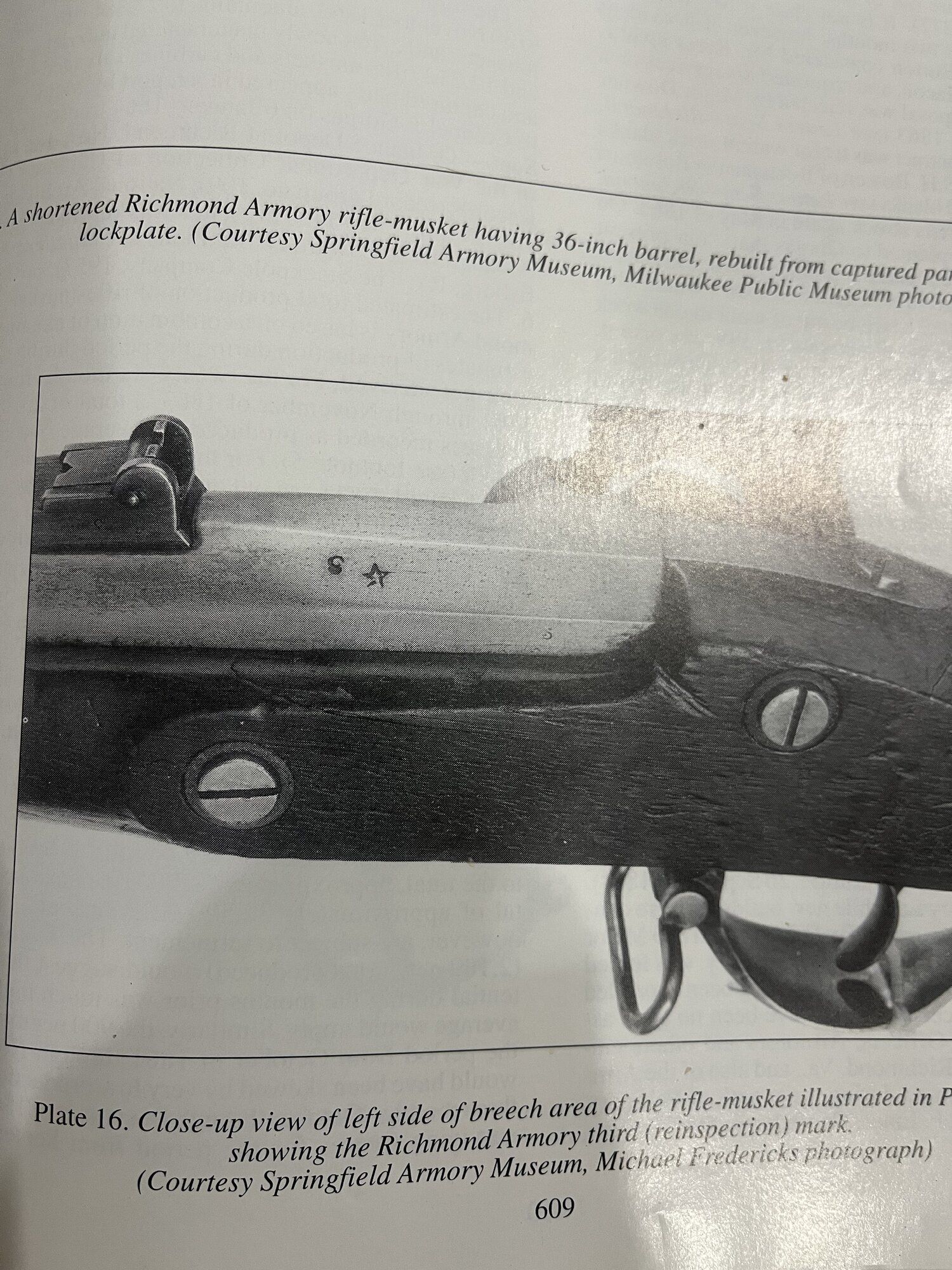
I'm going to hopefully put to rest the idea that barrels marked with a "3" or a "3M" are Richmond struck as seen in Confederate Rifles & Muskets by Murphy and Madus. On page 607 and 609 there purports to be 2 "captured parts" Richmond's that exhibit a "3" on the left breech flat. It appears Murphy & Madus believe the "3" to be the Third Reinspection Mark for Richmond Armory.

Here I present FIVE Whitney "Good & Serviceable" manufactured muskets with a mix of "M" and "M3" on otherwise bare breeches. Please consider that M&M did not have enough to items at their disposal at the time of publication.

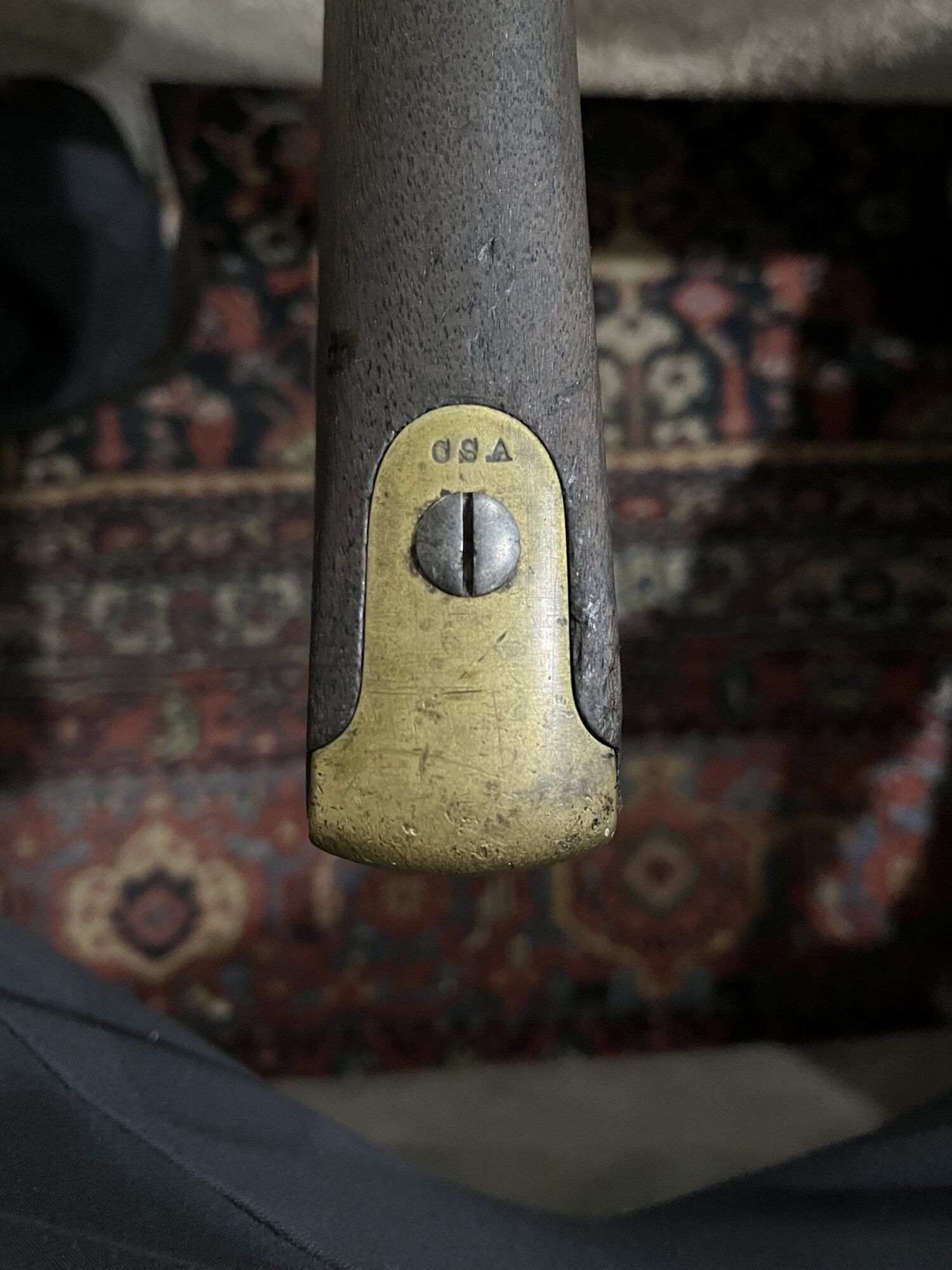
And IF I'm wrong, I'm sitting on a frigging MINT of Richmond's in choice condition. BTW, one of them has a Fayetteville buttplate that's been on a LONG time, probably to make it more "Reb" than it actually is….

IMG_2452.jpeg


IMG_2453.jpeg


IMG_9646.jpeg


IMG_2445.jpeg
 
Interesting that I didn't read that from this publication. Any reference book you suggest, Jeff?
I am away from my books today but I was referring to both the Murphy and Madus book you pictured and Paul Davies' book on the Richmond Armory; l have never heard anyone claim the small numbers and letters often seen along side the Star mark are Richmond reproof marks. It is the Star
 
Murphy & Madus, in their Confederate Rifles and Musket book section on Richmond Armory products, at the end of the section "OTHER RICHMOND ARMORY ASSEMBLAGES" starting at page 606, ends with this sentence "All three examples described bear a unique "star" stamping on the upper left side of the barrel, near the breach"
I don't have my Davies book to check it.
I myself have a rifle musket with a Springfield lock dated 1864 and a seven groove barrel I assume to be a Whitney barrel which has no proofs or letters on the barrel, just that five pointed star where the proof marks are usually located.
I also have one of the two-band 36 inch barrel rewords discussed in the references with no proofs on the barrel, except a "5" there, but when you look at the bottom of the barrel, there is one of those five pointed stars on the back of the barrel just where the tang screws in.
I used to have a model 1855 Springfield dated 1860 with no proofs, but with a "W" and the star where the proofs would be.
Those numerals and letters are some sort of inspectors marks, but it is the "STAR" that is considered the Richmond re-inspection mark.
 
Last edited:
…figured I'd pop my .02 in here as well. I also have 2 muskets with the Richmond "barrel star". One is an 1855 cadet and the other is a straight 1855
 
The strangest one I've ever seen, and still have, is one of those Bannerman Special shortened "Quaker Guns" made with a length of wooden dowel replacing most of the barrel, fastened to a cut off breach and with a metal barrel end - I have one made from a Model 1855 stock, and the breach section remaining has no proofs, only the five pointed Richmond star!
 
Interesting. As discussed before, Jobe Holiday told me in conversation that Davies wished that the "Star" comment had not been printed as it had not to that time been fully vetted.

I'll stand by my earlier comment on another thread that the barrels, if not the majority of parts assembled for those two "captured parts" muskets on pages 607 and 609 were actually Whitney produced.

Jeff, if you have one with the "3" on the breech I'd love to take a gander at it.
 
I've got some so-so quality photos which I will attach. I don't believe I ever checked the bore, so I don't know whether this has the 7 groove rifling I believe is common to Whitney barrels (is this correct?)
There is a discussion of these rifle-muskets, shortened to 36 inches and made into two band guns from three band guns. On mine, the stock was made with band springs inset into the wood in front of each band. Those were removed, and the remaining slots neatly filled with wood. You can see the wood filler just ahead of the rear band spring and the wood filler in what was the middle band spring slot. The two bands are the clamping type, and are spaced far apart.
Bill, as a Whitney collector, what's the story on Whitney's rifling being different from the standard three-groove rifling on a Springfield?

richmond-8285.jpg


richmond-8313.jpg


richmond-8316.jpg


richmond-8318.jpg


richmond-8320.jpg


richmond-8343.jpg


richmond-8348.jpg
 
The seven groove were early English import barrels. He used them on his Imitation Enfields and some of his '55's, tried to use them on his First Connecticut contract but got called out on them where the State wanted the Fed standard 3 groove. Whitney got his barrels from several different sources, Springfield condemned pieces, some condemned subcontractor made barrels to other Connecticut area manufacturers, he also got them from Colt when Colt dumped 5,000 barrels on the market when the US Govt rejected him using steel barrels.
I've got some so-so quality photos which I will attach. I don't believe I ever checked the bore, so I don't know whether this has the 7 groove rifling I believe is common to Whitney barrels (is this correct?)
There is a discussion of these rifle-muskets, shortened to 36 inches and made into two band guns from three band guns. On mine, the stock was made with band springs inset into the wood in front of each band. Those were removed, and the remaining slots neatly filled with wood. You can see the wood filler just ahead of the rear band spring and the wood filler in what was the middle band spring slot. The two bands are the clamping type, and are spaced far apart.
Bill, as a Whitney collector, what's the story on Whitney's rifling being different from the standard three-groove rifling on a Springfield?

View attachment 532295

View attachment 532296

View attachment 532297

View attachment 532298

View attachment 532299

View attachment 532300

View attachment 532301
you have a closeup of the lock at all?
 
Thanks for the info on the barrels. I will check about the lock. I am pretty sure it is an 1864 dated Springfield - I realize it has the earlier hammer, but that's the date.
 
Thanks for the info on the barrels. I will check about the lock. I am pretty sure it is an 1864 dated Springfield - I realize it has the earlier hammer, but that's the date.
If it has a 64 Springfield lock, it's been messed with as the barrel and hammer match up. Contracts pieces would still maintain the c shaped hammer as they were producing them on the US M1861 pattern. But you already knew that.
 
If it has a 64 Springfield lock, it's been messed with as the barrel and hammer match up. Contracts pieces would still maintain the c shaped hammer as they were producing them on the US M1861 pattern. But you already knew that.
Yes, I believe this is a Richmond Armory repair / rebuild arm. Mixed parts are to be expected.
 
Last edited:

Learn About Us
About CivilWarTalk
Contact the Webmaster
Meet the Staff
Link to CivilWarTalk
Join Our Community
Register
Browse Forums
View Today's Discussions
Search the Forum
Get Help
FAQ
Student Guide
Forum Rules & Etiquette
Copyright / DMCA

     Contact Us CivilwarTalk on Facebook CivilWarTalk on YouTube CivilWarTalk on Twitter RSS Feed

Bringing the American Civil War and More to Life.
© 1999 - , CIVILWARTALK, LLC - Site Version 10.0

SlaveryTalk.com - SecessionTalk.com - CivilWarTalk.com - ReconstructionTalk.com
Back
Top