GRAPHIC What's Going on with this Guy, Medically?

Gary Morgan

Sergeant Major
Forum Host
Joined
Aug 2, 2019
I'm writing about the gentleman in this famous photograph, who was a prisoner at Andersonville and who died at Annapolis, just about 100 miles from home. (Thanks to @Fairfield, I now know that the family was able to bring him home and he's buried with his wife and children at the local church cemetery - I hope that his family was able to see him again before he died; I know that he was at Annapolis for about two weeks, so it seems likely).

I'm trying to work out just what was going on with him medically. His pension records just say that he died of "Disease incurred while a prisoner of war" One retired doctor told me that the really large feet and ankles suggests the last stages of heart failure. An ophthalmologist tells me that the cloudy eyes are likely from malnutrition, and a long term lack of Vitamin A, and talked about something called "night blindness." Clearly starvation and malnutrition are factors. Is there anything else that can be gleaned about his condition just by examining this photograph?

This gentleman's descendant was on the board at one point, although I haven't seen any of his posts for a bit. Most of the photographs frequently captioned as "Andersonville survivors" were neither from Andersonville, nor did they generally survive. Most of them were from Richmond, usually Belle Isle, and died not long after their photos were taken. The photos were taken and apparently used by a Congressional committee investigating conditions in Confederate prisons post-war (although they really should have been investigating conditions in Northern prisons, as well).
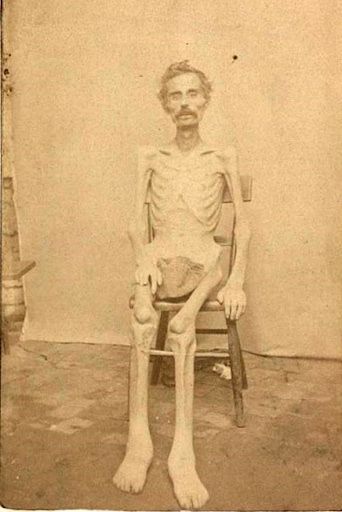
Phillip Hattal.jpeg


Phillip Hattal Cabinet Card.jpg
 
In the course of my research, I was able to pull up an autopsy reports. I chanced on it. The copy of the report is filed up at the historical society but I was just able to find a text copy online: it was one of a large number of such in a book--available via Google books--entitled: The medical and surgical history of the war of the rebellion, (1861-65). To find it, I simply googled <autopsy "ephraim york"> (that was the name of "my" soldier--of course, substitute your's).

If that fails, you might contact NARA which must have the original report. Either directly or via its History Hub mechanism.
 
In the course of my research, I was able to pull up an autopsy reports. I chanced on it. The copy of the report is filed up at the historical society but I was just able to find a text copy online: it was one of a large number of such in a book--available via Google books--entitled: The medical and surgical history of the war of the rebellion, (1861-65). To find it, I simply googled <autopsy "ephraim york"> (that was the name of "my" soldier--of course, substitute your's).

If that fails, you might contact NARA which must have the original report. Either directly or via its History Hub mechanism.
"There are no good matches for your search" - Google suggested the autopsy for Whitney Houston instead.

Given that he was one of thousands of guys who died of the treatment he was subjected to at Andersonville, and the fact that his family apparently was waiting to take his body home, I would have been surprised if an autopsy was conducted, but it was worth a shot.

This probably isn't particularly helpful for investigating soldiers, but for unexpected civilian deaths, coroner's reports can be fascinating. Coroners back in the day were not medical officials, but legal ones, and could be called in to investigate whenever there was an unexpected death to determine if a crime had been committed. I found one for my great grandfather's oldest sister, who died in Yorkshire in 1869. It included testimony from the mother, a neighbor, and the mother's uncle who lived in the house. Their testimony described the family the evening before ("perfectly sober" according to the neighbor, thank God). the mother's reaction when she discovered the baby was dead (not surprisingly, she screamed loud enough to bring the neighbor running), and the mother's description of nursing the baby the night before and what she saw when she woke up and found the baby dead. Going by the coroner's transcript, the Mom took the baby to bed to nurse, fell asleep, and rolled over on her during the night and accidentally smothered her. It was like looking through my great great grandparents' window on the worst morning of their lives.

I later stumbled on a file of coroner's reports from Plymouth Colony online - that made from some interesting reading - everything from wolf attacks to murder.
 
"There are no good matches for your search"
Hmmm! Here's Ephraim York's entry: https://books.google.com/books?id=y...AM#v=onepage&q=autopsy "ephraim york"&f=false. I think that you can use the search mechanism for the book to locate your man.

If that fails, try googling <autopsy "ephraim york">; third hit down; then use that search mechanism for the individual book--unless you really want to read about Ephraim York.

The name of the book is: The Medical and Surgical History of the War of the Rebellion. (1861-65). By United States. Surgeon-General's Office

I later stumbled on a file of coroner's reports from Plymouth Colony online
May I ask where? Plymouth and Massachusetts Bay are special interests.
 
May I ask where? Plymouth and Massachusetts Bay are special interests.
This was about 12 years ago, when I was in my "King Philip's War phase", which was the phase before my Andersonville phase. I can't find the one I'm thinking of, but at the bottom of this site of coroners' reports analyzed, there's a summary of the various cases:


I'll keep looking for the page that I saw, which had detailed reports on each case.

You may also find this one a "fun" read: file:///C:/Users/My%20Laptop/Downloads/ocm2535001_vol6.pdf

I grew up not too far from Plymouth. In fact, one of my cousins is the boy in the photographs for the book "On the Mayflower."

s-l500.jpg
 
This was about 12 years ago, when I was in my "King Philip's War phase", which was the phase before my Andersonville phase. I can't find the one I'm thinking of, but at the bottom of this site of coroners' reports analyzed, there's a summary of the various cases:


I'll keep looking for the page that I saw, which had detailed reports on each case.

You may also find this one a "fun" read: file:///C:/Users/My%20Laptop/Downloads/ocm2535001_vol6.pdf

I grew up not too far from Plymouth. In fact, one of my cousins is the boy in the photographs for the book "On the Mayflower."

View attachment 419306
Thank you! This ought to keep me occupied and out of trouble for a while! 🙂 I always feel badly when people can't recognized that the Pilgrims were not Puritans (and visa versa). Your little cousin is adorable!
 
My "little" cousin is now in his 30s and a geologist. He had the good sense to marry a teacher, and when he goes to visit his wife's classes around Thanksgiving, the kids treat him like rock star. He got the gig because his father is a carpenter who specializes in old ships, and worked on both the Mayflower II and Old Ironsides (and he's actually SAILED on both!). They were looking for a kid who was comfortable around old ships and would look like he knew what he was doing.

The colonial coroner's records are a really interesting read! Have fun, and don't let the wolves get you!
 
Nyctalopia (aka night blindness) is sometimes resultant of lack of vitamin A and the condition is often associated with scurvy. You might do some research to see if the other symptoms indicate the subject might have been suffering from scurvy. As you know, scurvy was rampant at CW prison camps including Andersonville.
 
I'm no doctor but the swelling arounds his ankles looks like edema, which is common in starvation cases. I can't remember if Sherwin Nuland covers starvation in his book "How We Die." It's an amazing book that covers lots of other ways life ends so it may be there.
As it was explained to me, when the heart starts to fail, it reaches the point where it can no longer pump the blood to the extremities, and so the blood pools there, while the heart's remaining energy is used to circulate blood through the brain and torso, and that's why the feet and ankles look bloated and huge compared to the rest of the skin and bones of his body. Probably about the same thing as edema, actually.
 
As it was explained to me, when the heart starts to fail, it reaches the point where it can no longer pump the blood to the extremities, and so the blood pools there, while the heart's remaining energy is used to circulate blood through the brain and torso, and that's why the feet and ankles look bloated and huge compared to the rest of the skin and bones of his body. Probably about the same thing as edema, actually.
Somehow the ability of the body to move liquids - often just water - through cell membranes is compromised and the extra fluid follows gravity to the feet.
 

Learn About Us
About CivilWarTalk
Contact the Webmaster
Meet the Staff
Link to CivilWarTalk
Join Our Community
Register
Browse Forums
View Today's Discussions
Search the Forum
Get Help
FAQ
Student Guide
Forum Rules & Etiquette
Copyright / DMCA

     Contact Us CivilwarTalk on Facebook CivilWarTalk on YouTube CivilWarTalk on Twitter RSS Feed

Bringing the American Civil War and More to Life.
© 1999 - , CIVILWARTALK, LLC - Site Version 10.0

SlaveryTalk.com - SecessionTalk.com - CivilWarTalk.com - ReconstructionTalk.com
Back
Top