
Little Boots
Private
- Joined
- Jul 7, 2023
While I was examining the photographs of the bridges that spanned the Chickahominy for a video on the subject (link below), I made some intriguing discoveries. Two photographs, which are seemingly not linked, do - in fact - have a tangible connection between them. More to the point, a number of the men who appear in these photographs I believe I have identified based on the research on the construction of these bridges. The two photographs in question are the Woodbury Bridge Photograph and the Grapevine Bridge Photograph. However, for the sake of not treading over the same information, we will be focusing on the Grapevine Bridge Photograph. The Grapevine Bridge (depicted below) was built by the men of the 5th New Hampshire Infantry Regiment, which had been detailed under the Army of the Potomac's Engineering Brigade. The brigade was led by (then) Colonel Charles B. Stuart, which included the 50th New York Engineering Regiment, the 15th New York Engineering Regiment - under the command of Colonel John McLeod Murphy - and the 5th New Hampshire Infantry Regiment, which was under the command of Colonel Edward E. Cross.

The "Woodbury Bridge" (depicted below) was built by the 15th New York Engineering Regiment and was up river from the Grapevine Bridge. The name "Woodbury Bridge" was based on the name of the Photographer - D. B. Woodbury - who first photographed it. This particular bridge would be photographed twice; first by Woodbury and later by James F. Gibson; the man responsible for the photographs of Savage's Station.

When I cross-examined the Woodbury photographs, I began taking notes on the similarities between the people portrayed in both photographs. In fact, between both photographs, the same men could be singled out either based on their facial appearance or based on the clothing they wore. Yet, more important than this, the officers featured in the photographs could be identified. The first of these individuals I was able to identify was the following officer (depicted below). The shoulder Chevrons and the officer's hat make it easy to identify him as a Colonel. Yet, the distinct shape of the nose, cheeks, and his rather rotund figure make it easy to identify him as Charles B. Stuart.

Colonel Charles B. Stuart was the senior-most officer within the Engineering brigade, which - as military tradition goes - left him in command of the brigade. He would later be made a Brigadier General and would - likewise - have a photograph taken (depicted below). The casual wear of the photograph above was due to the conditions during the time the photograph was taken. The Woodbury photographs date to between May and June of 1862. Around this time of year, the weather in Central Virginia becomes increasingly hot and muggy, making casual wear more commonplace. In addition, Colonel Stuart was an older officer; nearly fifty years old at the time the photograph was taken. By contrast, his official photograph shows off his formal officer's attire, including his heavier officer's coat.

The next individual in question (depicted below) is another officer with similar shoulder chevrons. However, he is wearing a shell jacket and a wide-brimmed hat; more commonly associated with casual civilian wear than with an officer. His shell jacket is mostly unbuttoned except for the lowest and highest buttons. In addition, he has a thick beard, which is a bit long in the tooth. This is most likely then Lieutenant Colonel William H. Pettes.
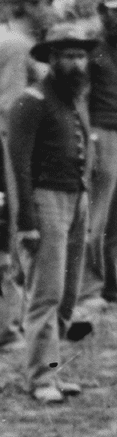
William H. Pettes was Lieutenant Colonel of the 50th New York Engineering Regiment. He would later be promoted to the rank of Colonel upon the promotion of Charles B. Stuart. Much as with Stuart, his clothing of choice was casual wear while out on the field or deep in the weeds with his subordinate officers and the enlisted men. His clothing - more befitting of a private - was likely deliberate. Prior to the war, he worked extensively as an engineer for many civil projects in New York and elsewhere. His official photograph (depicted below) shows off his parade uniform and was also likely taken in the months after the Peninsula campaign.

The third officer (depicted below) has a unique set of attire, which made him the easiest to identify. He's wearing attire that is more conducive to civilian clothing, yet is quite formal. Unlike with the other officers and men, he wears a thick belt around his waist to hold up his pants rather than the ubiquitous suspenders. He wears his officer's sword on his hip, riding boots on his feet, and dons upon his head an officer's hat. This - it would be hard to refute - is likely Colonel John McLeod Murphy of the 15th New York Engineering Regiment.
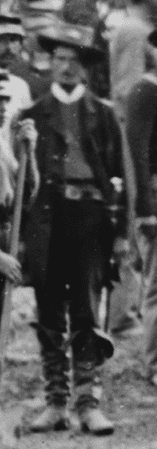
John McLeod Murphy was Colonel of the 15th New York Engineering Regiment from its inception, though would transfer to the Navy, take command of a gunboat, and serve during the Vicksburg Campaign. His attire speaks for itself as - in his studio photograph (depicted below) - he wore many of the same, identifiable articles of clothing for the shoot as he did on the field. The consistency between the two speaks to his personality and conduct of character, yet - most important of all - made him the easiest to identify without question.

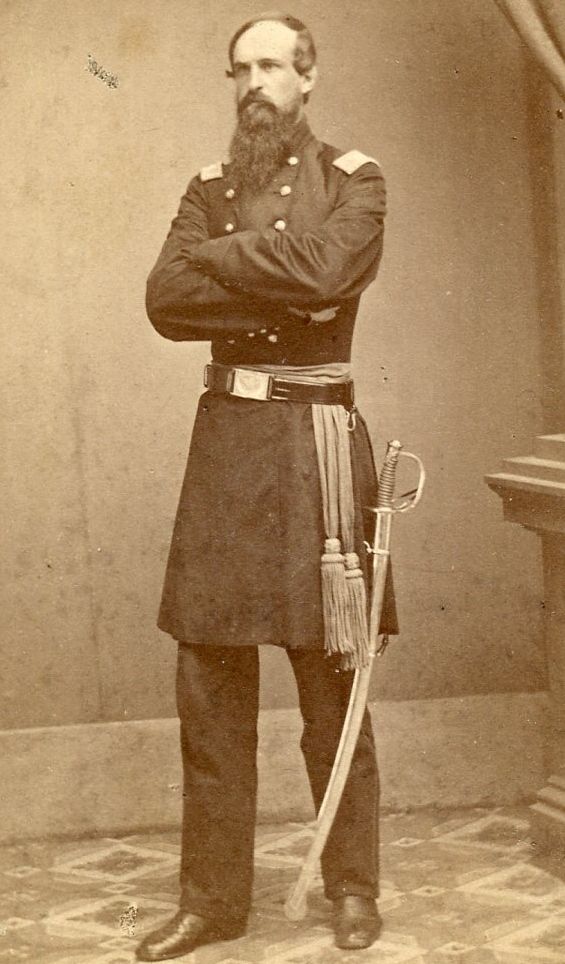
The final person (depicted below) is another officer partially obscured by one of the wagons brought along by the Engineering Brigade for the photo shoot. His attire - out of the four officers - is the most formal attire for the occasion; with the standard-issued kepi and officer's coat making it easy to identify his importance. Yet, one of the most important characteristics is his tall and slender figure relative to the men standing in front of him along with his short beard at the time of this photograph. This is most likely Colonel Edward E. Cross.

Colonel Edward E. Cross was the commanding officer of the 5th New Hampshire Infantry Regiment. He - along with his brother Robert - would serve are the regiment together from 1861 until 1863. Out of the four officers, Cross would be the only one to be killed in action during the war when - on July 2nd - he was mortally wounded on the Southern portion of the Wheatfield at Gettysburg, passing away on July 3rd, 1863. Early in 1863, he would pose for an official photograph (depicted below) in his officer's uniform. A noted feature of Colonel Cross was his tall stature.
Out of the four, the identification of Cross is the one I am least certain amount two to several reasons. First, Colonel Cross was wounded at the Battle of Seven Pines, which was roughly around the time these photographs were taken. Second, his brother - Captain Richard E. Cross - bears a similar appearance to Edward, meaning it could likely be him. This is further complicated by the short beard of the officer in the Grapevine Bridge photograph, though this could be explained by him growing out the beard between May, 1862 and his official photograph early in 1863.
All four officers can be found in the Woodbury bridge photograph (depicted below). All four officers are seen standing near one another. This demonstrates further how tall and slender Cross was compared to the others. Colonel Stuart - as with the Grapevine Bridge photograph - is at the head of the group of soldiers, demonstrating his position of authority as the commanding officer of the Engineering Brigade. He also exudes a sense of pride over the work of the men under his command; they had built multiple bridges over the Chickahominy, which would save the 5th Corps from total annihilation.

In all of this, we can see a vital link between the two photographs beyond being the product of the same photography team. It is likely both photographs were taken on the same day. The men of the Engineering Brigade - likely on the request of Woodbury - would go out that day and pose for these photographs; bringing to these bridges a sense of life and to show how the men of the Army of the Potomac were not letting mother nature stand in their way to reach the gates of Richmond and bring an end to the war. Yet - likely beyond their own comprehension - they would become a window into the past; a moment of their lives captured and preserved for those over one hundred, sixty years removed from that day to study, learn, and admire these men and all they had done in service of their nation.
________________________________________
If you wish to learn more about these bridges, I have linked below my Youtube video where I analyzed these two photographs and a few more of the bridges that crossed the Chickahominy. Give it a watch and review the sources provided.
The "Woodbury Bridge" (depicted below) was built by the 15th New York Engineering Regiment and was up river from the Grapevine Bridge. The name "Woodbury Bridge" was based on the name of the Photographer - D. B. Woodbury - who first photographed it. This particular bridge would be photographed twice; first by Woodbury and later by James F. Gibson; the man responsible for the photographs of Savage's Station.
When I cross-examined the Woodbury photographs, I began taking notes on the similarities between the people portrayed in both photographs. In fact, between both photographs, the same men could be singled out either based on their facial appearance or based on the clothing they wore. Yet, more important than this, the officers featured in the photographs could be identified. The first of these individuals I was able to identify was the following officer (depicted below). The shoulder Chevrons and the officer's hat make it easy to identify him as a Colonel. Yet, the distinct shape of the nose, cheeks, and his rather rotund figure make it easy to identify him as Charles B. Stuart.
Colonel Charles B. Stuart was the senior-most officer within the Engineering brigade, which - as military tradition goes - left him in command of the brigade. He would later be made a Brigadier General and would - likewise - have a photograph taken (depicted below). The casual wear of the photograph above was due to the conditions during the time the photograph was taken. The Woodbury photographs date to between May and June of 1862. Around this time of year, the weather in Central Virginia becomes increasingly hot and muggy, making casual wear more commonplace. In addition, Colonel Stuart was an older officer; nearly fifty years old at the time the photograph was taken. By contrast, his official photograph shows off his formal officer's attire, including his heavier officer's coat.
The next individual in question (depicted below) is another officer with similar shoulder chevrons. However, he is wearing a shell jacket and a wide-brimmed hat; more commonly associated with casual civilian wear than with an officer. His shell jacket is mostly unbuttoned except for the lowest and highest buttons. In addition, he has a thick beard, which is a bit long in the tooth. This is most likely then Lieutenant Colonel William H. Pettes.
William H. Pettes was Lieutenant Colonel of the 50th New York Engineering Regiment. He would later be promoted to the rank of Colonel upon the promotion of Charles B. Stuart. Much as with Stuart, his clothing of choice was casual wear while out on the field or deep in the weeds with his subordinate officers and the enlisted men. His clothing - more befitting of a private - was likely deliberate. Prior to the war, he worked extensively as an engineer for many civil projects in New York and elsewhere. His official photograph (depicted below) shows off his parade uniform and was also likely taken in the months after the Peninsula campaign.
The third officer (depicted below) has a unique set of attire, which made him the easiest to identify. He's wearing attire that is more conducive to civilian clothing, yet is quite formal. Unlike with the other officers and men, he wears a thick belt around his waist to hold up his pants rather than the ubiquitous suspenders. He wears his officer's sword on his hip, riding boots on his feet, and dons upon his head an officer's hat. This - it would be hard to refute - is likely Colonel John McLeod Murphy of the 15th New York Engineering Regiment.
John McLeod Murphy was Colonel of the 15th New York Engineering Regiment from its inception, though would transfer to the Navy, take command of a gunboat, and serve during the Vicksburg Campaign. His attire speaks for itself as - in his studio photograph (depicted below) - he wore many of the same, identifiable articles of clothing for the shoot as he did on the field. The consistency between the two speaks to his personality and conduct of character, yet - most important of all - made him the easiest to identify without question.
The final person (depicted below) is another officer partially obscured by one of the wagons brought along by the Engineering Brigade for the photo shoot. His attire - out of the four officers - is the most formal attire for the occasion; with the standard-issued kepi and officer's coat making it easy to identify his importance. Yet, one of the most important characteristics is his tall and slender figure relative to the men standing in front of him along with his short beard at the time of this photograph. This is most likely Colonel Edward E. Cross.
Colonel Edward E. Cross was the commanding officer of the 5th New Hampshire Infantry Regiment. He - along with his brother Robert - would serve are the regiment together from 1861 until 1863. Out of the four officers, Cross would be the only one to be killed in action during the war when - on July 2nd - he was mortally wounded on the Southern portion of the Wheatfield at Gettysburg, passing away on July 3rd, 1863. Early in 1863, he would pose for an official photograph (depicted below) in his officer's uniform. A noted feature of Colonel Cross was his tall stature.
Out of the four, the identification of Cross is the one I am least certain amount two to several reasons. First, Colonel Cross was wounded at the Battle of Seven Pines, which was roughly around the time these photographs were taken. Second, his brother - Captain Richard E. Cross - bears a similar appearance to Edward, meaning it could likely be him. This is further complicated by the short beard of the officer in the Grapevine Bridge photograph, though this could be explained by him growing out the beard between May, 1862 and his official photograph early in 1863.
All four officers can be found in the Woodbury bridge photograph (depicted below). All four officers are seen standing near one another. This demonstrates further how tall and slender Cross was compared to the others. Colonel Stuart - as with the Grapevine Bridge photograph - is at the head of the group of soldiers, demonstrating his position of authority as the commanding officer of the Engineering Brigade. He also exudes a sense of pride over the work of the men under his command; they had built multiple bridges over the Chickahominy, which would save the 5th Corps from total annihilation.
In all of this, we can see a vital link between the two photographs beyond being the product of the same photography team. It is likely both photographs were taken on the same day. The men of the Engineering Brigade - likely on the request of Woodbury - would go out that day and pose for these photographs; bringing to these bridges a sense of life and to show how the men of the Army of the Potomac were not letting mother nature stand in their way to reach the gates of Richmond and bring an end to the war. Yet - likely beyond their own comprehension - they would become a window into the past; a moment of their lives captured and preserved for those over one hundred, sixty years removed from that day to study, learn, and admire these men and all they had done in service of their nation.
________________________________________
If you wish to learn more about these bridges, I have linked below my Youtube video where I analyzed these two photographs and a few more of the bridges that crossed the Chickahominy. Give it a watch and review the sources provided.


 Bringing the