Saphroneth
Colonel
- Joined
- Feb 18, 2017
With the arrival of McClellan's first reinforcements (two brigades with six more assembling at Fort Monroe) he determined to place his first reinforcements north of the Chickahominy, rotating them into the line to provide a reserve from more experienced troops pulled out of the line along Tolopatamoy Creek and the line facing Mechanicsville.
At the same time, McClellan made use of his now emplaced artillery both in the north and south sectors on the other bank of the Chickahominy to press forwards and take the high ground in the central sector. This newly gained high ground was heavily reinforced, and beat off an abortive counterattack the following day (the 5th of July) as the troops placed there dug in with embrasured works and parallels - this newly gained ground was about two and a half miles from the main Confederate line of permanent forts, and would render some of the Confederate forward rifle pits untenable.
It is at about this date that McClellan wrote what has been called the Nine Mile Letter, written from his forward HQ at Nine Mile station. This letter provided advice of a military and political nature to Lincoln, and was not well recieved by the recipient.
This period is recorded in Lee's diary as one of intense frustration. With his own reinforcements arriving (an extra brigade for now, with four more en route to arrive throughout July) he had the force to do at least something, but while McClellan's careful advance meant he was making slow headway it also meant that there was no obvious target for Lee to actually attack. The next Union advance would necessarily be a dangerous moment for them, but to exploit this would require as great a force as possible - and Jackson had already been down as part of Lee's main army for a week and a half, raising the risk of an unopposed Union advance further south by Pope's army towards the North Anna. With Pope's army estimated at 50,000 men all told this would be a force that could be defeated, but not by Jackson alone - though Jackson could probably prevent the crossing of the Rappahanock, but this would leave Lee unresourced in the event McClellan moved further.
An ominous sign is that Lee has felt it necessary to place a garrison brigade in Fort Jackson.
Current forces:
McClellan (reinforced by nine regiments after the battles collectively known as First? Richmond): 121,000 PFD
20 brigades north of the Chickahominy, total about 58,000 PFD
22 brigades south of the Chickahominy, total about 63,000 PFD
Lee (reinforced by five regiments): 99,000 PFD:
Jackson's force about 19,000 PFD
Defensive forces south of the Chickahominy about 40,000 in Richmond itself, plus 2,000 in Petersburg
Mobile field army (Longstreet etc.) 38,000 - overall stripped to make Richmond's defences stronger
With the exception of AP Hill's force, the whole of the field army is in position to move quickly to help defend Richmond.
McClellan's plan at this point is essentially to make an offensive to capture the Old Tavern area. As a prelude to this he will extend the northern flank of his south-of-the-Chickahominy force west, occupying the river bank, and thus free up two brigades from needing to garrison the river bank. This force will be involved in an echelon attack, starting with his force near the railroad line and moving northwards. The "stop line" in the ideal case is the creeks running east of Forts Jackson and Johnston, though this will likely only be occupied by a skirmish line; the real prize is Old Tavern, within artillery range of the big Confederate forts.
This attack is slated for about the ninth of June, and McClellan has been told Burnside will be sent up to him by the 14th.
McClellan's actual estimate of Confederate force at this point is about 150,000 Present, of which about 20% is Jackson (he's concluded that Beauregard was not present and has overestimated the casualties he's inflicted to be about 30,000). This is a little greater than his own, but not by much at all - his own force is about 145,000 Present - and he feels that a cautious advance will work.
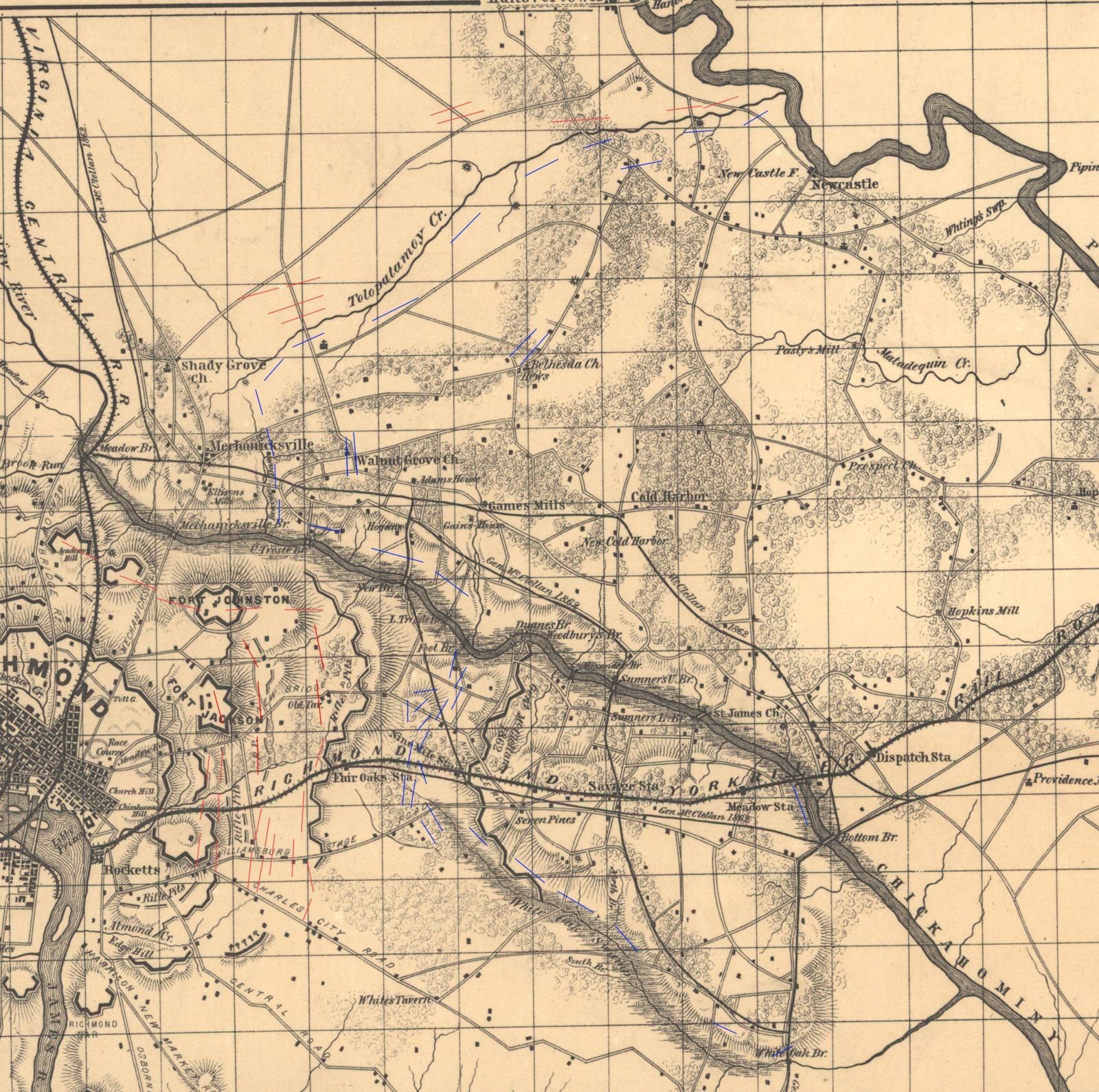
(The line of skirmishing between the two forces is roughly in the former Confederate resistance line.)
McClellan's plan for Burnside's force is as yet unresolved. He is considering using them to open the James by mounting a separate operation against the batteries at City Point (after which point they would advance up the east bank of the James and McClellan's own left wing would be thrown out to meet them) but it may be more prudent to just join them to his existing force to give him numerical superiority where it counts.
Any thoughts on Lee's next course of action in this situation of course appreciated!
At the same time, McClellan made use of his now emplaced artillery both in the north and south sectors on the other bank of the Chickahominy to press forwards and take the high ground in the central sector. This newly gained high ground was heavily reinforced, and beat off an abortive counterattack the following day (the 5th of July) as the troops placed there dug in with embrasured works and parallels - this newly gained ground was about two and a half miles from the main Confederate line of permanent forts, and would render some of the Confederate forward rifle pits untenable.
It is at about this date that McClellan wrote what has been called the Nine Mile Letter, written from his forward HQ at Nine Mile station. This letter provided advice of a military and political nature to Lincoln, and was not well recieved by the recipient.
This period is recorded in Lee's diary as one of intense frustration. With his own reinforcements arriving (an extra brigade for now, with four more en route to arrive throughout July) he had the force to do at least something, but while McClellan's careful advance meant he was making slow headway it also meant that there was no obvious target for Lee to actually attack. The next Union advance would necessarily be a dangerous moment for them, but to exploit this would require as great a force as possible - and Jackson had already been down as part of Lee's main army for a week and a half, raising the risk of an unopposed Union advance further south by Pope's army towards the North Anna. With Pope's army estimated at 50,000 men all told this would be a force that could be defeated, but not by Jackson alone - though Jackson could probably prevent the crossing of the Rappahanock, but this would leave Lee unresourced in the event McClellan moved further.
An ominous sign is that Lee has felt it necessary to place a garrison brigade in Fort Jackson.
Current forces:
McClellan (reinforced by nine regiments after the battles collectively known as First? Richmond): 121,000 PFD
20 brigades north of the Chickahominy, total about 58,000 PFD
22 brigades south of the Chickahominy, total about 63,000 PFD
Lee (reinforced by five regiments): 99,000 PFD:
Jackson's force about 19,000 PFD
Defensive forces south of the Chickahominy about 40,000 in Richmond itself, plus 2,000 in Petersburg
Mobile field army (Longstreet etc.) 38,000 - overall stripped to make Richmond's defences stronger
With the exception of AP Hill's force, the whole of the field army is in position to move quickly to help defend Richmond.
McClellan's plan at this point is essentially to make an offensive to capture the Old Tavern area. As a prelude to this he will extend the northern flank of his south-of-the-Chickahominy force west, occupying the river bank, and thus free up two brigades from needing to garrison the river bank. This force will be involved in an echelon attack, starting with his force near the railroad line and moving northwards. The "stop line" in the ideal case is the creeks running east of Forts Jackson and Johnston, though this will likely only be occupied by a skirmish line; the real prize is Old Tavern, within artillery range of the big Confederate forts.
This attack is slated for about the ninth of June, and McClellan has been told Burnside will be sent up to him by the 14th.
McClellan's actual estimate of Confederate force at this point is about 150,000 Present, of which about 20% is Jackson (he's concluded that Beauregard was not present and has overestimated the casualties he's inflicted to be about 30,000). This is a little greater than his own, but not by much at all - his own force is about 145,000 Present - and he feels that a cautious advance will work.
(The line of skirmishing between the two forces is roughly in the former Confederate resistance line.)
McClellan's plan for Burnside's force is as yet unresolved. He is considering using them to open the James by mounting a separate operation against the batteries at City Point (after which point they would advance up the east bank of the James and McClellan's own left wing would be thrown out to meet them) but it may be more prudent to just join them to his existing force to give him numerical superiority where it counts.
Any thoughts on Lee's next course of action in this situation of course appreciated!


 Bringing the