Uniform guidelines

handy.harris

Private
Joined
Jul 23, 2008
Location
Austria
Hello folks!

I did read the uniform guideline of the Clinch Rifles, which I did get from Erich Frazier.
Anyway, there is something confusing me:
Article 6th
Of the uniform
The uniform coat for a private shall be of light green cloth, single breasted, with ten gilt rifle buttons, equi-distance, in front; standing collar of black cloth, to hook and eye in front, and rise no higher than to permit the free turning of the chin, with two loops four and one half inches long, with small uniform buttons at back end of loops, edged all around; plain round cuffs, two and a half inches deep; black cloth slash flaps on the sleeves, four and a half inches long, and two and three eighth inches wide at the point, and two and one eighth wide at the narrowest part of the curve, with two loops and small buttons on the slash flaps of the sleeves; black cloth slash flaps on the skirts, with four loops and four large buttons and two large buttons at the waist; skirt to extend within two and a half inches of the bend of the knee; black cloth turn backs and facings with gold embroidered bugle on the bottom of the skirt. Loops on the collar and flaps to be of United States Army gold lace, half inch wide. The edgings of the collar, slash flaps, turn backs, back skirt edge, front of skirt, skirt strap, and front edge of button hole side of breast to be small gilt cord.
24B.
The uniform coat for Captain and Lieutenants shall be the same as privates, except they shall be double breasted, with two rows of buttons, ten in each row, at equidistance; the distance between the rows four inches at the top and two at the bottom, measuring from the center or eyes of the buttons. The captain to have three loops on slash flap of sleeves, each to have large gold embroidered bugles at bottom of skirts.
The uniform coat for non-commission officers shall be the same as privates, except the sergeants, who shall wear chevrons on the sleeves above the elbows, point up three bars for a sergeant and two for a corporal. The first-sergeant shall be designated by a lozenge under the point of lower bar of chevron.
The uniform pants shall be of dark green cloth, officers and privates the same, open in front, without pockets, made plain, to come well down over the boots, gold machine cord down the outside seam. 29F. Plain white drill pants to be worn from the 30th of April to the 30th of October.
The things for privates shall be a strap and bullion of black, and crescent of light green, non commissioned officers the same except the bullion will be mixed with gold.
The last sentence doesn't make any sense to me. What are they talking about? Does anybody here have a clue?

Kind regards
//Handy
 
Here is a thread on the CR from the AC.........

http://www.authentic-campaigner.com...glethorpe-Infantryman&highlight=Clinch+Rifles

Pg 60 of Time Life's Echoes of Glory: Arms and Equipment of the Confederacy shows the uniform coat and shako of Lt. William Henry Ansley. there are loops on the outside of the shoulder that I would hazard to say are probably for epaullets or russian knots, probably the "things" you are in question of... Hope this helps, sorry its but an educated SWAG.
 
Bullions = Crests and or awards, worn for special occasions.

Not exactly the same as Epaulettes or Shoulderboards, as a rank insignia.

M. E. Wolf
 
Capture.jpg
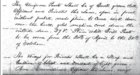
I added a image of part of the document. Looking at the letters, I don't think it actually means 'things'. The 'th' is entirly different from the the others on this page.
Maybe somebody can figure it out this way.

I do think that the Uniform shown on the pictures postet at authentic campainer are from the uniform prior to those guidelines. But I am not sure.
 
Handy.Harris,

I have to agree with Michael_Schaffner--it is too open to be 'th' and it has a classic lead in stroke of a "W."

Respectfully submitted for consideration,
M. E. Wolf
 
The Clinch Rifles were formed in Augusta, Ga., in 1852, being named after General Duncan L. Clinch who served in the Seminole Wars. In 1861 the unit became Company A of the 5th Georgia Infantry.
The uniform was described by the unit commander to the governor of Georgia as follows: "Our Dress uniform is a dress coat of dark green broad cloth, with gilt rifle buttons, and trimmed with gold lace and cord on the outside seams; cap of dark green with letters 'C.R.' surrounded with a gold wreath, light green pompon; wings of brass, army style. Our fatigue dress consists of a dark green cloth jacket, trimmed with gold lace, green cap and black pants."

Wings of Brass refer to the shoulder scales worn on full dress parade during the time.There is a possibilty that in their orginal reg's the Clinch Rifles were provided different scales for private soldiers, NCO's and Officers much as the US Army was.

Link to a Troiani painting of a Clinch Rifle Private the scales would go where the "stripe" on each shoulder is.

http://delawarerivergallery.com/artists/troiani/order_troiani_clinchrifles.htm

Common Brass Shoulder Scales "wings" US Army ACW

http://www.civilwarantiqueshop.com/ui4.htm

Common Officer Shoulder Scale (repro)

http://milkcreek.com/shop/index.php?main_page=popup_image&pID=1775

Other examples of Civil War era shoulder scales:

http://www.horsesoldier.com/catalog/558-373a.JPEG

http://www.horsesoldier.com/catalog/558-277b.JPEG

The style and color could vary especially in early war state units.
 
There's a thread on this site that deals with the 1862-63 diary of one of the privates of Co A. He was from Augusta and I think his name was McKay. We came to the conclusion that one of the men seated in an early photo was him. He had a small diary in his hand and a desk-like thing on his knees. [His name was actually McCoy.]
 
TerryB,

The 'desk like thing' in his lap is a writing slope aka writing box. It opened up when on a desk exposing a slanted writing surface and on the lap, the box raised the paper and writing instrument to a more comfortable surface, than on the actual legs/thighs of a human, as you have to hunch.

On the desk or table, it opened up and under the writing portion, storage for stationary items, some having drawers had places for extra nibs, tape, package powder ink, stamps, sealing wax, sealing wafers, and other items. Inkwells would be screw lid. Ponce Sanders, looked like pepper/salt shakers but the top was concave as to accept the unused portion of the absorbing material back into the bottle. This was used before blotting paper took hold. Though not terribly leak proof the box was not meant to be in any position but flat but, tight enough not to spill ink if jostled. Portable inkwells had spring loaded lids to keep the seal tight. Older writing slopes had room for goose quills. Majority of traveling writing slopes had keys to keep things private, when temporarily away from the open slope--some are two keys and some one key slopes. Some even had no keys at all.

But, all have in common a 3 inch sloped angle to write on. (Old school desks like the 1950's, 60's...yes I am aging myself LOL).

Came in different styles, one being a miniature of a school desk, lift up lid on the top.

Precursor to the computer lap top :)

I have a few myself and are dandy boxes to have. And, if you have arthritis or a bad shoulder, it is an amazing relief and in the days of using goose quills, the gravity feed depended on the 30% angle as not to create a blob of ink when writing. And, when writing a lot--these slopes made it comfortable to do hours of writing. It throws you back instead of hunching over your work, making back muscles tired from holding you up. My oldest slope is 1810 circa. Still sound despite wood shrinkage and splits. Lock still works as well.

Respectfully submitted,
M. E. Wolf
 
Thanks, M.E. I really can't believe what an amazing coincidence that the man with the diary really matches up well with McCoy.
 

Learn About Us
About CivilWarTalk
Contact the Webmaster
Meet the Staff
Link to CivilWarTalk
Join Our Community
Register
Browse Forums
View Today's Discussions
Search the Forum
Get Help
FAQ
Student Guide
Forum Rules & Etiquette
Copyright / DMCA

     Contact Us CivilwarTalk on Facebook CivilWarTalk on YouTube CivilWarTalk on Twitter RSS Feed

Bringing the American Civil War and More to Life.
© 1999 - , CIVILWARTALK, LLC - Site Version 10.0

SlaveryTalk.com - SecessionTalk.com - CivilWarTalk.com - ReconstructionTalk.com
Back
Top