Don Dixon
Sergeant
- Joined
- Oct 24, 2008
- Location
- Fairfax, VA, USA
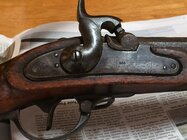
Not disagreeing, as that's certainly part of the difference I believe lies behind the use of the term "Type", but my understanding of the Pattern variations was that the differences are based based on standardization in manufacturing that began in 1862 which also included a slightly different lockplate that more closely resembled the Enfield, but only very slightly.
The Type I (or more precisely, the 1854 pattern model) was heavily based on the P53 Enfield and had short, medium and long range sights. Manufacturing standardization not only improved the weapon and the problems with the contract models, but it hybridized the new Pattern. The 1862 pattern is a hybrid of the P53 Enfield AND the M1861 Springfield. It also had a marginally thicker barrel to accommodate the .58 mini ball.
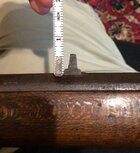
With that said, I guess I'm probably quibbling to say collectors IMO are actually mis-using the term "Type" when they should actually be referring to "Pattern" as normally done when we discuss Enfield. Clearly the term "Type" has been in use for a long time, but how/why did we stop using "Pattern" in our description and start saying Type? Was it just easier to ignore the differences and use "Type" solely to differentiate between a model with adjustable sights and one without while ignoring the manufacturing differences? If we only look at the sights, we could potentially be referring to either pattern or type as noted in my previous post.
I know, it's "in the weeds" and who actually cares, but isn't this the right forum to get into the minutia of these kinds of things?
Since I'm afraid that you got it all wrong, its not "in the weeds."
Based upon his experiments with earlier weapons systems, Werkfuhrer Josef Lorenz proposed a new barrel design with four lands and grooves with a right hand twist, and a caliber of 6 Linie 4 Punkte [.547 inches/13.9 mm]. The design provided good long range accuracy, and the reduction in caliber not only saved on gun powder and lead, it also increased the number of cartridges a soldier could carry without increasing the weight he had to carry. On 19 December 1853 Emperor Franz Joseph directed the establishment of a special test commission [Gewehrversuchskommission] chaired by Field Marshall Archduke Wilhelm Franz Karl of Austria-Teschen to test rifles modified using Lorenz's concepts. Lorenz was appointed as one of the members of the commission.
The commission reported the results of the tests to the k.k. Army on 3 August 1854. Lorenz's compression bullets had worked very well in the test weapons, and the commission believed that the results would have been even more favorable had the test used arms specifically designed by Lorenz for the compression bullet. The commission recommended that Lorenz's compression bullet be adopted. It proposed that a Dornstutzen be issued to the NCOs and third rank men in Jäger battalions, and that a Jägerstutzen without the Dorn [Tige] be issued to the men in the first two ranks in Jäger battalions. The commission proposed a "small" caliber weapon for line and Grenz [Border] infantry units, but disagreed about whether all of the new infantry weapons should be rifled. The commission's minutes of 15 July 1854 indicate that there had been major disagreement over whether to arm all infantry personnel with rifled arms, or just the third rank men and the Grenzers. Field Marshall General Stephan Freiherr von Wernhardt, who had been the k.k. Army's weapons inspector since 1850, wanted to adopt rifled arms as the standard weapon for all infantry personnel. On 5 August the Emperor directed that the first two ranks of line and Grenz infantry be equipped with smoothbore weapons and the NCOs and third rank men be equipped with rifled arms, and approved the proposal for arming the Jägers with Dornstutzen and Jägerstutzen. Emphasizing his desire that k.k. Army be rearmed expeditiously, the Emperor approved the expenditure of 2.5 million Gulden for the purpose on 10 September 1854; 650,000 Gulden more than had been asked for.
In a 27 August 1854 letter to the Emperor's senior military staff, von Wernhardt objected to Emperor's decision to arm the first two ranks with smoothbore muskets. First, the Army needed a unitary weapons system in which all troops would be issued the same ammunition. He pointed out that some authorities believed that issuing all infantrymen rifled arms would result in them shooting prematurely at long range and wasting ammunition with no effect. He responded to this criticism with the observation that if there was premature firing, it was the fault of the officers, not the infantrymen. Officers were supposed to command their troops, whether the troops had smoothbore or rifled arms. Smoothbore weapons gave the infantryman only a moderately effective combat capability of 150 Schritt [123 yards/112 meters]; a distance to which a man could almost throw a rock. For a soldier to know that other men in the army had more capable weapons but he had not been entrusted with one would affect his confidence.
Von Wernhardt's letter was effective, and on 19 January 1855 the Emperor appointed another commission to hear the arguments both for and against arming the entire k.k. Army infantry with rifled arms. Von Wernhardt, who belonged to the commission, persuaded the other commissioners to call for the entire Army to be armed with rifled arms. The thought that troops would open fire prematurely remained a concern, and the commission compromised by proposing that the first two ranks of line and Grenz infantry be armed with rifled weapons with fixed or "common" sights, while the NCOs and third rank men were armed with rifles with adjustable long range sights. The Emperor approved this recommendation on 12 February 1855.
Hence the enblock rear sight on the Muster 1854 infantry rifle, which was used to equip roughly 2/3s of the infantry, is the "Type I" sight, and the flip-up long range rear sight, which was used to equip the NCOs and the third rank infantry, is the "Type II" rear sight. The term "Muster" in Germanic armies corresponds to "Model" in the U.S. Army, or "Pattern" in the British Army. Consequently Type I and II rifles are not different patterns, they are simply two different variations of the Muster 1854 rifle based on their different rear sights. The Muster 1862 family of arms were product inproved versions of the Muster 1854 family, just as the M14 rifle was a product improved M1 rifle. Among the improvements that were made, all Muster 1862 rifles had long range rear sights. Neither the Muster 1854 or the Muster 1862 were based upon the Pattern 1853 Enfield in any way; although there is a similarity in appearance of the lockplates on the Muster 1862 rifle and the Pattern 1853 Enfield rifle musket. Both the Muster 1854 and 1862 rifles used .547 inch cartridges, not .58 caliber cartridges, in k.k. Army service. Some were manufactured in .58, or bored out and re-rifled to .577/.58, but those were done for Federal Army contracts, not for k.k. Army service.
I hope this short discussion makes the differences clear.
Regards,
Don Dixon
Last edited:



 Bringing the