Tracking down a mystery ship

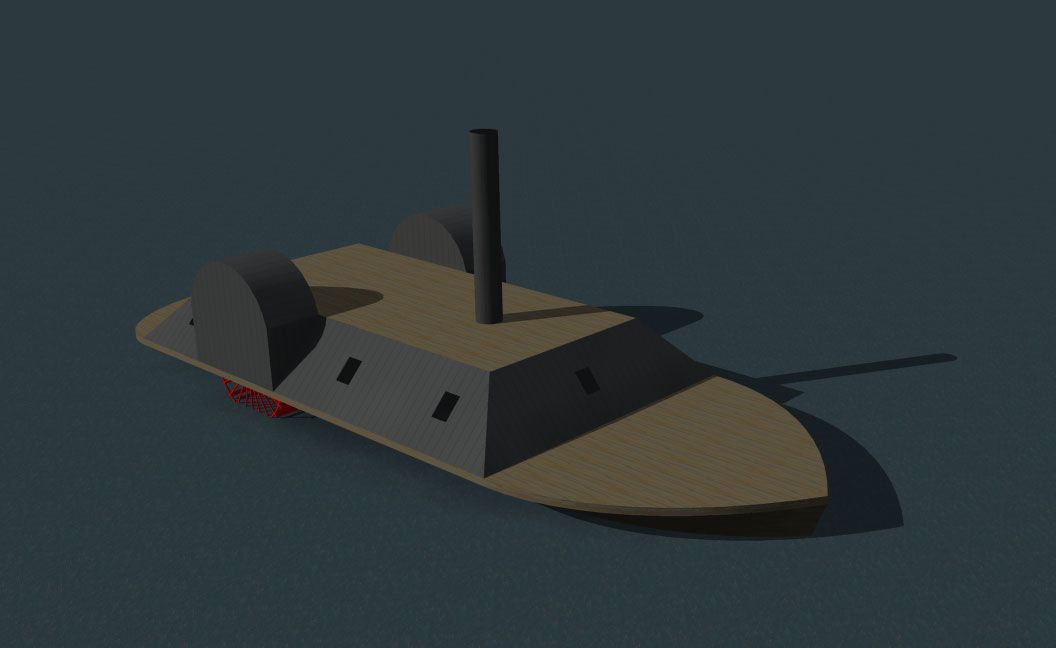
Guys, don't laugh, please. Here is my Stevens rendering. The model "bulit" in SketchUp is based on the sketch posted by John.

CSS_Stevens_JWW.jpg
 
Hart was turned over to the C.S. Navy and named after the recently deceased Lt. Henry "Hal" K. Stevens of S. Carolina who was killed aboard the Army gunboat Cotton during an engagement. Conversion of the "Stevens" began right after the loss of the Cotton and seems to have taken more time than expected. I've never seen a drawing of the Hart, and always imagined her as partially ironed like the Cotton. She was never finished and sunk as an obstruction. Apparently this was done carefully, as their was a report in the ORN's that the Union Navy broke up an attempt by the Confederates to raise her. She had a much smaller displacement versus the Cotton and it is difficult to imagine her with a fully ironed casemate.
 
Guys,

Forgive an old 'groundpounder's' ignorance in almost all things naval, but would the Stevens be classified as a 'timberclad?'

In other words, was she protected by any armor at all or was she simply encased in a protective wood casings?

Sincerely,
Unionblue
 
Forgive an old 'groundpounder's' ignorance in almost all things naval, but would the Stevens be classified as a 'timberclad?'

You could call it that. The term "timberclad" is not an 1860s one, but rather a back-formation, based on the terms "ironclad," "cotton-clad," and "tinclad," which were in use then. In general, a gunboat not protected by much more than her own structure and maybe some added timber was usually just called a gunboat. (Incidentally, not all of the "tinclads" were in fact protected by metal armor; it was just something of a derogatory nickname referring to their low level of protection compared to the ironclads.)
 
You could call it that. The term "timberclad" is not an 1860s one, but rather a back-formation, based on the terms "ironclad," "cotton-clad," and "tinclad," which were in use then. In general, a gunboat not protected by much more than her own structure and maybe some added timber was usually just called a gunboat. (Incidentally, not all of the "tinclads" were in fact protected by metal armor; it was just something of a derogatory nickname referring to their low level of protection compared to the ironclads.)

Thanks, Mark.

And FYI, I saw the term 'timberclad' in a Syfy/Alternate History book. :)

Sincerely,
Unionblue
 
Oh, it's commonly used, and Myron J. Smith, Jr. uses it in the title of his terrific book about the three most famous of them (Lexington, Tyler, Conestoga): The Timberclads in the Civil War (McFarland, 2008). It's just not a 'period' term. (Sort of like calling the Pook turtles "City Class" boats; that term seems to have been coined by Ed Bearss.)
 
Well here is a small version, redrawn from a sketch by the late Ben Shuman.
View attachment 13046
I think its a safe guess that the ironing for this boat would have been railway iron, possibly a mix of strap iron (1 inch?) with reversed T-rail forward. Due to a shortage of heavy artillery I speculate she would have pivoted bow and stern chasers and possibly two broadside guns. If Lt. Roy worked on her armament, she might have had a single broadside gun on a pivot and a long carriage to allow a center mount gun to fight either side. I believe Roy did something similar on the Missouri. Hart was a small boat and her ability to carry ironing was limited. I've never seen any documentation that the Hart/Stevens carried her chasers within a casemate. They may have been exposed pivots like the J.F. Cotten with the ironing concentrated on protecting her machinery.
 
I think its a safe guess that the ironing for this boat would have been railway iron, possibly a mix of strap iron (1 inch?) with reversed T-rail forward. Due to a shortage of heavy artillery I speculate she would have pivoted bow and stern chasers and possibly two broadside guns. If Lt. Roy worked on her armament, she might have had a single broadside gun on a pivot and a long carriage to allow a center mount gun to fight either side. I believe Roy did something similar on the Missouri. Hart was a small boat and her ability to carry ironing was limited. I've never seen any documentation that the Hart/Stevens carried her chasers within a casemate. They may have been exposed pivots like the J.F. Cotten with the ironing concentrated on protecting her machinery.
Thanks Georgew, I feel another version coming up !
 
She had four guns reportedly, so two in the casemate and two outside?
Hi Rebel! I think we have to be careful about using the term casemate on converted river steamers. They tended to have their boilers forward with the fireboxes forward to improve their draft. There is a question whether they had the tackle and time to drop Hart's boilers into the hull, plus the obvious modifications to the steam and water runs. If they did drop the boilers, then a forward timber and ironed "casemate" is possible. The sketches by Union engineers of the remains of the scuttled Cotten clearly show three gun rings on the foredeck and what appears to be horizontal runs of strap iron running fore and aft along the sides of the "casemate" to approximately the side-wheels. I suspect the intention was to do something similar to the Hart. If they left the boilers in their original positions on deck then timber and ironing of the area would make sense. In the narrow tributary rivers and bayous there proved to be limited points where a vessel could be turned easily and they had frequently fought their bow ordnance as the vessel backed up river. So once again, a priority for protection of the machinery forward. The Confederate attempt to raise the Hart/Stevens leads to the conclusion that she had been very carefully scuttled and primary damage was to the upper works. Once again, it would be useful to know if her boilers had been dropped.
 

Learn About Us
►About CivilWarTalk
►Contact the Webmaster
►Meet the Staff
►Link to CivilWarTalk
Join Our Community
►Register
►Browse Forums
►View Today's Discussions
►Search the Forum
Get Help
►FAQ
►Student Guide
►Forum Rules & Etiquette
►Copyright / DMCA

     Contact Us CivilwarTalk on Facebook CivilWarTalk on YouTube CivilWarTalk on Twitter RSS Feed

Bringing the American Civil War and More to Life.
© 1999 - , CIVILWARTALK, LLC - Site Version 10.0

SlaveryTalk.com - SecessionTalk.com - CivilWarTalk.com - ReconstructionTalk.com
Back
Top