
- Joined
- Mar 31, 2012
- Location
- Central Ohio
Now, this isn't the first time I've been confronted with the possibility of the existence of another ironclad, outside of the ones I've heard of... but it hasn't happened recently (and by that, I mean in at least a couple of decades).
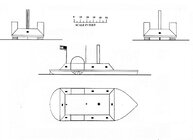
I'm reading Donald S. Frazier's Thunder Across the Swamp: The Fight for the Lower Mississippi, February 1863 - May 1863 (good read but almost too detailed) and I've run into several references to an "ironclad" called CSS Stevens. Specifically, this is called a vessel that was never finished, so on the surface it's not surprising that it's not widely known... but I've just never seen a reference to it anywhere before, so I'm confounded.
There is precisely one reference in the Official Records, Navies to what must be the same vessel, but it's not particularly enlightening. In Series I, Volume 20, pp. 822-825, there are reproduced excerpts from a report of CSA Major General Richard Taylor of 23 April 1863, wherein he states:
" * * * I was compelled to order the destruction of the gunboat Stevens, below New Iberia; she was in [the] charge of the Navy Department, and under command of Lieutenant Humphreys, C.S. Navy [presumably Lt. Joshua Humphreys, CSN --MFJ]. That officer reporting to me that she was in an unfinished condition and unfit for action with the enemy, there being no means of getting her out of reach of the enemy, I ordered her to be sunk as low down the bayou as possible, so that she would afford an obstruction to the enemy's boats ascending. This order was not carried out as given by me, but she was sunk about 2 miles below New Iberia, when she might have been sunk 5 or 6 miles lower."
The fullest description given by Frazier, on page 98 of Thunder Across the Swamp:
". . . Two miles below New Iberia at the Olivier plantation, Orange Grove, crews worked steadily to transform the cottonclad gunboat Hart into the ironclad CSS Stevens, named for Lieutenant Henry Kennedy Stevens, the former executive officer of the CSS Arkansas who had been killed on board the [gunboat J. A.] Cotton in January. When finished, Stevens would be a dangerous boat, boasting 32-pounders fore and aft, and a 24-pounder in each broadside, all protected by three-inch railroad iron. She would probably equal anything else afloat in Berwick Bay."
Unfortunately, Frazier's citation for the paragraph gives no clue as to the source of this information, being concerned with sourcing a list of boats earlier in the paragraph.
The only Hart I can find was a transport, listed in Paul H. Silverstone's Civil War Navies, 1855-1883: "Hart: Name may have been Ed R. Hart. Transport in Bayou Teche amd Berwick Bay, 1862-63. Sunk to avoid capture at Bayou Teche, 14 Apr 1863." (p. 174) She is not indicated to have carried armament. Her destruction is mentioned several times in ORN I:20, with General Banks apparently claiming credit for her destruction (he doesn't say so explicitly, but the way he puts it seems to claim credit), but nowhere is she called a gunboat... except on ibid., p. 380, where US Acting Volunteer Lieutenant Frederick Crocker reported on 28 July 1863 that "Deserters report that the rebel ironclad steamer Hart was nearly raised when the received news of the arrival of our gunboats, upon which it was immediately sunk again and now lies under water."
Way's Packet Directory mentions that the Ed R. Hart entered Confederate service, but says no more about it. (There are two other Harts, a Kate Hart and a John W. Hart, but the Kate was built a year after these events and the John W. was a late-19th century construction.)
So, I'm left puzzled. Any suggestions as to leads?
I'm reading Donald S. Frazier's Thunder Across the Swamp: The Fight for the Lower Mississippi, February 1863 - May 1863 (good read but almost too detailed) and I've run into several references to an "ironclad" called CSS Stevens. Specifically, this is called a vessel that was never finished, so on the surface it's not surprising that it's not widely known... but I've just never seen a reference to it anywhere before, so I'm confounded.
There is precisely one reference in the Official Records, Navies to what must be the same vessel, but it's not particularly enlightening. In Series I, Volume 20, pp. 822-825, there are reproduced excerpts from a report of CSA Major General Richard Taylor of 23 April 1863, wherein he states:
" * * * I was compelled to order the destruction of the gunboat Stevens, below New Iberia; she was in [the] charge of the Navy Department, and under command of Lieutenant Humphreys, C.S. Navy [presumably Lt. Joshua Humphreys, CSN --MFJ]. That officer reporting to me that she was in an unfinished condition and unfit for action with the enemy, there being no means of getting her out of reach of the enemy, I ordered her to be sunk as low down the bayou as possible, so that she would afford an obstruction to the enemy's boats ascending. This order was not carried out as given by me, but she was sunk about 2 miles below New Iberia, when she might have been sunk 5 or 6 miles lower."
The fullest description given by Frazier, on page 98 of Thunder Across the Swamp:
". . . Two miles below New Iberia at the Olivier plantation, Orange Grove, crews worked steadily to transform the cottonclad gunboat Hart into the ironclad CSS Stevens, named for Lieutenant Henry Kennedy Stevens, the former executive officer of the CSS Arkansas who had been killed on board the [gunboat J. A.] Cotton in January. When finished, Stevens would be a dangerous boat, boasting 32-pounders fore and aft, and a 24-pounder in each broadside, all protected by three-inch railroad iron. She would probably equal anything else afloat in Berwick Bay."
Unfortunately, Frazier's citation for the paragraph gives no clue as to the source of this information, being concerned with sourcing a list of boats earlier in the paragraph.
The only Hart I can find was a transport, listed in Paul H. Silverstone's Civil War Navies, 1855-1883: "Hart: Name may have been Ed R. Hart. Transport in Bayou Teche amd Berwick Bay, 1862-63. Sunk to avoid capture at Bayou Teche, 14 Apr 1863." (p. 174) She is not indicated to have carried armament. Her destruction is mentioned several times in ORN I:20, with General Banks apparently claiming credit for her destruction (he doesn't say so explicitly, but the way he puts it seems to claim credit), but nowhere is she called a gunboat... except on ibid., p. 380, where US Acting Volunteer Lieutenant Frederick Crocker reported on 28 July 1863 that "Deserters report that the rebel ironclad steamer Hart was nearly raised when the received news of the arrival of our gunboats, upon which it was immediately sunk again and now lies under water."
Way's Packet Directory mentions that the Ed R. Hart entered Confederate service, but says no more about it. (There are two other Harts, a Kate Hart and a John W. Hart, but the Kate was built a year after these events and the John W. was a late-19th century construction.)
So, I'm left puzzled. Any suggestions as to leads?




 Bringing the