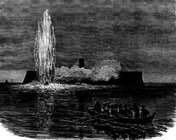
You ain't kiddin'. When the original David attacked New Ironsides in October 1863, the explosion of the torpedo swamped the boat and put out the fires in the furnace. The commander, engineer and fireman decided their best chance of survival was to swim for it and hope to be picked up by the Yankees. (The commander and the fireman were, in fact rescued.) When David didn't sink, the engineer changed his mind, climbed back aboard the boat, and he and the pilot managed to get the thing bailed out, get the fire re-lit, and return to Charleston. The pilot, J. Walker Cannon, had reportedly stayed with the boat because he could not swim.
I just could not image being in one of those things. Talk about confined spaces, I wonder how water worthy those boats were actually. I have to say guts for sure
Yes, the image is at Charleston. The tidal range there is a few feet. Someone local might be able to identify the exact spot, but I'm thinking this is on the eastern side of the old part of the city, where the Cooper River empties into the harbor, maybe down near the Battery. The actual waterfront has been extended since 1865, but it's still marshy along there in places where it's not actively dredged. There's a fair chance that the house in the background, having survived four years of war intact, is still around.
This is that area, Google Earth overlaid with an 1863 Coast Survey chart. Note the extremely shallow water; those soundings are in feet:
All the tidal marsh area was filled in sometime between 1886 and 1911, after the earthquake. The structure is the Mill House for Chisolm's Mill- at 200 Tradd Street. That house doesn't survive. That end of Tradd Street was all owned by the Chisolm family and they had another nicer home at 180 Tradd street that can be seen in the attached image.




 Bringing the