Trial Trip of the Steam Ram Dunderberg.
https://books.google.com/books?jtp=173&id=V141AQAAMAAJ#v=onepage&q&f=false
Scientific American Volume 16, Issue 11, p173.
March 16, 1867
On Friday, Feb. 22d, the iron-clad ram Dunderberg left her dock, foot of 6th street, East River, for a trial trip at sea. Besides the engineers, firemen, and crew, there were about forty persons on board, comprising invited guests, representatives of the press, and the builder of the ship. Mr. Wm. H. Webb; Messrs. John Roach & Son of the Etna Iron Works, constructers of the engines; Erastus W. Smith, A. P. D., the designer of the engines and machinery and superintendent of their construction; officers of the navy detailed to superintend the trial; Mr. Thomas Main, engineer at the Etna Works, together with several sea captains of prominence and experience.
As the ship wound her tortuous course through the East River, propelled by her powerful engines and immense screw, her obedience to her helm was remarked by all on board as particularly satisfactory.
Her dimensions are as follows :—Extreme length, 380 feet 4 inches; extreme beam, 72 feet 10 inches; depth of main hold, 22 feet 7 inches ; height of casemate, 7 feet 9 inches ; length of ram. 50 feet; draft when ready for sea, 21 feet; displacement, 7,000 tuns; tonnage, old measurement, 5,000 tuns.
The doors and frames of the hull are of oak timber accurately hewed and planed together, so that when in position the sides and floor were one solid mass. This was calked inside and outside; the sides were then stiffened with truss work of heavy bars of iron placed diagonally in opposite directions and riveted at the crossings and bolted to the frames. This was then covered with timber ceiling. The floor, outside, is covered with heavy oak planking. The sides at the bilge are covered with two courses of timber, increasing upward, so that at the water line the sides are six feet thick, and at the angle of casemate seven feet thick. The bow of the hull is constructed with special adaptation for use as a ram. The lines are what nautical men call easy or sharp, and the structure is of solid timber and iron for a distance of fifty feet from the ram, the beak of which is six feet below water line and incased in a heavy shield of iron. The "quarters" of the ship are made of peculiar shape, extending aft far over the propeller and rudder, and curving upward, outward, and downward to a considerable distance below the water line, forming a thorough protection to the rudder and propeller. The entire side to a depth of six feet below the water line from the beak of the ram to the angular point of the main deck aft, is protected with hammered wrought-iron plates, varying in thickness from three and a half to four and a half inches, secured by one and a half inch countersunk wood-screw bolts.
The main deck outside the casemate is composed of a tier of heavy beams transverse the ship, overlaid with a course of timber laid solid longitudinally, and the whole covered with bomb-proof plates. The casemate or fort is built of three courses of timber each one foot thick, the casemate deck being of two courses of timber. The sides and ends of the casemate are inclined inward for the purpose of "shedding" the shot fired against it, and plated with armor plates twenty-eight inches wide, four and a half inches thick, extending in one section the entire height of the casemate. The deck is also armor-plated and bomb-proof gratings of wrought iron placed over all the hatchways and openings, including the smoke-pipe hatch. The casement is pierced for twenty guns, but will mount only sixteen guns, four of 15-inch bore and twelve of 11-inch bore.
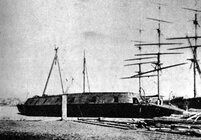
In external appearance, the ship looks like a fort mounted upon a long, low, sharp vessel. She has a "hermaphrodite brig" rig, and while she has a formidable and invulnerable look as a war craft, the rake of her masts and smoke-stack, together with the angular contour of the casemate and shear of the hull, make up a symmetrical and even pleasing appearance. Lying so low in the water, and a large part of her hull being below the surface, she does not present the appearance of magnitude which would be expected. It is only when one walks her decks and views her in all her parts that her immense proportions present themselves to the understanding.
The engines are two in number, of the back-action, horizontal type, with cylinders 100 inches diameter and a stroke of 45 inches. They are placed side by side on the starboard side of the vessel; the crossheads being on the opposite side, connecting with the piston by two piston rods, one above and one below the shaft, the connecting rod vibrating between. Each cylinder is fitted with separate bed frames, affording a gangway in the center, giving convenient access to the cut-off eccentrics and the center shaft journals. The frames are made in two sections, the upper section admitting of removal, and this in combination with a movable chock behind the bottom section of engine-shaft journal bearing, admits of the removal, repair, or renewal of the journal bearings without disconnecting the engine or moving the shaft. This is the first application of this combination. Each cylinder is fitted on top with slide valves in two sections, the division being made for the double purpose of avoiding the irregularities of expansion, inseparable from a valve of great surface, reducing the size to within that which had been found to work well in practice, and inclining the seats on the cylinder, thereby shortening the ports and proportionally reducing the waste of steam therein.
The steam valves are double-ported and fitted with Holmes' improved slide cut-off. The friction of the steam valves upon the cylinder faces is balanced by Waddell's plan, consisting of counter openings communicating both with the steam and vacuum, and packed with brass packing frames.
The steam valve eccentrics are on the outside of either cylinder. The cut-off eccentrics are between them. The engine shaft, cranks and crank pins are of wrought iron made in separate sections fitted and shrunk together. The shaft journals are twenty inches in diameter, the crank pins seventeen inches diameter faced with steel. The large reciprocating connections of the engines are balanced by the cranks, which have a large quadrant-shaped counterbalance opposite the crank pin.
The condenser is tubular, affording 12,000 square feet of condensing surface. The tubes are of solid drawn brass, without seam, and for the protection of the boilers, are tinned inside and outside. The tube heads are packed with seasoned and compressed white pine ferrules, a cheap, simple and efficient method, on the plan of Horatio Allen. The condenser is fitted with two circulating and two air pumps, worked separate and independent of the main engines by means of two steam cylinders having a. diameter of thirty-six inches by thirty-six inches stroke. The steam cylinders and the circulating pumps are on the plan of Henry B. Worthington, and, together with the air pumps, were manufactured under the direction of Mr. Smith, by him. They are located at right angles with the main engines and beneath the condenser and main crossheads, the slides of the latter being supported by the bottom of the former, and the whole sustained by the framework of the independent engines connecting with the framework of the main engines.
The arrangement of independent condenser engines is believed to afford great advantages in making it practicable to run the main engines—disencumbered by the circulating and the air pumps-at a greater number of revolutions, as well as admitting of a more convenient and rapid starting, stopping, or reversing of the main engines, as the condenser can remain continually in effective operation. [The condensing engines were not stopped during the entire trip.] This must materially facilitate the maneuvering of the ship when in action. The arrangement for handling the main engines is very simple, convenient and effective. There are two small direct-acting engines with cylinders fourteen inches diameter and twelve inches stroke, connected at right angles and attached by means of screws to the quadrants connecting with the Stevenson link. A simple handle and rod changes the lead of the small engines to run ahead or back. A small hand wheel and rod controls the valve that admits the steam; the small engines are put in motion and the links of the main engines are soon run to a point where the engines will stop or go ahead or back. [The main engines were repeatedly stopped and reversed in from twenty to thirty seconds]
The line shafting is in sections connected by wrought iron couplings forged on to the shaft, keyed and bolted together. There is near the engines a clutch coupling fitted with fixtures for disconnecting the engines from the propeller or turning the engines by hand. There is in addition, near the stern, a Wilmarth universal coupling of wrought iron with steel faces. This appliance will compensate for any change of line of the shaft bearings arising from changes in the floor of the ship-which takes place to a greater or less extent in every ship-and has in some instances caused serious trouble. This is the first application of this coupling to one of our vessels of war.
The line shaft is fitted with both a collar and a ball thrust bearing, which can be made to take the thrust separately or together. The collar-thrust contains thirteen collars two inches thick.
The propeller is of composition, 21 feet diameter with four blades and 217 to 30 feet pitch. The weight when cast was 34,800 pounds, and is believed to be the largest composition propeller ever cast in this country.
The boilers are eight in number—six large and two small—of the horizontal "return tubular type, with double-tier furnaces, and so connected that either one or all of them can be used upon the engines. The boilers are placed athwart the ship—on either side of the keelson—the fire room between, extending fore and aft the ship for 75 feet. The small boilers are intended for auxiliary use in connection with the pumps and distilling apparatus.
Whole number of furnaces sixty; affording 1250 square feet of grate surface. The total amount of fire surface is 30,000 square feet.
Some idea may be had of the fire room when it is understood that the boilers placed side by side would make a continuous front of 150 feet with two tiers of furnaces, or 300 feet with a single tier. The fire room floor is fitted with a raised trunk of iron upon which the firemen stand when firing the upper tier of furnaces. The sides of this trunk are perforated for the passage of air from the blowers, either to improve the draft or cool the fire room. The fire room is fitted with four large blowers, driven by independent engines. The blowers were not in use during the trial trip.
All the boilers have vent in a single smoke pipe having a diameter of 14 feet, the largest ever made here. The smoke pipe is telescopic and can be raised or lowered at pleasure.
There are, beside the six cylinders embraced in the main engines, six others for driving the blowers, feeding the boilers, working the steam, fire and bilge pumps, supplying the fresh water still, etc.
With these data one can form some idea of the value of this trial trip and of the behavior of the vessel, from the following description of the trip. After leaving the bay the ship was put straight out at sea. There had been, for over forty-eight hours a steady north-cast gale with but little intermission, yet at sea the immense ship obeyed her helm as readily as in the smoothest water. Several times her engines were stopped and she thrown into the trough of the sea, to ascertain her bearings. Although there was considerable sea on, she moved as easily as a yacht, not coming back with a jerk, but gently lifting herself as soon as she found her bearings. It was so also in riding across seas, she moved so gently and easily that at no time did any of the landsmen on board experience any great difficulty in walking her upper deck. During this trial of her qualities as a sea boat, the guns were fired under all the circumstances of her pitching and rolling. Although the crew were not picked and were inexperienced in handling them, the guns were served beautifully; one of the eleven-inch pieces which we timed being served and fired with time shells in less than two minutes between the explosions. The fire of the fifteen-inch guns had no more effect on the ship than they would have had on a fixed structure, the concussion inboard being too slight to be felt. Repeatedly we stood on the spar deck directly over these immense guns the muzzles of which were only seven feet below us and felt no tremor worthy of the name. The gun carriages are furnished with Ericsson's patent compressors. Her speed was tried, although the machinery had been but little worked. She made easily twelve and a half knots with only twenty pounds of steam, the throttle partly open, and her average was over ten knots. The highest number of revolutions of the screw was fifty, but it is believed she will reach sixty when her machinery is seated to its bearings. A very satisfactory test of her management was her obedience to the helm in a sea way. She was put around a circuit, the propeller turning ahead all the time, and made one circuit of one-half mile diameter in twelve minutes, and another of about the same radius in ten minutes and forty seconds, using in this latter case the bow as well as the stern rudder. Capt. Comstock, formerly of the Collins line of Atlantic steamers, expressed the opinion that she could be turned as quickly and easily as any of our Sound or river steamers.
During the trip the consumption of coal was but eighty-one tuns, less than three tuns per hour, and during the most of the time she was blowing off. This shows her tremendous powers for generating steam. Although the top of her smoke stack is but a comparatively short distance above her spar deck, it is from the furnaces sixty feet high. It is a telescopic tube, to be lowered, if deemed advisable, in action or in a gale, but under the latter circumstances it will not probably ever be necessary, as the movement of the ship in a sea is less than that of ordinary steamers.
The Dunderberg is unlike any other vessel we have any account of. The conception and the construction is the work of a master mind, only. The same gentleman has built for foreign Governments three of the fastest and most formidable steam frigates ever constructed here. The
General Admiral for the Russian Government, and the
Re d'Italia and
Re Don Portogallo, both ironclads, for the Italian Government.
On making his contract with the U. S. Government for the Dunderberg, Mr. Webb employed Mr. Erastus W. Smith as his constructing engineer, and entrusted to him the important and responsible work of arranging the plans, preparing the specifications and superintending the construction of the machinery of his great work. Mr. Smith, notwithstanding he had at one time the engineership of one of our largest engine establishments and has had more than twenty years of constant practice in the construction and management of marine engines, with an unselfishness not always met with in the profession, incorporated into the machinery of the
Dunderberg, such as improvements and inventions of other engineers as he thought might add to the general perfection of the machinery, and has desired the publication of their names in connection there with. He also expresses his obligations to chief engineer W.W.W. Wood, of the USN, a gentleman of extensive naval experience and at the time the general inspector of the U. S. ironclads, for aid and co-operation in inducing the adoption of some of the novel features of the machinery, and to Mr. Thomas Main, the engineer of the Etna Works, where the machinery was constructed, for cooperation and assistance in carrying out the details of the work.
The forgings of the engines were made at the Franklin Forge, this city, and the machinery was erected in the ship by Mr. Henry Rodman.
Extracts from the engineer's log show consumption of coal for the 24 hours preceding the termination of the trip to be 143,000 pounds; pressure of steam, 10 to 20 pounds; vacuum, 24 to 26 inches; temperature of the hot well, 70° to 114° ; temperature of circulating water, after passing the condenser tubes, 60° to 94° ; temperature of sea water, 40° to 43° ; temperature on deck, 27° to 38° ; mean temperature of engine room, 60°, oil consumed on the machinery for 24 hours, 45 gallons, while on a similar trial trip of two other vessels in the navy—no larger—the consumption for the same period was in one instance 490 gallons and in the other 209 gallons.
 Forum Host




 Bringing the