Thunder Mountain

The British press reported extensively on the Dunderberg and its faults, thin armor being the foremost among them. The 3.5 inches thought impervious to shot in 1861 was woefully inadequate by 1867, with chilled steel Palliser shot perhaps the greatest current threat. A correspondent to [British magazine] Engineering, Volume 4, p.27 (https://books.google.com/books?id=w40hAQAAMAAJ) calls her "that misbegotten packing case, Dunderberg".
In fact, the Dunderberg was quite fast, and her modest draft made her a potent foe. Her several 15-inch smoothbore guns would have cracked open any European ironclad then afloat, with the more numerous 11-inch Dahlgrens to finish the work. The French Navy replaced the Dahlgren smashers with lighter rifles, foregoing her principal advantage.
The British were whistling through the graveyard a bit from about 1865 to 1870, touting the alleged superiority of their naval rifles and ironclads, and disparaging the American monitors as too slow and with such small freeboard as to have no function beyond coastal defense. The Dictator, Puritan (with 20-inchers), and the Kalamazoo class could have posed a real threat, although still slow. But they too would have been obsolete within a few years, if commissioned. The US lacked a reason to join in the fast evolution of naval arms of the period 1865-1885.
 
The British press reported extensively on the Dunderberg and its faults, thin armor being the foremost among them. The 3.5 inches thought impervious to shot in 1861 was woefully inadequate by 1867, with chilled steel Palliser shot perhaps the greatest current threat. A correspondent to [British magazine] Engineering, Volume 4, p.27 (https://books.google.com/books?id=w40hAQAAMAAJ) calls her "that misbegotten packing case, Dunderberg".
In fact, the Dunderberg was quite fast, and her modest draft made her a potent foe. Her several 15-inch smoothbore guns would have cracked open any European ironclad then afloat, with the more numerous 11-inch Dahlgrens to finish the work. The French Navy replaced the Dahlgren smashers with lighter rifles, foregoing her principal advantage.
The British were whistling through the graveyard a bit from about 1865 to 1870, touting the alleged superiority of their naval rifles and ironclads, and disparaging the American monitors as too slow and with such small freeboard as to have no function beyond coastal defense. The Dictator, Puritan (with 20-inchers), and the Kalamazoo class could have posed a real threat, although still slow. But they too would have been obsolete within a few years, if commissioned. The US lacked a reason to join in the fast evolution of naval arms of the period 1865-1885.
The French Navy made significant alterations to Rochmabeau, but as her sea keeping abilities in the Channel and on the Atlantic coast were dubious, she would have been very suited to the Baltic and to the Mediteranean however. The reason the SBs were changed for the French BLR was simply to bring her into line with the rest of the fleet.
 
The French Navy made significant alterations to Rochmabeau, but as her sea keeping abilities in the Channel and on the Atlantic coast were dubious, she would have been very suited to the Baltic and to the Mediteranean however. The reason the SBs were changed for the French BLR was simply to bring her into line with the rest of the fleet.

Dunderberg and Onondaga were not valued by the French navy, except to deprive the Prussians:
From what I've read of their various rebuildings of her, the French did not like much at all about the Dunderberg/Rochambeau. She was, after all, an expedient wartime coastal design not well-suited for high-seas use. Sea-handling of the ram was impaired by her flat bottom. And I think that I remember some complaint about the "slapping" of her split tail in heavy seas. Her armor was so thin against 15-inch Dahlgrens that she had limited utility to even the USN. The French and British navies had rigid doctrines, and the ram and the dual-turret monitor Onondaga were settled upon the French Navy incidental to keeping them from the Prussians. But the deadly effectiveness of 15-inch smoothbores close-up in coastal encounters was old news by 1866 (from the quick defeat of CSS Atlanta, etc.). The Prussians simply could not be allowed them in a moderately-armored shallow-draft vessel.

Some theorizing:
As to a limited ability to work her guns (and being "wet") in rough water, I wonder if that is more of the "continental" view on where and how decisive naval battles would likely occur. It seems to me that the "national" tactics of Britain assumed a battle in bad sea conditions in or near the Channel, and other nation's warships were praised or damned on that basis. But an American naval descent upon Britain was never a realistic scenario; America lacked the capability to project significant naval power that far.

American battlefleet uses (as in the two prior Anglo-American wars) would likely be defense of her ports, a battle in coastal waters to break up a British blockade, or a battle in Canadian or West Indies waters (springing from efforts to deprive the RN of bases in the western hemisphere). Anything the US Navy and Army would want to threaten would be near home, and Britain had much at risk in that category. The Russian (steam clippers, 1856-60) and American (Isherwood cruisers, 1864-68) naval investment in fast raiders aimed to provide the "force projection" part of war-making, and development of HMS Inconstant and type showed that the RN fully understood the shipping risks there.

The real tribute due the Royal Navy of that era is that Britain persistently funded ongoing technical development that quickly made other fleets obsolescent, right up to 1914.
 
Last edited:
Quite a bit of information, FenianPirate! May I ask, what ship is your avatar? Looks like a relatively deep-draft monitor.
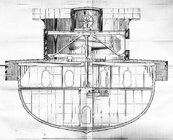
USS Dictator turret.

I think I scanned it from:
Burgh, Nicholas Procter.: Modern marine engineering, illustrated with thirty six correctly drawn plates and two hundred and fifty nine wood-cuts. London, New York, E. & F.N. Spon, 1867..

-- but it may have come from:
Bourne, John.: A treatise on the screw propeller, screw vessels and screw engines, as adapted for purposes of peace and war. London, Longmans, Green, and co., 1867.
 
Dunderberg and Onondaga were not valued by the French navy, except to deprive the Prussians:
From what I've read of their various rebuildings of her, the French did not like much at all about the Dunderberg/Rochambeau. She was, after all, an expedient wartime coastal design not well-suited for high-seas use. Sea-handling of the ram was impaired by her flat bottom. And I think that I remember some complaint about the "slapping" of her split tail in heavy seas. Her armor was so thin against 15-inch Dahlgrens that she had limited utility to even the USN. The French and British navies had rigid doctrines, and the ram and the dual-turret monitor Onondaga were settled upon the French Navy incidental to keeping them from the Prussians. But the deadly effectiveness of 15-inch smoothbores close-up in coastal encounters was old news by 1866 (from the quick defeat of CSS Atlanta, etc.). The Prussians simply could not be allowed them in a moderately-armored shallow-draft vessel.

Some theorizing:
As to a limited ability to work her guns (and being "wet") in rough water, I wonder if that is more of the "continental" view on where and how decisive naval battles would likely occur. It seems to me that the "national" tactics of Britain assumed a battle in bad sea conditions in or near the Channel, and other nation's warships were praised or ****ed on that basis. But an American naval descent upon Britain was never a realistic scenario; America lacked the capability to project significant naval power that far.

American battlefleet uses (as in the two prior Anglo-American wars) would likely be defense of her ports, a battle in coastal waters to break up a British blockade, or a battle in Canadian or West Indies waters (springing from efforts to deprive the RN of bases in the western hemisphere). Anything the US Navy and Army would want to threaten would be near home, and Britain had much at risk in that category. The Russian (steam clippers, 1856-60) and American (Isherwood cruisers, 1864-68) naval investment in fast raiders aimed to provide the "force projection" part of war-making, and development of HMS Inconstant and type showed that the RN fully understood the shipping risks there.

The real tribute due the Royal Navy of that era is that Britain persistently funded ongoing technical development that quickly made other fleets obsolescent, right up to 1914.
You got that right Fenian Pirate ! the Channel, North Sea and French Atlantic coasts can be and often are some of the roughest water in the world. Even the Baltic and Med can get cross !
 
You got that right Fenian Pirate ! the Channel, North Sea and French Atlantic coasts can be and often are some of the roughest water in the world. Even the Baltic and Med can get cross !
This is off-forum but on topic: I found out about Baltic gales in the Clive Cussler's "Sea Hunters" video (Set 2, Volume 2) on the sinking of the Russian monitor Rusalka. I recommend it also for the discussion of how the wreck ended up half-buried and vertical, bow down.
 
USS Dictator turret.

I think I scanned it from:
Burgh, Nicholas Procter.: Modern marine engineering, illustrated with thirty six correctly drawn plates and two hundred and fifty nine wood-cuts. London, New York, E. & F.N. Spon, 1867..

-- but it may have come from:
Bourne, John.: A treatise on the screw propeller, screw vessels and screw engines, as adapted for purposes of peace and war. London, Longmans, Green, and co., 1867.

OK, I just confirmed that the transverse section of the "Dictator" is Plate XVI from Bourne's book, and the turret and ship are thoroughly described on pp. 368-372, starting at:
https://babel.hathitrust.org/cgi/pt?id=uc1.$c12640;view=1up;seq=422

The scanned plate page, folded-up (arrgh!), is found at:
https://babel.hathitrust.org/cgi/pt?id=uc1.$c12640;view=1up;seq=429

-- so I went to the California State Library to piece-scan, and splice together, the complete plate attached.

For anyone who happens upon this thread digression, I also have scans of many of the Bourne plates, including the engines of USS Princeton, USS Monadnock, USS Hassalo, and the Russian ironclad Pervenetz, and Bourne's plan and section of the Civil War shallow draft monitors (the sad failures). Also, I scanned the plates for a number of British naval and merchant screw steamers. Let me know if you want any of these images by opening a conversation.
 

Attachments

  • USS Dictator turret.jpg
    USS Dictator turret.jpg
    5.1 MB · Views: 204
Regarding monitors vs. broadside ironclads, there was a prominent native dissenter to British ironclad policy: the noted steam engineer John Bourne.

"...But Ericsson prefers that only one turret carrying two guns should be employed, as greater power of gun and of armour may thus be obtained than if the number of guns or turrets were increased. The Americans have constructed very few broadside iron-clads, nearly all their armour-covered vessels being of the monitor construction. But besides these they have a large fleet of swift and heavily armed, but unarmoured cruisers, which in the event of war will be able to capture unarmed merchantmen and to run away from iron-clads able to inflict injury without suffering any. I propose that in this mode of procedure we should imitate the Americans, and that any additions now to be made to our navy should be either swift unarmoured rovers or monitors with 18 inch side armour, one 24 inch turret carrying two 20 inch wrought-iron guns, and power sufficient to realize a speed of from sixteen to seventeen knots per hour. It is plain that we should either discard armour altogether, or only employ such as is impenetrable; and it is only on the monitor principle of construction that very thick armour can be introduced. In monitors the area of the armour on any given displacement is made a minimum, and its thickness consequently a maximum; and the guns are similarly concentrated, so that the result is the production of the strongest possible vessel both to penetrate and to resist that on such displacement can be constructed." -- Bourne, John.: A treatise on the screw propeller, screw vessels and screw engines, as adapted for purposes of peace and war. London, Longmans, Green, and co., 1867.
https://catalog.hathitrust.org/Record/001624338

In an appendix to the same book, Bourne provides the entire text of his 1867 presentation to the ICE on this recommendation, as well as the related discussion published in Engineering journal (in which he countered the usual complaints about low-freeboard monitors), and his letter to the London Times.

The text sections are:
pp. 365-372
CHAPTER VII.
SCREW VESSELS FOR PURPOSES OF WAR.

and APPENDIX, pp. cxii-cxvi

"...and that's all I have to say about that!" -- Forrest Gump
 
Regarding monitors vs. broadside ironclads, there was a prominent native dissenter to British ironclad policy: the noted steam engineer John Bourne.

"...But Ericsson prefers that only one turret carrying two guns should be employed, as greater power of gun and of armour may thus be obtained than if the number of guns or turrets were increased. The Americans have constructed very few broadside iron-clads, nearly all their armour-covered vessels being of the monitor construction. But besides these they have a large fleet of swift and heavily armed, but unarmoured cruisers, which in the event of war will be able to capture unarmed merchantmen and to run away from iron-clads able to inflict injury without suffering any. I propose that in this mode of procedure we should imitate the Americans, and that any additions now to be made to our navy should be either swift unarmoured rovers or monitors with 18 inch side armour, one 24 inch turret carrying two 20 inch wrought-iron guns, and power sufficient to realize a speed of from sixteen to seventeen knots per hour. It is plain that we should either discard armour altogether, or only employ such as is impenetrable; and it is only on the monitor principle of construction that very thick armour can be introduced. In monitors the area of the armour on any given displacement is made a minimum, and its thickness consequently a maximum; and the guns are similarly concentrated, so that the result is the production of the strongest possible vessel both to penetrate and to resist that on such displacement can be constructed." -- Bourne, John.: A treatise on the screw propeller, screw vessels and screw engines, as adapted for purposes of peace and war. London, Longmans, Green, and co., 1867.
https://catalog.hathitrust.org/Record/001624338

In an appendix to the same book, Bourne provides the entire text of his 1867 presentation to the ICE on this recommendation, as well as the related discussion published in Engineering journal (in which he countered the usual complaints about low-freeboard monitors), and his letter to the London Times.

The text sections are:
pp. 365-372
CHAPTER VII.
SCREW VESSELS FOR PURPOSES OF WAR.

and APPENDIX, pp. cxii-cxvi

"...and that's all I have to say about that!" -- Forrest Gump
He belonged to the Cowper Coles school of thought- they were both right in many ways, and both wrong in many others, but that is hindsight!.
 
The best general source on the Dunderberg/Rochambeau is probably:
Warship International Magazine - Volume XXX, Number 4 (1993), which devoted both feature articles to this ship:
  • The French Coast Defense Ship Rochambeau, by Stephen S. Roberts - pp333-345
  • "Thunder Mountain" The Ironclad Ram Dunderberg, by William H. Roberts - pp363-400
There are many photos, plans, and construction documents, as well as complementary and comprehensive histories.
It is still available from the publisher for $8.25 (http://www.warship.org/back issues.htm), or currently for twice that on ebay.

Yesterday, I noticed that a description and fabrication plans of the ship's propeller are in:
Elements of machine construction and drawing: or, Machine drawing, with some elements of descriptive and rational cinematics ... / By S. Edward Warren . (1872)

Volume 1 has the text (https://babel.hathitrust.org/cgi/pt?id=miun.ajr6250.0001.001;view=1up;seq=258), and

Volume 2 has Plate XXVIII (scan attached, since it is not available online,
Screw plan - Dunderberg - Warren's 1872.jpg
that I know of)
 

Learn About Us
About CivilWarTalk
Contact the Webmaster
Meet the Staff
Link to CivilWarTalk
Join Our Community
Register
Browse Forums
View Today's Discussions
Search the Forum
Get Help
FAQ
Student Guide
Forum Rules & Etiquette
Copyright / DMCA

     Contact Us CivilwarTalk on Facebook CivilWarTalk on YouTube CivilWarTalk on Twitter RSS Feed

Bringing the American Civil War and More to Life.
© 1999 - , CIVILWARTALK, LLC - Site Version 10.0

SlaveryTalk.com - SecessionTalk.com - CivilWarTalk.com - ReconstructionTalk.com
Back
Top