The Way They Cook Dinner In Camp.

Robert Gray

Sergeant Major
Joined
Jul 24, 2012
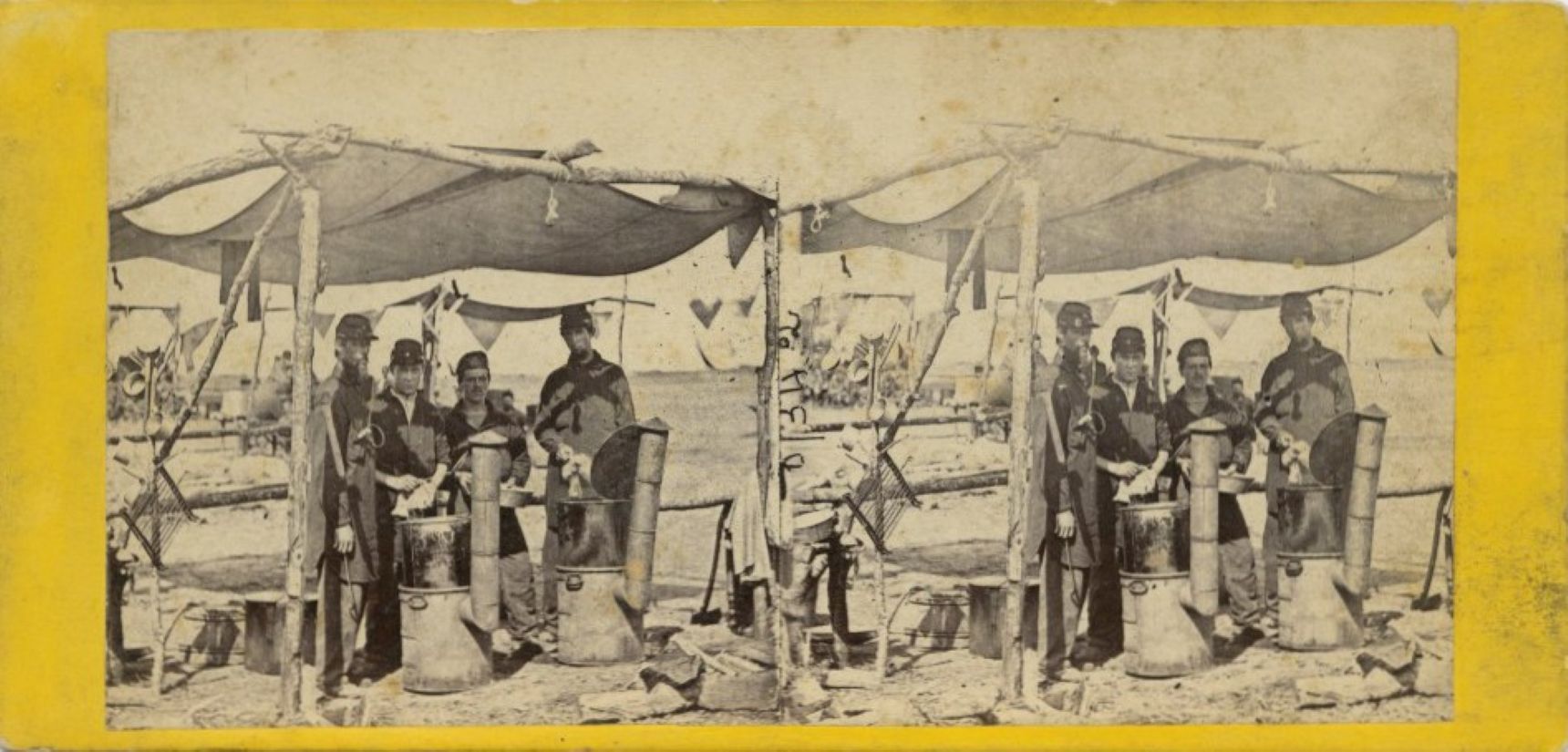
War Views - Army Of The Potomac. Negative No. 2057
The Way They Cook Dinner In Camp.
Jeffrey Kraus Antique Photographics.

Although it doesn't appear in the first stereoview, a duplicate image at the New York Historical Society suggests this soldier group is from the 2nd Rhode Island Infantry. Notice the inscription "2RI" scratched into the emulsion on the upper part of the original negative.
1756093928968.jpeg


1756093987863.jpeg


1756094022900.jpeg
 
I am not sure how that cooking apparatus works. At first I thought it was a double boiler, but that's not it. Perhaps the kettles are stacked upon each other? Still, I don't think a fire could be built in those sheet iron kettles with the stove pipes.

Regardless, it's a great photo.
 
IMG_0103.jpeg

By isolating one half of the steriographic image, details become clearer.


IMG_0104.jpeg

Edited down to the cooking pots, cooks & related details, several things become apparent.

The cooks have long handled spoons & pot holder rags in their hands

The cooking pots have hinged lids & clearly fit the top of the camp stove exactly.

Camera right beneath the camp stove pipe is a ventilation / clean out grate.

Along the sides of both camp stoves are a series of air vents.

Camera right is an axe & split wood. That argues for the devices to be wood stoves.

The cooking pots have clearly been used over an open fire.

The heavy duty handles, vent gills, stove pipe & cap indicate a purpose built camp stove.

Note: Thanks for the image, I had not seen one of these very clever camp stoves before. Oddly enough, I recently purchased a camp stove for our granddaughter & family. It is a vertical burning camp stove that is very efficient. I assume it is similar in design philosophy to these.

A Western Theater side bar is General George Thomas' order creating messes. Rather than issuing rations to individuals, regular cooking arrangements were ordered. This had two desirable effects. An enormous amount of waste was avoided & the rations were properly prepared. Win / win if there ever was one.

The link I have attached is a doozie. I have never seen so many photos & drawings of camp cooking & stoves before. The image that Robert Gray posted in this thread is included.

Link:

 
I suspect the trench fires are for long term camps and the stoves used 'on the march' as they need little time to set up and heat up. main disadvantage - stews only! The ovens are far better.
 
They do look something like immersion heaters. The bottom "kettle" is actually a fire box as evidenced by the stove pipe. The upper kettle could be used to heat water or make stews/soups. On the far left of the picture is a sapling with a grate and several tin cups hanging from it, suggesting that grilling could also be done.
 
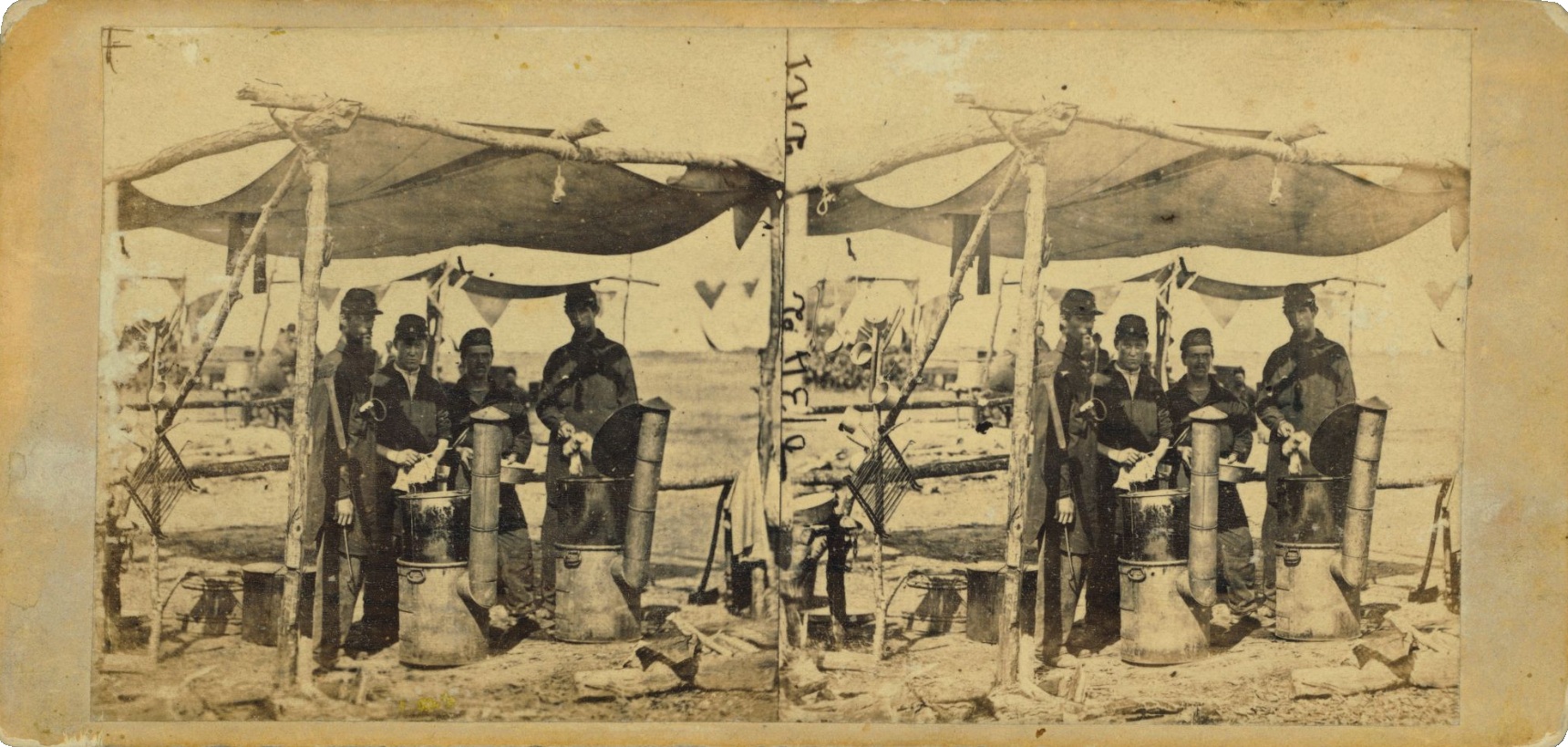
War Views - Army Of The Potomac. Negative No. 2057
The Way They Cook Dinner In Camp.
Jeffrey Kraus Antique Photographics.

Although it doesn't appear in the first stereoview, a duplicate image at the New York Historical Society suggests this soldier group is from the 2nd Rhode Island Infantry. Notice the inscription "2RI" scratched into the emulsion on the upper part of the original negative.
View attachment 558682

View attachment 558683

View attachment 558684
Back in the '80s I made little stoves like that from oil cans from the chinese place I dish dogged at. The were rectangle and much smaller and had round pry open tops that a small frying pan fit into perfectly. I sold them for $20.00. I wish I could have kept one. This photo actually verifies small camp stoves at work on the field.
Thanks for posting this image.
Cheers!
 
View attachment 558709
By isolating one half of the steriographic image, details become clearer.


View attachment 558708
Edited down to the cooking pots, cooks & related details, several things become apparent.

The cooks have long handled spoons & pot holder rags in their hands

The cooking pots have hinged lids & clearly fit the top of the camp stove exactly.

Camera right beneath the camp stove pipe is a ventilation / clean out grate.

Along the sides of both camp stoves are a series of air vents.

Camera right is an axe & split wood. That argues for the devices to be wood stoves.

The cooking pots have clearly been used over an open fire.

The heavy duty handles, vent gills, stove pipe & cap indicate a purpose built camp stove.

Note: Thanks for the image, I had not seen one of these very clever camp stoves before. Oddly enough, I recently purchased a camp stove for our granddaughter & family. It is a vertical burning camp stove that is very efficient. I assume it is similar in design philosophy to these.

A Western Theater side bar is General George Thomas' order creating messes. Rather than issuing rations to individuals, regular cooking arrangements were ordered. This had two desirable effects. An enormous amount of waste was avoided & the rations were properly prepared. Win / win if there ever was one.

The link I have attached is a doozie. I have never seen so many photos & drawings of camp cooking & stoves before. The image that Robert Gray posted in this thread is included.

Link:

The images at the link are great.
 
The images at the link are great.

Indeed. As you know my graphic arts background informs many of my posts. I have never encountered a site about field cookery quite like this one.

One of my favorite living history experiences was at Fort Donelson. They have a few small shelters.

Link:


The "black powder parks" bring their cannon together for programs. A couple of us decided to cook for the battery. I spent three days living & working in the tiny log shelter. It is hard to explain what it is like to have the park to ourselves once the visitors are gone.
 
Indeed. As you know my graphic arts background informs many of my posts. I have never encountered a site about field cookery quite like this one.

One of my favorite living history experiences was at Fort Donelson. They have a few small shelters.

Link:


The "black powder parks" bring their cannon together for programs. A couple of us decided to cook for the battery. I spent three days living & working in the tiny log shelter. It is hard to explain what it is like to have the park to ourselves once the visitors are gone.
Good experience. I haven't made it to Fort Donelson, and my traveling days are nearing an end, so I appreciate even more learning from the experiences of others, such as you.
 

Learn About Us
About CivilWarTalk
Contact the Webmaster
Meet the Staff
Link to CivilWarTalk
Join Our Community
Register
Browse Forums
View Today's Discussions
Search the Forum
Get Help
FAQ
Student Guide
Forum Rules & Etiquette
Copyright / DMCA

     Contact Us CivilwarTalk on Facebook CivilWarTalk on YouTube CivilWarTalk on Twitter RSS Feed

Bringing the American Civil War and More to Life.
© 1999 - , CIVILWARTALK, LLC - Site Version 10.0

SlaveryTalk.com - SecessionTalk.com - CivilWarTalk.com - ReconstructionTalk.com
Back
Top