
 Forum Host
- Joined
- Oct 10, 2012
- Location
- Mt. Jackson, Va
After Lincoln's assassination on April 14, 1865, a three-week series of events was held to mourn the death and memorialize the life of the fallen President. Funeral services, a procession, and a lying in state were held in Washington D.C., then a funeral train transported Lincoln's remains 1,654 miles through seven states for burial in Springfield, Illinois. Never traveling more than 20 mph, the train made several stops in important cities and state capitols for processions, orations, and additional lyings in state. Millions of Americans viewed the train along the route and participated in associated ceremonies.
At 7 a.m. on Friday, April 21, the Lincoln coffin was taken by honor guard to the depot. The train left Washington, at 12:30 pm, carrying Lincoln's eldest son Robert, and the remains of his younger one Willie. Included were Cabinet Secretaries Stanton, Welles, Hugh McCulloch, and John Pamer Usher along with generals Grant and Montgomery Meigs. However, it did not carry his wife Mary who was too overcome with grief to make the journey. The train largely retraced the route Lincoln had traveled to Washington as the newly elected President on his way to his first inauguration back in 1861.
The funeral train had nine cars, including a baggage car, hearse car, and the President's car, built for use by the president and other officials and containing a parlor, sitting room, and sleeping apartment. The President's car was draped in mourning and carried the coffins of Lincoln and his son. New locomotives were substituted at several points.
The Dept. of War designated the route and declared the railroads used as military roads. Only persons authorized by the State Department were allowed to travel on the train, which was limited to 20 miles (32 km) an hour for safety. A pilot train preceded it to ensure the track was clear.
Four men accompanied the train in a logistics capacity: Captain Charles Penrose, as quartermaster and commisary of subsistence, Ward Hill Lamon, Lincoln's longtime bodyguard and friend and U.S. Marshal for the District of Columbia; and Dr. Charles B. Brown and Frank T. Sands, embalmer and undertaker respectively. Governors Morton of Indiana, Brough of Ohio, and Stone of Iowa accompanied the train with their aides.
The train arrived at Springfield on May 3. Lincoln was interred on May 4, at Oak Ridge Cemetery in Springfield. Every town the train passed or stopped in there was always a crowd to pay their respects to one of the greatest men in history. Lincoln's funeral train was the first national commemoration of a president's death by rail.
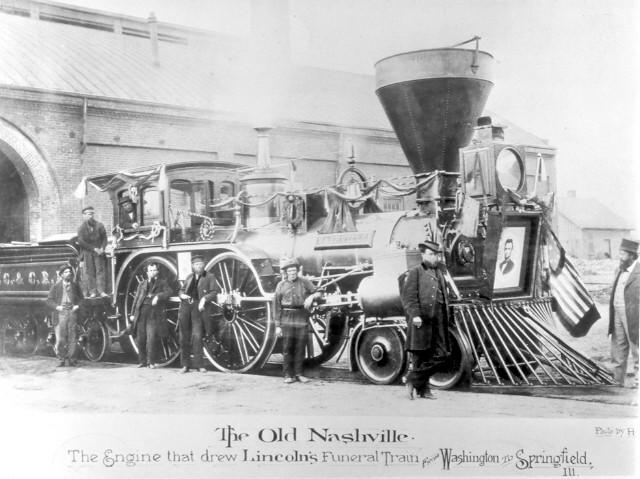
At 7 a.m. on Friday, April 21, the Lincoln coffin was taken by honor guard to the depot. The train left Washington, at 12:30 pm, carrying Lincoln's eldest son Robert, and the remains of his younger one Willie. Included were Cabinet Secretaries Stanton, Welles, Hugh McCulloch, and John Pamer Usher along with generals Grant and Montgomery Meigs. However, it did not carry his wife Mary who was too overcome with grief to make the journey. The train largely retraced the route Lincoln had traveled to Washington as the newly elected President on his way to his first inauguration back in 1861.
The funeral train had nine cars, including a baggage car, hearse car, and the President's car, built for use by the president and other officials and containing a parlor, sitting room, and sleeping apartment. The President's car was draped in mourning and carried the coffins of Lincoln and his son. New locomotives were substituted at several points.
The Dept. of War designated the route and declared the railroads used as military roads. Only persons authorized by the State Department were allowed to travel on the train, which was limited to 20 miles (32 km) an hour for safety. A pilot train preceded it to ensure the track was clear.
Four men accompanied the train in a logistics capacity: Captain Charles Penrose, as quartermaster and commisary of subsistence, Ward Hill Lamon, Lincoln's longtime bodyguard and friend and U.S. Marshal for the District of Columbia; and Dr. Charles B. Brown and Frank T. Sands, embalmer and undertaker respectively. Governors Morton of Indiana, Brough of Ohio, and Stone of Iowa accompanied the train with their aides.
The train arrived at Springfield on May 3. Lincoln was interred on May 4, at Oak Ridge Cemetery in Springfield. Every town the train passed or stopped in there was always a crowd to pay their respects to one of the greatest men in history. Lincoln's funeral train was the first national commemoration of a president's death by rail.


 Bringing the