"But, if we are to believe the author, then Colonel Charles Candy, the brigade commander, named all of his Ohio regiments as animals." -
Rooster Riddle
Source: http://talesfromaop.blogspot.com/2013/12/rooster-riddle.html
A few days ago, I posted a tale from the Battle of Taylor's Ridge (or Ringgold Gap). Colonel William R. Creighton commanded the Union brigade that got savaged there. His brigade included the regiment he once commanded, the 7th Ohio Volunteer Infantry. At Ringgold, no regiment suffered as badly as the 7th. It took 220 officers and men into the fight and it came out with only forty-five.
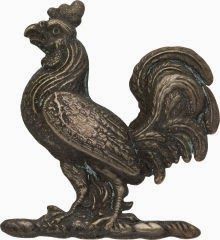
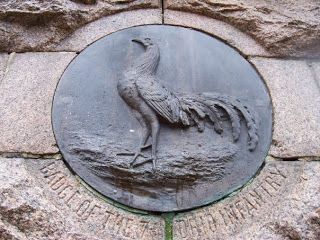
Anyway, most buffs know about the 7th Ohio's nickname. The officers and men called themselves the "Roosters." In fact, before most battles, Colonel Creighton crowed like a rooster. (Apparently, this got his men fired up.) Even more unusual, the officers and men of the 7th Ohio wore rooster pins on their uniforms. These pins are among the rarest of Civil War insignia. It is not exactly clear when the 7th Ohio adopted them, but they certainly predated the Battle of Taylor's Ridge. Photographs of some of the officers who were later killed on November 27, 1863, show them wearing their roosters. Finally, the 7th Ohio's postwar monument at Gettysburg contains a large bronze seal with a rooster in the center.
(Here is a photograph of Col. Creighton--the same one I showed in the previous post. You can see the Rooster pin on his jacket.)
(This image shows Lt. Col. Orrin J. Crane, who, like Creighton, was also killed in action on November 27, 1863. Note the Rooster pin at his third row of buttons.)
(Here is a close-up of Lt. Col. Crane's Rooster badge.)
(This photograph shows an enlisted man from the 7th Ohio. Again, you can see the Rooster pin on this soldier's chest, right above his corps badge.)
(I get kind of thorough when it comes to wielding evidence. Here's yet another example. This enlisted man from the 7th Ohio has a Rooster badge, a corps badge, and his regimental number on his chest.)
(This officer from the 7th Ohio also has a Rooster badge. It is hard to see. It is just above his sword belt's shoulder strap.)
(Here is a close-up of an original Rooster badge.)
(This is the seal on the 7th Ohio's monument at Gettysburg. Again, the rooster features prominently. You can find this monument on Culp's Hill.)
(Here is the front page of the 7th Ohio's unit history. Again, you can see the Rooster badge. Clearly, the rooster meant something to the soldiers of this regiment. Would you believe that the regimental history never says why?)
All right, why a rooster? Is there something I'm not getting? If a story existed behind the nickname, the members of the 7th Ohio never left anything behind for the historians to find. Even Lawrence Wilson's postwar regimental history says nothing about the origins of the nickname. (Wilson was a veteran of the regiment.)
Yet another complicating factor emerges. The 7th Ohio was brigaded with three other Ohio regiments: the 5th, 29th, and 66th Ohio Volunteers. One of these regiments also sported an elusive nickname. The members of the 5th Ohio called themselves the "Owls." Now, I have never found a photograph of a soldier from the 5th Ohio wearing an owl pin, but the 5th Ohio's two monuments at Gettysburg both sport owls. Further, the Ohio brigade monument at Antietam lists the 5th and 7th Ohio regiments side by side on the front plaque. Carved in granite below each plaque are an owl and a rooster.
(Here's the 5th Ohio's monument at Gettysburg. Can you see the owl underneath the knapsacks?)
(The 5th Ohio has a small plaque on a boulder about thirty paces behind the principal monument. Again, there is an owl on it and an enigmatic quote, "Boys, keep the colors up." There is no primary source for this quote.)
UPDATE, 12-2-13: One of my readers shared his knowledge on the origins of the quote. "Boys, keep the colors up" were the last words of Captain George B. Whitcom of Cincinnati, who died during the Battle of Kernstown, March 23, 1862. Four color-bearers had been shot while holding aloft the 5th Ohio's banner, and then Whitcom took the standard, holding it for a time, until he too fell. A bullet struck him just above the eye, killing him instantly. My reader's information led me to an 1886 article in the
Marion Star which discussed the origins of the quote. The article discussed the construction of the 5th Ohio monument, also mentioning the inclusion of the owl. Yet again, it did not discuss the reason for the owl.)
(Finally, here is the Ohio brigade monument at Antietam. It lists the three regiments engaged at the battle: the 5th, 7th, and 66th Ohio. Note the owl at the lower left and the rooster at the lower right.)
Again, I'm baffled. Did one regiment fight better at night and the other better in the morning? Nothing left behind by the veterans of the 5th Ohio indicates the source of their unit's nickname.
Some years after I first became interested in this conundrum, I read a modern-day unit history written by David Thackery entitled,
A Light and Uncertain Hold (1999). This regimental profiled the 66th Ohio, one of the other regiments in the brigade. Thackery briefly mentioned the 7th Ohio's rooster nickname this way. He said, "The two organizations [the 66th and 7th] had fought side by side since Port Republic. ([Colonel Charles] Candy had referred to them in command code as 'bulldog' and 'rooster' respectively.)"
All right, so I had an answer here—well, sort of. The members of the 66th Ohio were the "Bulldogs." The members of the 7th Ohio were the roosters, and their brigade commander concocted the nicknames. Unfortunately, Thackery's footnote did not take me to a source that shed any light on this weird riddle. But, if we are to believe the author, then Colonel Charles Candy, the brigade commander, named all of his Ohio regiments as animals. The 5th and 7th Ohio put their nicknames on their monuments. In addition, the 7th Ohio adopted badges for their uniforms.
But again, I ask, why? Why did Candy choose these particular animals? Why did he insist on using a code to refer to the regiments? When did he design these codes? Why did the 66th Ohio never refer to their nickname, "the bulldogs," on their monuments? What about the final Ohio regiment in the brigade, the 29th Ohio? Did it have a nickname too? If so, why does no one seem to know it? I find myself asking more questions now than ever.

(Here is an image taken sometime during the last week of May 1864. This is all that remains of the 7th Ohio. The regiment came off the front lines after the Battle of New Hope Church. A small contingent--those who had re-enlisted for three additional years--joined the 5th Ohio. This contingent represents those who did not re-enlist. Presumably, this is the regiment's final parade, held somewhere in northwest Georgia. The survivors now awaited a train to take them home to Cleveland. All of these men knew the meaning of the Rooster. I'll bet they are all wearing rooster badges in this photograph. None of them, it seems, left anything behind to let us know what those roosters meant.)




 Bringing the