Smith's Patent Shoulder Straps...

Private Watkins

2nd Lieutenant
Joined
Apr 12, 2014
Location
Oklahoma
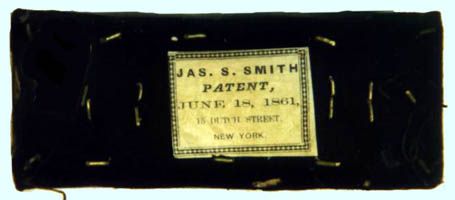
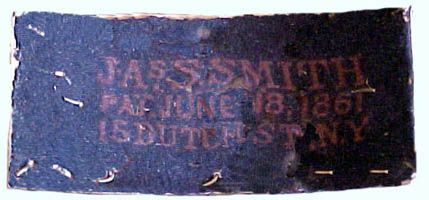
I guess I had always assumed that shoulder straps/boards were made of cloth, embroidered, and sewn onto the officer's coat... so was interested to learn such was not always the case, as shown with the Smith-Patent type shoulder straps:

H1042-L66526568.jpg
H1042-L66526562.jpg


The Smith-Patent straps utilize stamped brass imitation embroidery borders with stamped brass rank device on a cloth field (color depending on branch of service). Since made of metal, but worn on the shoulders, they have a convex plane when viewed from the side, i.e. they are curved to fit the shoulder. They are generally about 4" long x 1 5/8" wide. The gold gilt stamped brass imitation embroidery border is about 3/8" wide.

When viewed from the back, each strap bottom has a dark underlayment material sewn directly to the backing material, and in some cases a label remains. Some of his straps are also marked with stenciled or stamped marking rather than a paper label. Since it might be rather difficult to sew these metal straps on, strings were attached to facilitate attachment to the coat (although such strings were often used with cloth straps as well).

James S. Smith was a military outfitter whose business was located at 15 Dutch Street in New York City. His straps were produced in quantity, and it's not unusual to encounter them today (although beware of post-war production). My presumption is that this type of strap was faster and cheaper to mass produce than the cloth type, Yankee ingenuity at work if you will, and also maybe they held up better in the field.

I'd love to learn more from the experts out there, as well as see any other examples you might have to offer...

Expired Image Removed

M1061A.jpg


ee59cd962a38a755d08a424ff9134f68.jpg


infcaptsmithpat2.jpg


stensmith2.jpg
 
Last edited:
Also they appeared to not hold up as well as the cloth/embroidered versions in the riggers of field use..... we would occasionally excavate broken parts of these...
That makes sense... perhaps these tended to come apart, or if the strings broke one might be out of luck. On the other hand, one probably wouldn't excavate the cloth kind since likely long decomposed...

I would think the cloth kind would be more comfortable, lighter, and in the hot sun perhaps not as hot... as well as perhaps looking nicer, if indeed an officer had any choice or preference in the matter. Perhaps though these were cheaper, and at times all that was available...?
 
The originals that Ive examined were of stamped brass... they had attachment wires on the back to affix to the cloth base... Having worn shoulder straps for a number of years as a reenactor.. they do habitual get bent, twisted, snagged and frayed.. The embroidered ones can get rather beat up after awhile.... These metal ones wouldn't give much... appear to be prone to bend, kink and break... However would be easier to swap to another coat... less need to have multiple sets, one sewn on each coat/jacket/frock.... but cant really see much more advantage beyond that... I would care to guess they might have been less expensive... Many that have survived appear to have been hardly used... maybe for just causes.... don't find them too often still attached to a uniform coat very much...
 
What do you think... are any of these guys wearing Smith-Patent straps (i.e. stamped brass border & rank device) or do they all have on cloth embroidered straps...?

1.
main_900.jpg


2.
8793d5ff4b7fe6fa2cb4c6383b116302.jpg


3.
48%2BPA%2BSchuck%252C%2BBenjamin.jpg


4.
s_c06_0003752a.jpg


5.
article-2104419-11D738AB000005DC-730_634x612.jpg


6.
518px-emerson_opdycke_-_brady-handy.jpg


7.
Expired Image Removed

8.
guyu.jpg


9.
i6b.jpg


What's your vote... which ones might be Smith-Patent, if any?

Would love to see pics that clearly show Smith-Patent straps if anyone knows of any... thanks!
 
No.5 image above is a possibility... the others in my observation do not appear to be those of Smith Patent shoulder straps.... Genuine embroidered straps tend to have a certain light refraction and texture to them that the stamped plates cant really effectively replicate the same in earnest...
 
In the collecting community, Smith's Patent shoulder straps command a premium, which tells me that they are the more rare of the two. Straps just prior and in the first year of the war were wide gaudy things (4-5/8 length by 2" wide with three rows of embroidery), but officers in the field (line officers mostly) went with a very small strap some even went with collar insignia similar to today's rank. The idea of being a prime target for the many sharpshooter companies that the Confederates employed an uncomfortable prospect.

You must also take into account that many officers had field gear and as such would not be wearing their dress coat into battle. Comfort was the name of the game in the field and many officers elected to wear an officer's sack coat. I have a wonderful grouping of John Cromwell, Colonel of the 47th Ill., he was killed at Champion's Hill, wearing his officer's sack coat. His trunk had his dress frock, two pairs of trousers, vest, socks, bible, dress belt and Infantry pom pom from his 1851 shako, as an officer in the Peoria Blues. His dress coat has the larger insignia Smith's Patent and the coat has sewn grommet holes for the ties on the straps. Keep in mind that officer's had to supply their own clothing and as such took liberty and stretched regulations according to what budget allowed.

Schuyler, Hartley & Graham was a huge purveyor of military goods and their reproduced catalog is a wonderful reference as to regulations and available officer's goods. Regulation straps were 4 inches in length by 1-3/8 inches width, with a 1/4 inch width of embroidery. The miniature straps are 3" by 1-1/8" with the same 1/4" embroidery.
 
In the collecting community, Smith's Patent shoulder straps command a premium, which tells me that they are the more rare of the two. Straps just prior and in the first year of the war were wide gaudy things (4-5/8 length by 2" wide with three rows of embroidery), but officers in the field (line officers mostly) went with a very small strap some even went with collar insignia similar to today's rank. The idea of being a prime target for the many sharpshooter companies that the Confederates employed an uncomfortable prospect.

You must also take into account that many officers had field gear and as such would not be wearing their dress coat into battle. Comfort was the name of the game in the field and many officers elected to wear an officer's sack coat. I have a wonderful grouping of John Cromwell, Colonel of the 47th Ill., he was killed at Champion's Hill, wearing his officer's sack coat. His trunk had his dress frock, two pairs of trousers, vest, socks, bible, dress belt and Infantry pom pom from his 1851 shako, as an officer in the Peoria Blues. His dress coat has the larger insignia Smith's Patent and the coat has sewn grommet holes for the ties on the straps. Keep in mind that officer's had to supply their own clothing and as such took liberty and stretched regulations according to what budget allowed.

Schuyler, Hartley & Graham was a huge purveyor of military goods and their reproduced catalog is a wonderful reference as to regulations and available officer's goods. Regulation straps were 4 inches in length by 1-3/8 inches width, with a 1/4 inch width of embroidery. The miniature straps are 3" by 1-1/8" with the same 1/4" embroidery.
That's super info... thank you very much!! Sometime you'll have to post pics of the Cromwell grouping for us to see... sounds fantastic, and very interesting to understand what all he had, what was packed, what was worn, etc.
 
I have a few sets (Staff Major, and a Cav. 2nd Lt.). As someone stated above, they generally command a premium today. I've always heard the opposite in that they were more expensive and stylish for officers to purchase. Probably used more for dress than daily use I'd imagine.
 

Learn About Us
About CivilWarTalk
Contact the Webmaster
Meet the Staff
Link to CivilWarTalk
Join Our Community
Register
Browse Forums
View Today's Discussions
Search the Forum
Get Help
FAQ
Student Guide
Forum Rules & Etiquette
Copyright / DMCA

     Contact Us CivilwarTalk on Facebook CivilWarTalk on YouTube CivilWarTalk on Twitter RSS Feed

Bringing the American Civil War and More to Life.
© 1999 - , CIVILWARTALK, LLC - Site Version 10.0

SlaveryTalk.com - SecessionTalk.com - CivilWarTalk.com - ReconstructionTalk.com
Back
Top