Seeking Information on a Photo

R. Porter

Sergeant Major
Joined
Oct 6, 2020
I know nothing about old photos. I don't know the types, when or how they were made. I also can't tell anything from the clothing worn by the subjects. I would like to find out whatever I can about a photo I picked up the other day for about $30.00. I thought it might be a good photo to start learning on. Some questions I have are:

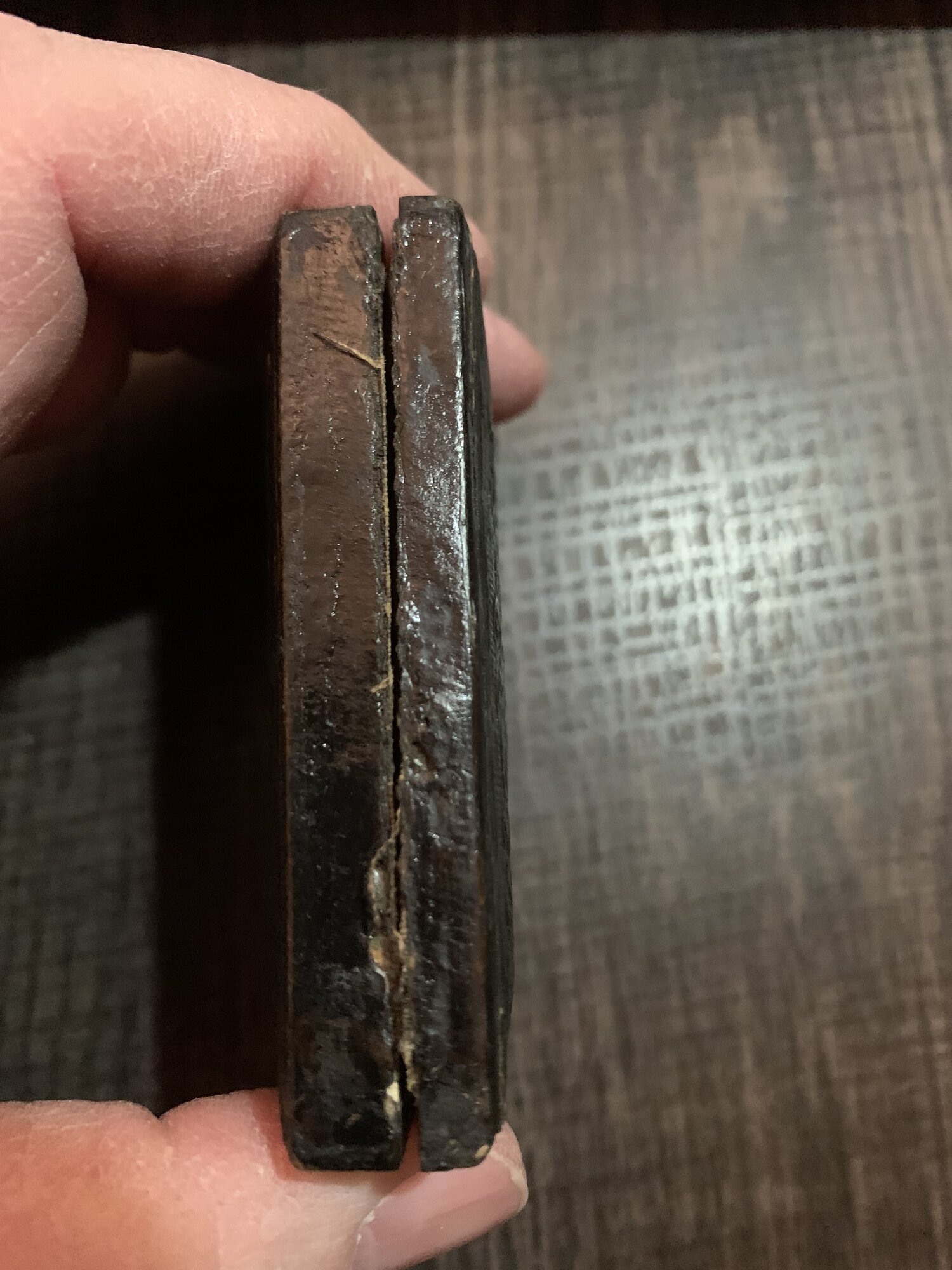
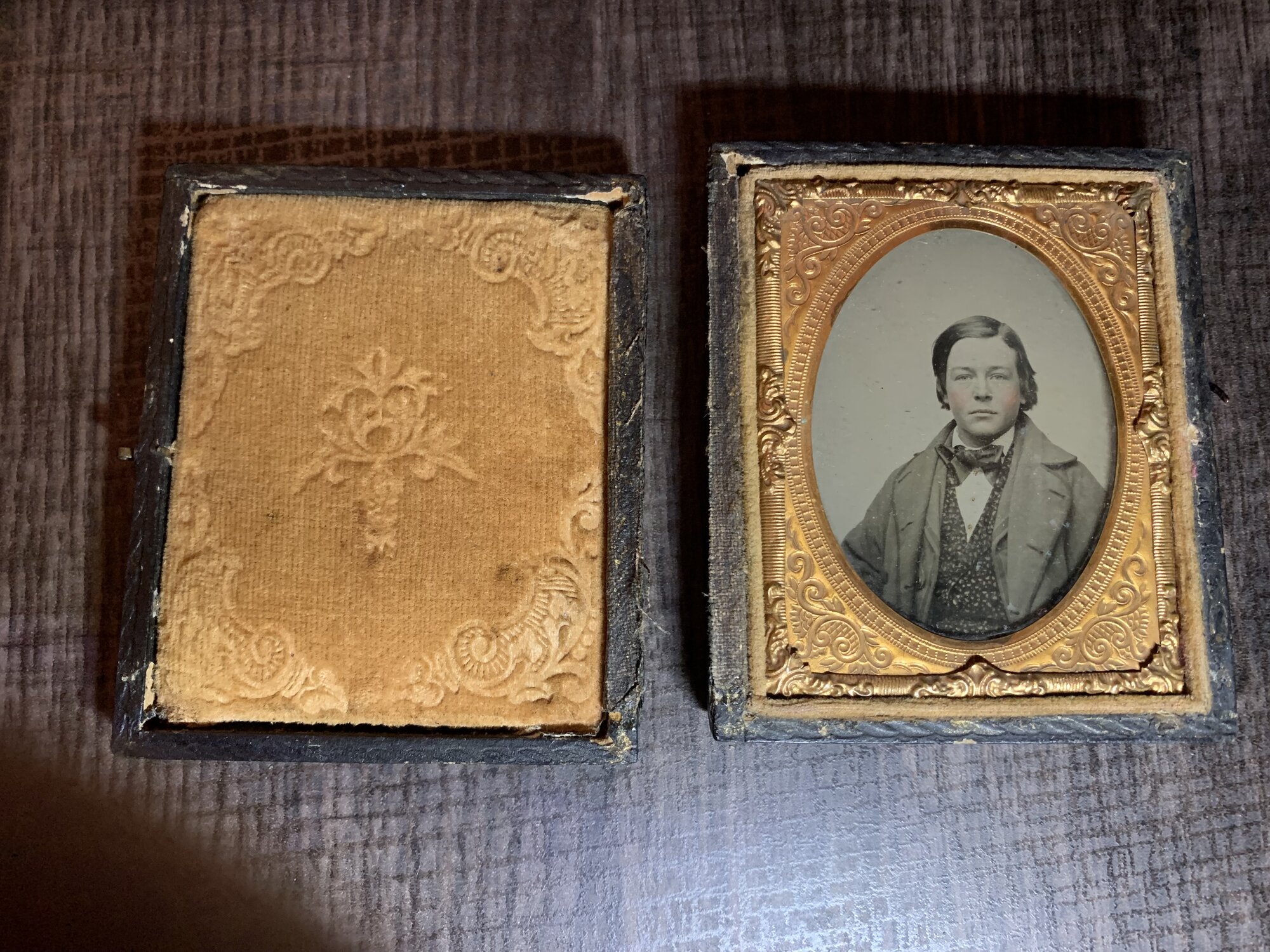
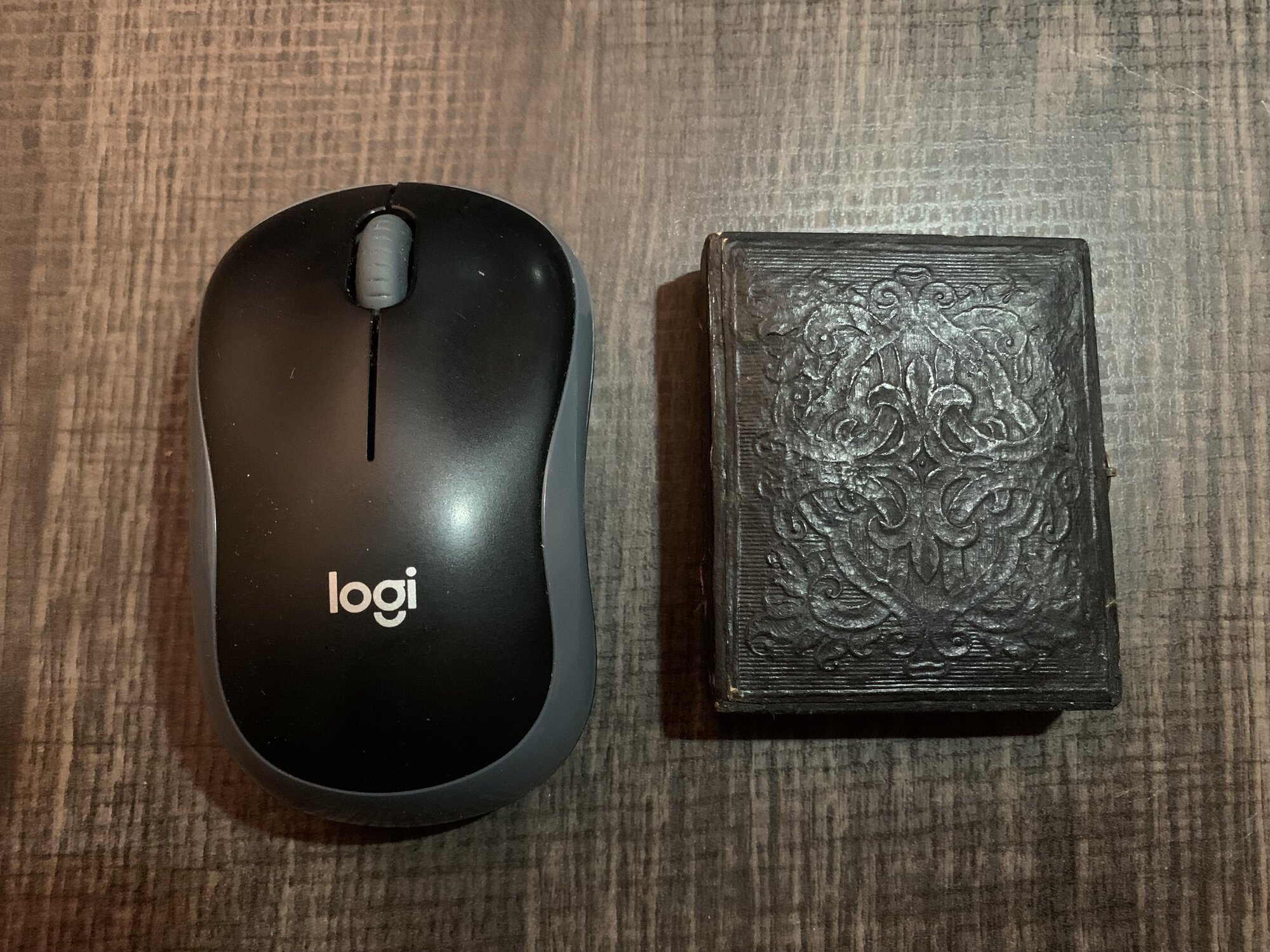
1. What can I learn from the case? It appears to be about 2 7/16 inches by 2 15/16 inches. It seems to be something like black lacquer. If there were hinges they are long gone and there is no indication that they were ever there. It looks like there are traces of thread on that side of the case, so maybe a cloth hinge? On the inside of the front of the case is a velvet-like cushion that might have been yellow at one time. The picture appears to be glass held in place by a two-part brass frame within a cardboard insert placed into the right side of the case. I have not attempted to take the image out of the case.

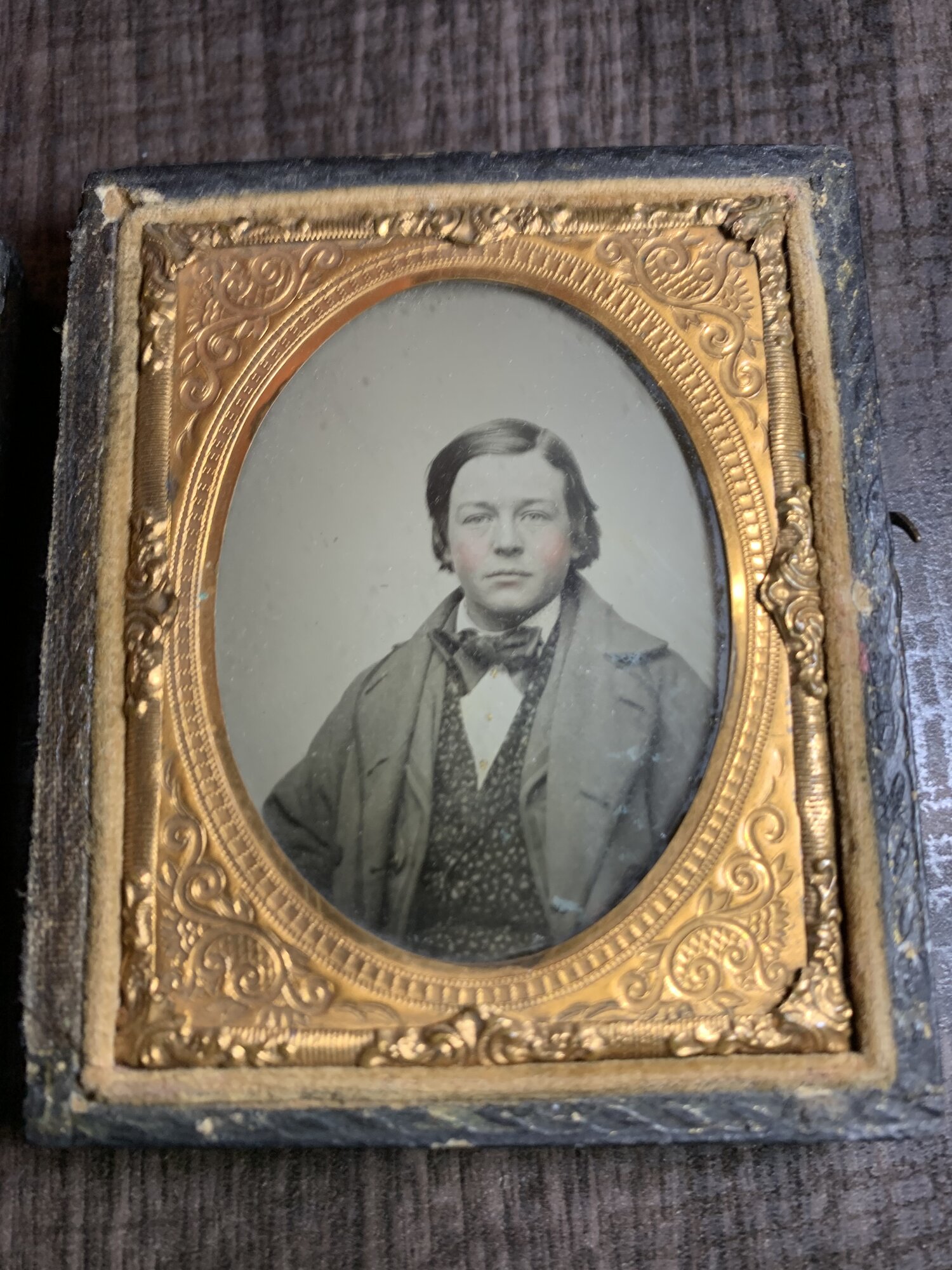
2. What can I learn from the image? The young man in the image appears to be wearing a white shirt, bow tie, vest with a spotted design, coat and overcoat. The coat and overcoat appear to be the same solid color. Both coats seem to have trim. The overcoat appears to be double breasted. Is this a uniform? Can we tell something about the time period from his clothes?

I know I should have done some research on my own but I thought I would be lazy and get some help from the start. Thanks for any help!
IMG_7958.jpeg
IMG_7962.jpeg
IMG_7963.jpeg
IMG_7964.jpeg
IMG_7966.jpeg
IMG_7967.jpeg
IMG_7968.jpeg
 
Isn´t that a sweet photo! What a pleasant looking fellow! I think it´s definitely an 1850s - 1860s period image. The case is gutta percha, kinda like papier mache, with the designed embossed. There would have been a hinge on the open side. They were very small and delicate. I can kinda make out where the bottom one might have been in your photo, but sometimes they had paper or cloth hinges instead. So it would have been hinged but it´s gone now. I think he´s wearing a civilian coat, sometimes called a ¨sack¨because it wasn´t closely fitted, with an overcoat on top. This might be a disappointment to you: I can´t make that into a uniform. Sitting for your image was a big event back then, so although I don´t think he was going to war, he may have been off on another major life adventure like going west or heading to California or Colorado to search for gold.
 
It looks like ambrotype/tintype however ambrotype is on glass but I notice the vest and coat buttons are the right way around - not a mirror image as usual with tintype.

Ambrotye is actually a negative but the 'black' parts of the negative (the light parts of a print) are actually a light coloured medium and with a black background it looks positive under reflected light - hence the 'dark' appearance.. If you coat/cover the actual image side and look at it from the glass side it loses the 'mirror image'. Tintype is similar, but it is aways seen from the image side since the plate - the backing - is made of thin metal.

 
Hi @R. Porter, one way Images of this period are classified are by their plate size. The sizes are fractional and include 1/16,1/9,1/6,1/4,1/2 and full/whole plate. There is also a cdv size roughly 1/8 and an imperial size which is very large. 1/6 and 1/9 seem to be the most common. 2.75x3.25 is the size of a 1/6 plate.

Ambrotype images are on glass, when held to a light source and they turn red that is called a ruby ambrotype. Almost like looking at a negative is the best I can describe it.

The image is held in by friction from the velvet liner and a pillow on the other side protects and cushions it. Behind the image is sometimes but not always a photographers logo stamp or even an actual tax stamp. The image will have a piece of glass, a brass border and a brass decorative plate, in your case an oval. Civil war period and beyond tend to have ornate plates with scroll work, flowers or sometimes even patriotic motifs like cannons and eagles and flags. Older images like daguerreotypes tend to have plain brass plates sometimes with the maker or photographer mark in the corner, sometimes a patent date. It's easy to remove from the case with a fingernail or something flat to gently pry up.

Cases you'll encounter can be leather bound or embossed usually a woody structure or thermoplastic. Some cases have a fabric hinge which you have or it had at one point. Thermoplastic tend to have the metal hinges. They make reproduction cases now but they will have circular indents from the mold it's formed in on the border of the case.

Your gentleman appears to be wearing civilian clothes. You'll notice if you look at more war images that their buckles are backwards at times, that's part of the photographic process and is sometimes covered up with photographer embellishments
 
Thanks for the info everybody! I'll have to see about taking the image out of the case to see if anything is on the back.
 
If you can get the photo out of the case without doing any damage, you might find something written. I've found a newspaper clipping that identified a Civil War ancestor, which was put in the case late in the war. The clipping also said the picture was taken in Feb 1860. As for another one, it was a total mystery, two sets of initials that I could never run down.
 
I was able to easily get the photo out of the case and take some additional pictures. Unfortunately there were no great revelations.

IMG_8016.jpeg

The image had a paper on the back of it which I removed to examine more closely.
IMG_8017.jpeg

The back of the paper was blank.
IMG_8018.jpeg

Looking at the edge of the image, it appears to be on a glass plate.
IMG_8019.jpeg

Looking through the image toward a light there is a distinct pinkish color detected.

IMG_8021.jpeg
 
I was able to easily get the photo out of the case and take some additional pictures. Unfortunately there were no great revelations.

View attachment 536196
The image had a paper on the back of it which I removed to examine more closely.
View attachment 536197
The back of the paper was blank.
View attachment 536198
Looking at the edge of the image, it appears to be on a glass plate.
View attachment 536199
Looking through the image toward a light there is a distinct pinkish color detected.

View attachment 536200
Congratulations on your ruby ambrotype. Don't toss that blue paper backing. Its original to the case. It was worth a try to find an ID, sometimes you get lucky
 
Congratulations on your ruby ambrotype. Don't toss that blue paper backing. Its original to the case. It was worth a try to find an ID, sometimes you get lucky
I'm not so sure that the image is actually a ruby ambrotype. It is an ambrotype for certain, but if you look at the photo where the backside of the image is shown, you can see clearly through the glass in the areas where the miner flaking has occurred. That would not be the case with ruby colored glass plates. I believe that the "ruby coloring" that you may have found is from looking through the thinner areas of the black varnish commonly used as backing on clear glass photographs.
 
I'm not so sure that the image is actually a ruby ambrotype. It is an ambrotype for certain, but if you look at the photo where the backside of the image is shown, you can see clearly through the glass in the areas where the miner flaking has occurred. That would not be the case with ruby colored glass plates. I believe that the "ruby coloring" that you may have found is from looking through the thinner areas of the black varnish commonly used as backing on clear glass photographs.
I believe you're right, I see where it's not ruby toward the bottom now my apologies.
 

Learn About Us
►About CivilWarTalk
►Contact the Webmaster
►Meet the Staff
►Link to CivilWarTalk
Join Our Community
►Register
►Browse Forums
►View Today's Discussions
►Search the Forum
Get Help
►FAQ
►Student Guide
►Forum Rules & Etiquette
►Copyright / DMCA

     Contact Us CivilwarTalk on Facebook CivilWarTalk on YouTube CivilWarTalk on Twitter RSS Feed

Bringing the American Civil War and More to Life.
© 1999 - , CIVILWARTALK, LLC - Site Version 10.0

SlaveryTalk.com - SecessionTalk.com - CivilWarTalk.com - ReconstructionTalk.com
Back
Top