John, in most cases I would expect the diameter to be nine feet, whether the pistons operated directly on the cranks, as with an oscillating engine, or on fixed beds with a connecting rod -- the latter referred to on the river as a "pitman." The center-line of the crank pins would trace a circle (rotary motion) with a diameter equal to the stroke (reciprocating motion) of the engine. During one turn, the crank pin comes exactly in line with the piston twice, at either end of the stroke -- a position known as "dead center."
Theoretically a walking beam engine -- not much used on the rivers because it required a deep hull for the enormous, low-pressure cylinder required -- could be adjusted with an asymmetrical walking beam that changed the length of the stroke on one side to a shorter or longer one on the other (like a teeter-totter with one long end and one short end), but I don't recall any description of that being done.
Added: a Western Rivers engine with a nine-foot stroke would be one of the largest around. The famous postwar racer
Robt. E. Lee, her opponent
Natchez, and the big steamers
Great Republic and
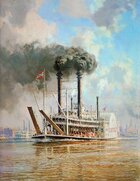
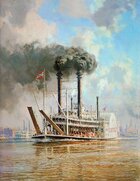
J. M. White (above) all had engines with ten-foot strokes, only a little more than your query.





 Bringing the