Question about chimneys

Mike Serpa

Lt. Colonel
Joined
Jan 24, 2013
Several photos show barrels on top of chimneys. Here are two examples:

33031v.jpg

Headquarters 1st Brigade Horse Artillery, February, 1864 (Brandy Sta.) LOC #33031
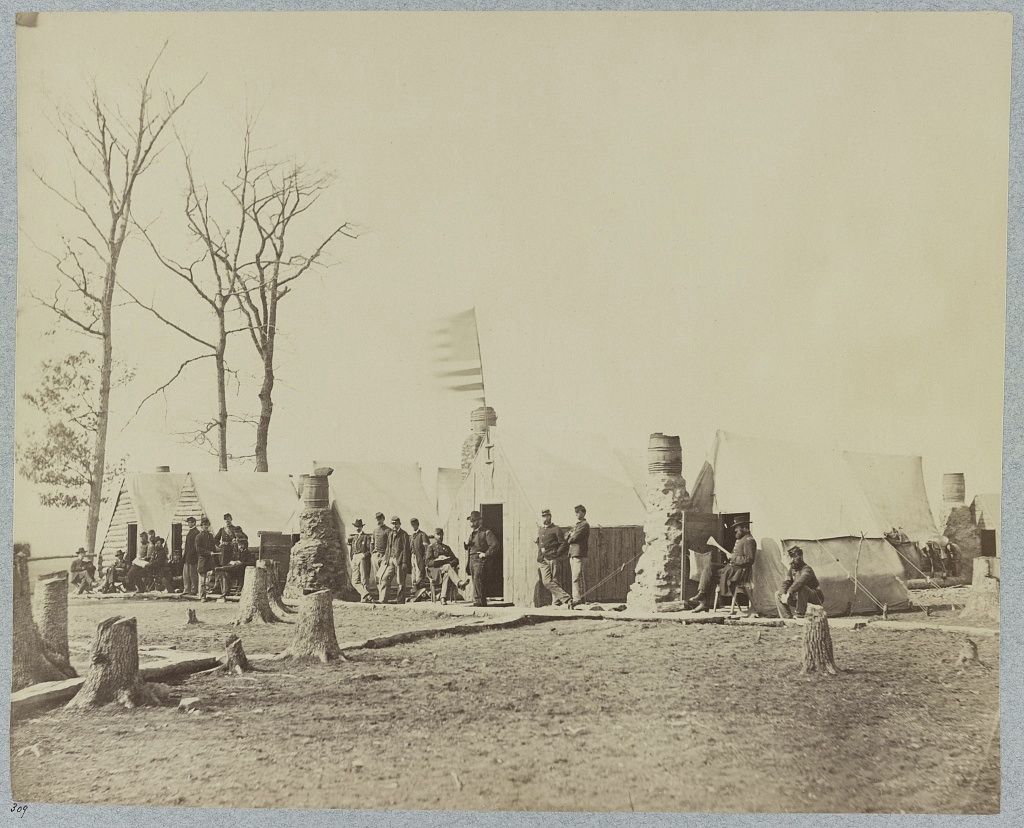
32999v.jpg

Winter quarters of a Regimental Head Quarters Army of Potomac, February, 1864 LOC #32999

Why was this done? It seems they chimneys are not tall enough but the first photo has chimneys of different heights. Thanks.
 
This is one of those questions that I wish I'd asked.

But let me guess -- might that have been for smoking beef rations?
 
Chimney.jpg


From Billings, Hardtack and Coffee:

The chimney was built outside, after the southern fashion. It stood sometimes at the end and sometimes in the middle of one side of the stockade. It started from a fire-place which was fashioned with more or less skill, according to the taste or mechanical genius of the workman, or the tools and materials used, or both. In my own company there were two masons who had opportunities, whenever a winter camp was pitched, to practise their trade far more than they were inclined to do.

The fire-places were built of brick, of stone, or of wood. If there was a deserted house in the neighborhood of the camp which boasted biick chimneys, they were sure to be brought low to serve the Union cause in the manner indicated, unless the house was used by some general officer as headquarters. When built of wood, the chimneys were lined with a very thick coating of mud. They were generally continued above the fireplace with split wood built cob-fashion, which was filled between and lined with the red clayey soil of Virginia, but stones were used when abundant.

Very frequently pork and beef barrels were secured to serve this purpose, being j)ut one above another, and now and then a lively hurrah would run through the camp when one of these was discovered on fire. It is hardly necessary to remark that not all these chimneys were monuments of success. Too often the draught was down instead of up, and the inside of some stockades resembled smoke-houses. Still, it was "all in the three years,'" as the boys used to say. It was all the same to the average soldier, who rarely saw fit to tear down and build anew more scientifically. The smoke of his camp-fires in warm weather was an excellent preparative for the smoking fireplace of winter-quarters.​

So from this I gather that barrels were used largely because they were plentiful and just exactly the right size and shape for use in a chimney.
 
Figured it was an easy way to heighten the chimney and thus improve the draw.

Green wood tends to generate tar which coats the chimney and tends to catch fire. It will catch fire eventually. Doesn't happen when one is burning seasoned wood like that which comes from fences and clapboard. Ask our extreme northeast brethren who depend on wood to heat their homes with wood.
 
Two guesses, and they are only guesses:

First, to keep out the rain when the chimney wasn't needed for heat, etc. This assumes the bottom would have been left in the barrel, which was inverted before dropping down over the chimney--thus keeping out the rain. Most of these boys probably didn't know about smoke shelves, chimney hoods, or other such ways of keeping rain out of the cabin.

Second, as has been said, to improve the draw. A good chimney builder knows the chimney needs to be a minimum of two feet higher than the highest part of the roof to ensure a good draw in various kinds of swirling winds. At least I have read that, but who knows whether I was reading reliable information? The boys who built these quarters might have stacked up their chimneys on nothing more than instinct. They might have said: "That looks good to me." I can imagine a veteran brick mason quartered in the cabin just down the way coming along and saying: "Boys, your chimney ain't tall enough. Either stack up another 30" of bricks or go commandeer a barrel and knock the bottom out of it and stack it up on that thing. 'course, your barrel will probably catch fire eventually, so you ought to heed my first suggestion."

Other than those two possibilities, I haven't got a clue.

By the way: Heck of a stout bunch of wall logs in that first photo. They didn't remove the bark, but they knew it was a temporary structure. Dang, those are stout walls! Obviously, they didn't pay as much attention to their roof--the most important part of the structure.
 
Mike, I can't see how putting a barrel on top of the chimney could help anything, other than making a liquor high. They may have had a good deal going there.
 
Figured it was an easy way to heighten the chimney and thus improve the draw.

Green wood tends to generate tar which coats the chimney and tends to catch fire. It will catch fire eventually. Doesn't happen when one is burning seasoned wood like that which comes from fences and clapboard. Ask our extreme northeast brethren who depend on wood to heat their homes with wood.

While touring the Cape Cod area we noticed trap doors giving access to the roof around the chimney area. We were told that in case of chimney fires that were frequent, they had a supply of sand handy to throw it onto the fire to help extinguish the flames....(Colonial time period, practiced even today.
 
When Billings said the chimney was built outside after the southern fashion, that was in part to keep more heat outside since a southern fireplace might be used for cooking in weather when heating wasn't necessary, but the other reason, on little southern log cabins, was if the chimney caught fire you could knock it over away from the cabin and thereby save the main structure.
 
Just found this photo. Was this tree stump hollowed out to make a chimney?
3a49467u.jpg

Provost Guard at Headquarters 6th Army Corps, near Hazel River, Va., 1864 - LOC #3a49467
 
Just found this photo. Was this tree stump hollowed out to make a chimney?
View attachment 53561
Provost Guard at Headquarters 6th Army Corps, near Hazel River, Va., 1864 - LOC #3a49467
Okay, I'll admit I'm really dumb, but I don't see a tree stump? The closest chimney looks like it's heavily mud covered, maybe with a split log stacked interior (just a guess), slathered with mud inside and out, and topped with that barrel of course. The farther one is harder to see, but looks like two barrels on top of some sort of base--can't tell what the base is.

Where are you seeing the tree stump? Though honestly, a big hollow sycamore wouldn't be hard to find if one was camped in the right location, near a low-lying river for example, and if lined heavily with mud, it might do the job as well as a barrel.
 
Okay, I'll admit I'm really dumb, but I don't see a tree stump? The closest chimney looks like it's heavily mud covered, maybe with a split log stacked interior (just a guess), slathered with mud inside and out, and topped with that barrel of course. The farther one is harder to see, but looks like two barrels on top of some sort of base--can't tell what the base is.

Where are you seeing the tree stump? Though honestly, a big hollow sycamore wouldn't be hard to find if one was camped in the right location, near a low-lying river for example, and if lined heavily with mud, it might do the job as well as a barrel.
YouarenotasdumbasIfeelrightnow. I thought the closer chimney was a tree that maybe fell over years before in a lightning strike and was utilized as something but it couldn't be a chimney. I could tell the barrel was attached with mud. Not unusual to see tree 10x that diameter where I live. I'msoembarrassedrightnow. I wear glasses and they must have been dirty or something like that or maybe I wasn't even wearing them. Maybe my wife asked me a question and distracted me and my concern her caused me to forget to finish looking at the photo in greater detail. Areyoubelievinganyofthis? The photo was postage stamp size on my computer and somehow magically enlarged itself and I can now see easily the cracked mud. Thisdidn'thappen. Whatever happened I didn't make a dumb mistake. Good thing I didn't post this on an international forum where the whole world could read it! :) Thanks everyone for the correction.
 

Learn About Us
About CivilWarTalk
Contact the Webmaster
Meet the Staff
Link to CivilWarTalk
Join Our Community
Register
Browse Forums
View Today's Discussions
Search the Forum
Get Help
FAQ
Student Guide
Forum Rules & Etiquette
Copyright / DMCA

     Contact Us CivilwarTalk on Facebook CivilWarTalk on YouTube CivilWarTalk on Twitter RSS Feed

Bringing the American Civil War and More to Life.
© 1999 - , CIVILWARTALK, LLC - Site Version 10.0

SlaveryTalk.com - SecessionTalk.com - CivilWarTalk.com - ReconstructionTalk.com
Back
Top