
- Joined
- Feb 8, 2017
- Location
- Monterey, CA
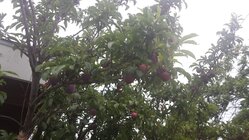
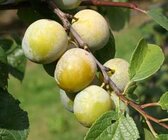
Our plum tree is looking beautiful and we should be ready to harvest within the next week. I realized I know nothing about the history of plums in the United States, and as fresh fruit was important to the soldiers in the Civil War as well as to us, I thought it a perfect time to share the following article:
PLUM TREES (PRUNUS DOMESTICA, PRUNUS SALICINA) TAXONOMY
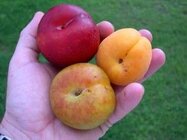
Clockwise from top: Japanese plum, apricot, and their hybrid the pluot.
Plum trees are placed within the Prunoideaesubfamily of the Rosaceae, which contains all of the stone fruits such as peach, cherry, and apricot. The subgenus Prunophora contains plums and apricots. Hybrids between plums and apricots have been produced recently which are said to be finer fruits than either parent. A "Plumcot" is 50% plum, 50% apricot; an "Aprium" is 75% apricot, 25% plum; and the most popular hybrid, the "Pluot" is 75% plum, 25% apricot.
Plum species:
1. European plum trees - Prunus domestica L. Worldwide, this is one of the main species grown. Produces fruit that are generally oval, smaller, and more variable in color than Japanese plums. In the USA, P. domestica is used for prunes or fruit cocktail or other products, and rarely eaten fresh.
2. Japanese plum trees - P. salicina Lindl. and hybrids. These produce the most common fresh eating plums in the USA. They are larger, rounder (or heart shaped), and firmer than European plums and are primarily grown for fresh market.
3. Damsons, Bullace plums, St. Juliens, and Mirabelles – P. insititia L. These are the small, wild plums native to Europe, cultivated their prior to the introduction of P. domestica. The 'St. Julien' types are used as dwarf rootstocks for plums. Fruit are small and oval (1 inch), purple and clingstone for Damsons and yellow and freestone for Mirabelles, with heavy bloom. They are used primarily for jams/jellies/preserves.
Plums are particularly diverse in terms of size, color, and flavor:
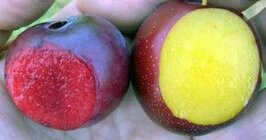
Japanese plum hybrids
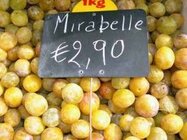
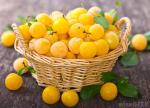
Mirabelle plums (P. insititia)
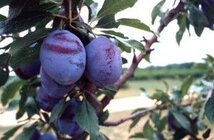
'Stanley', a major prune cultivar in the USA
European Plum Cultivars
These are placed into 4 groups, based mostly on fruit color and/or size, and use (processed or fresh).
1. Reine Claude or Greengage – Round, green or golden plums used for canning and fresh market. 'Reine Claude', 'Imperial Gage', 'Hand'.
2. Yellow egg – Large, yellow, oval plums primarily used for canning. 'Yellow egg', 'Golden drop'.
3. Lombard – Large, oval, red or pink plums, used for fresh market in western Europe. 'Victoria', 'Lombard', 'Pond'.
4. Prunes – Oval, dark blue or purple, freestone cultivars, dried postharvest. 'French' (syn. Agen), 'Stanley', 'Italian' (syn. 'Fellenberg'), 'Blufre', and 'President'.
Japanese Plum Cultivars
'Santa Rosa', 'Burbank', 'Shiro', 'Beauty', 'Gold', 'Methley', 'Red Beaut', and 'Ozark Premier' are grown in several countries. In addition, 'Friar' and 'Simka' are popular in the USA. Like European plums, many flesh and skin colors occur in Japanese plum cultivars.
ORIGIN AND HISTORY OF THE PLUM TREE (PRUNUS DOMESTICA, PRUNUS SALICINA), HISTORY OF CULTIVATION
P. domestica
This species is native to western Asia, in the Caucasus mountains adjacent to the Caspian Sea. It was brought to North America by Spanish Missionaries (west coast) and English Colonists (east coast). Today, most production is in western states, with the vast majority in California's central valley, where climate disfavors disease and rain cracking.
P. salicina
Contrary to the name, this species originated in China, where it was cultivated for thousands of years. It was brought to Japan 200-400 years ago, where it then spread around the world, being falsely called "Japanese plum". In the USA, it is grown primarily in California, and is the major fresh market plum seen in grocery stores.
PLUM TREE (PRUNUS DOMESTICA, PRUNUS SALICINA) BOTANICAL DESCRIPTION
Plant
Plum trees are small to medium sized trees, similar to but more erect growing than peach. European plum trees are larger and more erect than Japanese plums. Leaves ovate or elliptic with acute or obtuse tips, short petioles, crenulate margins. Japanese plum trees have rougher bark, more persistent spurs, and more numerous flowers than European plums. They are also more precocious, disease resistant, and vigorous than European plums.
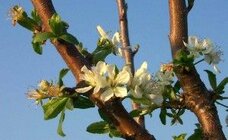
Flowers of European Plums.
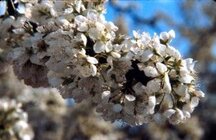
Flowers of Japanese plums (basically the same as those of European Plums in structure, but more abundant in Japanese types)
Flowers
Flowers are similar in morphology to peach trees, but white, smaller, and have longer pedicels. Flowers are borne mostly in umbel-like clusters of 2-3 individuals on short spurs, and solitary or 2-3 in axils of 1-yr-old wood. European plums bloom much later than Japanese types, and are therefore less frost prone.
Pollination
Honey bees are the major pollinator. For Japanese plums, pollinizers are necessary for commercial production for most cultivars. 'Bruce', 'AU Producer', 'Beauty', 'Santa Rosa' (and its sports), 'Simka', 'Casselman' and 'Methley' do not require cross pollination. In P. domestica, about ½ of the major cultivars require pollinizers, but most of the major prunes produced in the USA do not. 'Stanley', 'French', 'Italian', and 'Sugar' prune types are self-fruitful.
Fruit
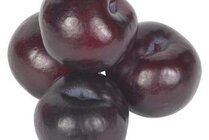
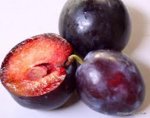
A drupe. Oval shaped in European types, round to conical in Japanese types. Bloom (epicuticular wax) is usually present on glabrous surface (thus, the fruit surface is termed "glaucous"). Plums require 2.5 to 6 months for fruit development, with most Japanese ripening in relatively short periods (3 months), and some prune & canning cultivars ripening in autumn. Thinning is necessary for proper size development for Japanese plums, but not always necessary for European plums, particularly prunes, since they are not as floriferous, and fruit set is generally lighter.
PLUM TREE (PRUNUS DOMESTICA, PRUNUS SALICINA) GENERAL CULTURE
Soils and Climate
Deep, well-drained soils with pH 5.5 – 6.5 give best results. However, plums are the most tolerant of all stone fruits with respect to heavy soils and waterlogging.
Plums are adapted to a wide range of climatic conditions; at least some cultivars can be grown in almost every state in the US. European plums have a more northern adaptation, and Japanese do better in southern areas of the temperate zone or in Mediterranean climates, Commercially, Japanese plums and prunes are grown where rainfall during the growing season is minimal, and humidity low to prevent diseases; this is why most production is in California. Cold hardiness is excellent for European plums, similar to apple and pear, but Japanese plums are less cold hardy (similar to peach). Plums have chilling requirements ranging from 550-800 hrs for Japanese, and >1000 for European. Rainfall during the growing season can reduce production by accentuating diseases and causing fruit cracking.
PLUM (PRUNUS DOMESTICA, PRUNUS SALICINA) HARVEST, POSTHARVEST HANDLING
Maturity
A variety of indices are used for plum maturity, depending on use, species/cultivar and location. Japanese plums and European plums for fresh market are harvested based on skin color and firmness, although sugar content and sugar to acid ratio has been used. Flesh color, firmness, and sugar content are the most reliable indicators for prunes; flesh turns from green-yellow to amber, solids reach 25-35%, and firmness of 1-2 lbs.
Harvest Method
Plums for fresh consumption must be hand harvested, and require 2-4 pickings for optimal maturity over a 7-10 day period, as for peach. Prunes for canning or drying are harvested by shake and catch methods like sour cherries.
Postharvest Handling
Fresh plums are handled postharvest just like peaches. Prunes used to be dried in the sun like raisins, but now are dried in forced air tunnels for a more uniform product.
Storage
Plums have similar storage characteristics and problems as peaches, cherries, and apricots. They can be stored about 2-3 weeks at 32 F and 90% RH. Neither species is susceptible to chilling injury in normal storage conditions. Brown rot and Rhizopus rot, and blue and grey molds are the most common storage problems. Once prunes are dried, they are relatively resistant to postharvest diseases, and can last for months.
http://www.fruit-crops.com/plum-prunus-domestica-prunus-salicina/
PLUM TREES (PRUNUS DOMESTICA, PRUNUS SALICINA) TAXONOMY
Clockwise from top: Japanese plum, apricot, and their hybrid the pluot.
Plum trees are placed within the Prunoideaesubfamily of the Rosaceae, which contains all of the stone fruits such as peach, cherry, and apricot. The subgenus Prunophora contains plums and apricots. Hybrids between plums and apricots have been produced recently which are said to be finer fruits than either parent. A "Plumcot" is 50% plum, 50% apricot; an "Aprium" is 75% apricot, 25% plum; and the most popular hybrid, the "Pluot" is 75% plum, 25% apricot.
Plum species:
1. European plum trees - Prunus domestica L. Worldwide, this is one of the main species grown. Produces fruit that are generally oval, smaller, and more variable in color than Japanese plums. In the USA, P. domestica is used for prunes or fruit cocktail or other products, and rarely eaten fresh.
2. Japanese plum trees - P. salicina Lindl. and hybrids. These produce the most common fresh eating plums in the USA. They are larger, rounder (or heart shaped), and firmer than European plums and are primarily grown for fresh market.
3. Damsons, Bullace plums, St. Juliens, and Mirabelles – P. insititia L. These are the small, wild plums native to Europe, cultivated their prior to the introduction of P. domestica. The 'St. Julien' types are used as dwarf rootstocks for plums. Fruit are small and oval (1 inch), purple and clingstone for Damsons and yellow and freestone for Mirabelles, with heavy bloom. They are used primarily for jams/jellies/preserves.
Plums are particularly diverse in terms of size, color, and flavor:
Japanese plum hybrids
Mirabelle plums (P. insititia)
'Stanley', a major prune cultivar in the USA
European Plum Cultivars
These are placed into 4 groups, based mostly on fruit color and/or size, and use (processed or fresh).
1. Reine Claude or Greengage – Round, green or golden plums used for canning and fresh market. 'Reine Claude', 'Imperial Gage', 'Hand'.
2. Yellow egg – Large, yellow, oval plums primarily used for canning. 'Yellow egg', 'Golden drop'.
3. Lombard – Large, oval, red or pink plums, used for fresh market in western Europe. 'Victoria', 'Lombard', 'Pond'.
4. Prunes – Oval, dark blue or purple, freestone cultivars, dried postharvest. 'French' (syn. Agen), 'Stanley', 'Italian' (syn. 'Fellenberg'), 'Blufre', and 'President'.
Japanese Plum Cultivars
'Santa Rosa', 'Burbank', 'Shiro', 'Beauty', 'Gold', 'Methley', 'Red Beaut', and 'Ozark Premier' are grown in several countries. In addition, 'Friar' and 'Simka' are popular in the USA. Like European plums, many flesh and skin colors occur in Japanese plum cultivars.
ORIGIN AND HISTORY OF THE PLUM TREE (PRUNUS DOMESTICA, PRUNUS SALICINA), HISTORY OF CULTIVATION
P. domestica
This species is native to western Asia, in the Caucasus mountains adjacent to the Caspian Sea. It was brought to North America by Spanish Missionaries (west coast) and English Colonists (east coast). Today, most production is in western states, with the vast majority in California's central valley, where climate disfavors disease and rain cracking.
P. salicina
Contrary to the name, this species originated in China, where it was cultivated for thousands of years. It was brought to Japan 200-400 years ago, where it then spread around the world, being falsely called "Japanese plum". In the USA, it is grown primarily in California, and is the major fresh market plum seen in grocery stores.
PLUM TREE (PRUNUS DOMESTICA, PRUNUS SALICINA) BOTANICAL DESCRIPTION
Plant
Plum trees are small to medium sized trees, similar to but more erect growing than peach. European plum trees are larger and more erect than Japanese plums. Leaves ovate or elliptic with acute or obtuse tips, short petioles, crenulate margins. Japanese plum trees have rougher bark, more persistent spurs, and more numerous flowers than European plums. They are also more precocious, disease resistant, and vigorous than European plums.
Flowers of European Plums.
Flowers of Japanese plums (basically the same as those of European Plums in structure, but more abundant in Japanese types)
Flowers
Flowers are similar in morphology to peach trees, but white, smaller, and have longer pedicels. Flowers are borne mostly in umbel-like clusters of 2-3 individuals on short spurs, and solitary or 2-3 in axils of 1-yr-old wood. European plums bloom much later than Japanese types, and are therefore less frost prone.
Pollination
Honey bees are the major pollinator. For Japanese plums, pollinizers are necessary for commercial production for most cultivars. 'Bruce', 'AU Producer', 'Beauty', 'Santa Rosa' (and its sports), 'Simka', 'Casselman' and 'Methley' do not require cross pollination. In P. domestica, about ½ of the major cultivars require pollinizers, but most of the major prunes produced in the USA do not. 'Stanley', 'French', 'Italian', and 'Sugar' prune types are self-fruitful.
Fruit
A drupe. Oval shaped in European types, round to conical in Japanese types. Bloom (epicuticular wax) is usually present on glabrous surface (thus, the fruit surface is termed "glaucous"). Plums require 2.5 to 6 months for fruit development, with most Japanese ripening in relatively short periods (3 months), and some prune & canning cultivars ripening in autumn. Thinning is necessary for proper size development for Japanese plums, but not always necessary for European plums, particularly prunes, since they are not as floriferous, and fruit set is generally lighter.
PLUM TREE (PRUNUS DOMESTICA, PRUNUS SALICINA) GENERAL CULTURE
Soils and Climate
Deep, well-drained soils with pH 5.5 – 6.5 give best results. However, plums are the most tolerant of all stone fruits with respect to heavy soils and waterlogging.
Plums are adapted to a wide range of climatic conditions; at least some cultivars can be grown in almost every state in the US. European plums have a more northern adaptation, and Japanese do better in southern areas of the temperate zone or in Mediterranean climates, Commercially, Japanese plums and prunes are grown where rainfall during the growing season is minimal, and humidity low to prevent diseases; this is why most production is in California. Cold hardiness is excellent for European plums, similar to apple and pear, but Japanese plums are less cold hardy (similar to peach). Plums have chilling requirements ranging from 550-800 hrs for Japanese, and >1000 for European. Rainfall during the growing season can reduce production by accentuating diseases and causing fruit cracking.
PLUM (PRUNUS DOMESTICA, PRUNUS SALICINA) HARVEST, POSTHARVEST HANDLING
Maturity
A variety of indices are used for plum maturity, depending on use, species/cultivar and location. Japanese plums and European plums for fresh market are harvested based on skin color and firmness, although sugar content and sugar to acid ratio has been used. Flesh color, firmness, and sugar content are the most reliable indicators for prunes; flesh turns from green-yellow to amber, solids reach 25-35%, and firmness of 1-2 lbs.
Harvest Method
Plums for fresh consumption must be hand harvested, and require 2-4 pickings for optimal maturity over a 7-10 day period, as for peach. Prunes for canning or drying are harvested by shake and catch methods like sour cherries.
Postharvest Handling
Fresh plums are handled postharvest just like peaches. Prunes used to be dried in the sun like raisins, but now are dried in forced air tunnels for a more uniform product.
Storage
Plums have similar storage characteristics and problems as peaches, cherries, and apricots. They can be stored about 2-3 weeks at 32 F and 90% RH. Neither species is susceptible to chilling injury in normal storage conditions. Brown rot and Rhizopus rot, and blue and grey molds are the most common storage problems. Once prunes are dried, they are relatively resistant to postharvest diseases, and can last for months.
http://www.fruit-crops.com/plum-prunus-domestica-prunus-salicina/


 Forum Host




 Bringing the