The band served with the regiment (44th Ohio Volunteer Infantry) through the campaigns of 1861 and 1862, in Kanawha Valley and beyond, until their discharge Oct. 20, 1862, under the new law of Congress abolishing regimental bands as paid auxiliaries of the service. An attempt was made but failed to form a brigade band of seventeen from the old band of twenty-five. In January, 1863, the officers of the regiment raised a fund of $1,000 for purchase of instruments, and deputed Capt. Tulleys a committee to purchase same and secure a teacher. His choice of leader fell upon Andrew Watt, of the old band, who, on the 17th of February, 1863, undertook, at Frankfort, Ky., the formation of a band detailed from the ranks. From a band of twelve (nine horns) the organization grew to sixteen (thirteen horns) before the return to Springfield, in January, 1864, on veteran furlough; at Camp Dennison three more were added, and thenceforward, as the
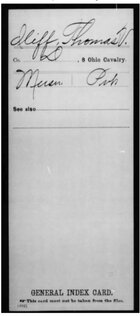
BAND OF THE EIGHTH O.V.C. (8th Ohio Cavalry)
The organizaton numbered nineteen all told, as follows:
Andrew Watt, leader
(listed as F&S; Co not listed); John Casad
(carded records not located),
Lyman Munger (Co C), Philip Harper (Co L), H.H.(Harvey H) Birely (Co G), Daniel Genier (Co H), Eli M. Long (Co I), Joseph McLellan (Co K), James (R.) Littler (Co F), Harman (H.) Deam (Co I), James T. Flack (Co D), Joshua C. Kooken (Co H),
Timothy Munger (Co C), Arthur M. Nelson (Co L), Joseph Wilcox (Co E), John F. Owens (filed as John F Owen, Co F), John W. Booth
(record for Svc in 8th Ohio Cav. but Co not listed), J.W.R. Cline (Co D), William H. Porter (Co F), John Iliff (Co A).
At Knoxville, in 1863, the band was specially honored by Gen. Burnside. Reenlisting, and serving on horseback, the band had some singular and unusual experiences, as being detailed by Gen. Wallace to guard a bridge, on the road from Frederick City, Md., to Baltimore, during the panic following Gen. Early's entrance into that section (followed by the battle of Monocacy); a two months' experience as Post band at Relay House, Md., while separated from their command, and a lively series of trips during the fall of 1864, and with Gen. Averill's cavalry division (Sheridan's army), in the Shenandoah Valley, and also having the honor of furnishing the only music for Gen. Sheridan's masterly and historically famous repulse of Early at Cedar Creek, October 19, 1864, after Early had nearly routed the Union forces, before the well-known "Sheridan's Ride" occurred, when the tide was turned in favor of the Union army. The men served — as enlisted — until the close of the war, July, 1865, each man being allowed to retain the instrument he played.
http://clarkoh.ancestralsites.com/military/ex-soldiers-h.php


 Forum Host
 Thread Medic




 Bringing the