Petition for Release from Camp Chase

WestCoastSB

Corporal
Joined
Oct 9, 2021
My fourth great-grandfather Aaron Hensley was a Private in Company E, 14th Virginia Cavalry; he was 56 at the time of his enlistment in September 1862 (I'm not sure why he enlisted at that age, but his son, and my direct ancestor John Wesley, had enlisted in the 30th Battalion Virginia Sharpshooters the same month and year). Company E was comprised of men from western Virginia, and when he road off with his comrades, the area still belonged to Virginia.

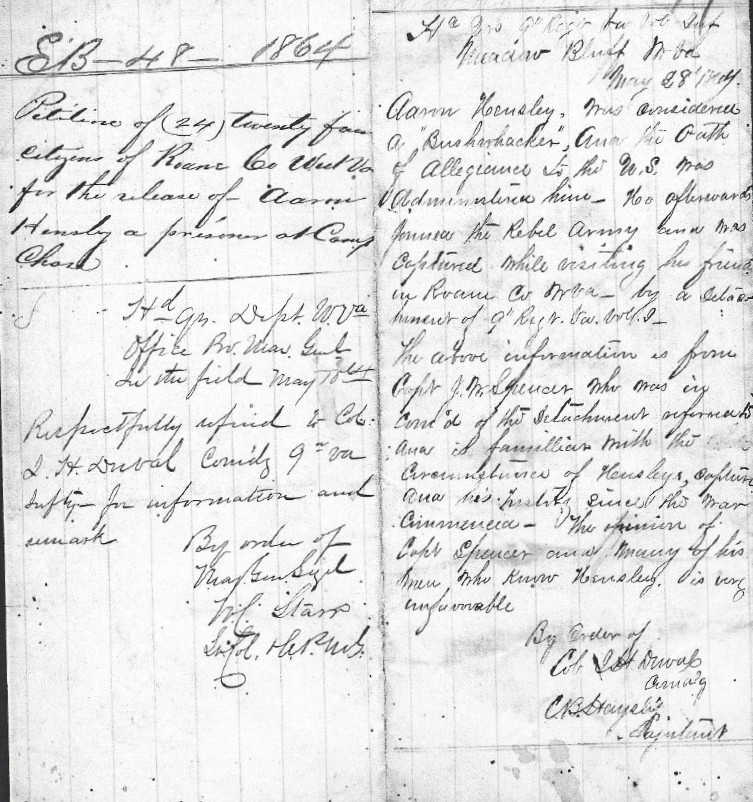
Not long after his enlistment, the age-advanced Aaron was apparently experiencing health issues. He was sent on detached duty in early 1863 and medically discharged by August 1863. However, that did not prevent him from being captured and sent to Camp Chase. Of note, 24 citizens of Roane County, VA had submitted a petition for his release from Camp Chase. The note is interesting, because "WVa" was written down. Either they were saying the "right" thing to have Aaron released, or a soldier transcribed this message.

Either way, he was finally released in late April 1865.
1744530245859.png
 
The note is pretty clear about why they arrested him. He took the oath to the US and then enlisted in the CS Army. That was strike one. After serving in the Confederate army and returning home, he became a bushwhacker. That was strike two. The opinion of the commander of the cavalry unit who arrested Hensley and his men, it says, was "very unfavorable." So while his friends and neighbors didn't approve of his being captured, the local Union troops did.

Now - was Hensley a bushwhacker? The status of irregular troops is almost impossible to determine so he could have been enlisted in a local unit and fighting to further the Confederate cause. Or, more likely, he could have been part of a local unit that worked to protect local interests during a time when the area was occupied by the Union or frequently changing sides. This seems more likely since the neighbors appeared to approve of him.
 
The note is pretty clear about why they arrested him. He took the oath to the US and then enlisted in the CS Army. That was strike one. After serving in the Confederate army and returning home, he became a bushwhacker. That was strike two. The opinion of the commander of the cavalry unit who arrested Hensley and his men, it says, was "very unfavorable." So while his friends and neighbors didn't approve of his being captured, the local Union troops did.

Now - was Hensley a bushwhacker? The status of irregular troops is almost impossible to determine so he could have been enlisted in a local unit and fighting to further the Confederate cause. Or, more likely, he could have been part of a local unit that worked to protect local interests during a time when the area was occupied by the Union or frequently changing sides. This seems more likely since the neighbors appeared to approve of him.
His region had a previous guerrilla organization known as the Moccasin Rangers. Prior to irregular forces being standardized by the Virginia government, the Moccasin Rangers operated along the Little Kanawha River which included Roane County; he was also residing in Calhoun County at different times.

Now, I have never heard of my ancestor having been a "bushwhacker". This would be a revelation to me. As far as I knew, he enlisted in the 14th Virginia Cavalry, and that was his first interaction with military activities.
 
There were a lot of local units, especially later in the war. The Union had rules for who was an official soldier (sworn in, part of a larger unit, uniformed, etc.) that many local Confederate outfits didn't fit into. Often they couldn't meet that standard. How many families had fabric for uniforms in the South near the end of the Civil War? Official records will call these troops bushwhackers or guerillas. Unless there is other evidence that your ancestor was part of a group known for crossing the line from soldiering to criminal activity I would assume he was part of a group of armed men who wanted to protect their neighborhood and serve the Confederacy. That his neighbors vouched for him in a group tells me that he wasn't terrorizing them.
 
There were a lot of local units, especially later in the war. The Union had rules for who was an official soldier (sworn in, part of a larger unit, uniformed, etc.) that many local Confederate outfits didn't fit into. Often they couldn't meet that standard. How many families had fabric for uniforms in the South near the end of the Civil War? Official records will call these troops bushwhackers or guerillas. Unless there is other evidence that your ancestor was part of a group known for crossing the line from soldiering to criminal activity I would assume he was part of a group of armed men who wanted to protect their neighborhood and serve the Confederacy. That his neighbors vouched for him in a group tells me that he wasn't terrorizing them.

My favorite name for them is "banditti." Something about it has just the disparaging Victorian gentleman's sound to it… it is also fun to say when giving a talk.
 
Last edited:
While Roane County was still part of Virginia when Aaron Hensley enlisted in 1862, the county was part of West Virginia when that state was admitted to the Union on June 20, 1863.
Yep! And he was picked up by a patrol in September 1863 after his medical discharge in that same county.
 
There were a lot of local units, especially later in the war. The Union had rules for who was an official soldier (sworn in, part of a larger unit, uniformed, etc.) that many local Confederate outfits didn't fit into. Often they couldn't meet that standard. How many families had fabric for uniforms in the South near the end of the Civil War? Official records will call these troops bushwhackers or guerillas. Unless there is other evidence that your ancestor was part of a group known for crossing the line from soldiering to criminal activity I would assume he was part of a group of armed men who wanted to protect their neighborhood and serve the Confederacy. That his neighbors vouched for him in a group tells me that he wasn't terrorizing them.
In East TN in Confederate leaning papers any irregular union forces were, mounted robbers, bandits and murderers. Confederate irregulars were white knights, patriots and heros.
In Union leaning papers irregular Conftederate forces were mounted robbers, bandits and murderers. Union irregulars were white knights, patriots and heros.
Tell me the newspaper and I can tell you what they say on the topic. Met the new boss same as the old boss... ;)
 
In East TN in Confederate leaning papers any irregular union forces were, mounted robbers, bandits and murderers. Confederate irregulars were white knights, patriots and heros.
In Union leaning papers irregular Conftederate forces were mounted robbers, bandits and murderers. Union irregulars were white knights, patriots and heros.
Tell me the newspaper and I can tell you what they say on the topic. Met the new boss same as the old boss... :wink:
My thoughts exactly.
 
What distinguished a Guerilla from a Bushwacker? In 1863 my 56 year old 3rd great grandfather James Tincher was picked up as a Confederate Guerilla along with his sons Albert and Francis in Greenbrier County. The sons were in the 79th Va Militia and listed as POWs. All three are listed together in Union captivity. They were sent from Camp Chase to Vicksburg for parole. James never made it home having died enroute. Albert was unfortunate to have returned to Camp Chase where he died in Dec 1864 having enlisted in the 21st Va Cav after his initial release.
 
What distinguished a Guerilla from a Bushwacker? In 1863 my 56 year old 3rd great grandfather James Tincher was picked up as a Confederate Guerilla along with his sons Albert and Francis in Greenbrier County. The sons were in the 79th Va Militia and listed as POWs. All three are listed together in Union captivity. They were sent from Camp Chase to Vicksburg for parole. James never made it home having died enroute. Albert was unfortunate to have returned to Camp Chase where he died in Dec 1864 having enlisted in the 21st Va Cav after his initial release.
Great question; I am not certain if there was a "legal" distinction or if it was a matter of semantics.

I'll have to look into that history.
 
What distinguished a Guerilla from a Bushwacker?
Am not saying the following is definitive, but have read that in the border states of the western theater, guerrilla fighters on both sides were commonly called 'bushwackers'. ( See https://www.battlefields.org/learn/articles/bushwhackers-and-jayhawks ).

Guerrilla fighters (often not in regular army uniforms) engaged in irregular warfare, typically by roaming freely in small independent bands unattached to any formal army commands and carrying out hit and run actions. Seems 'bushwacking' was a practice applied by guerrillas of both sides and it involved ambushing individuals or army detachments from concealed/hidden positions.
 
Last edited:
Hensley's POW records correctly note his regiment and company. I am guessing that Federal troops accepted the fact he was visiting a friend. By late 1863 bushwhackers and guerillas had an increasing tendency to be shot while escaping or falling off a cliff while being taken into captivity.
 
Hensley's POW records correctly note his regiment and company. I am guessing that Federal troops accepted the fact he was visiting a friend. By late 1863 bushwhackers and guerillas had an increasing tendency to be shot while escaping or falling off a cliff while being taken into captivity.
My ancestors Lt. James K. Morrow fought an unrelenting war with J J Kirkland's guerrilas. He never brought back any alive, and Kirkland didn't spare his boys. Reminds me of my dad's story of the South Pacific in WW2. Brutal, Brutal and more Brutal.
 
What distinguished a Guerilla from a Bushwacker? In 1863 my 56 year old 3rd great grandfather James Tincher was picked up as a Confederate Guerilla along with his sons Albert and Francis in Greenbrier County. The sons were in the 79th Va Militia and listed as POWs. All three are listed together in Union captivity. They were sent from Camp Chase to Vicksburg for parole. James never made it home having died enroute. Albert was unfortunate to have returned to Camp Chase where he died in Dec 1864 having enlisted in the 21st Va Cav after his initial release.
Guerilla and bushwhacker are pretty much interchangeable. Both mean a man operating outside military structure, which meant any actions he took which might have been legal for a soldier were illegal. So a soldier requisitions horses and mules, a guerilla/bushwhacker steals them. The Union Army did have a working definition of non-regular soldiers that they developed during the war. Men who were not in uniform and not in part of an accepted larger unit were irregular troops.

I recently read through a trial transcript from Tennessee and every witness was asked to describe the clothing the accused bushwhackers wore. Most witnesses were asked if they had any knowledge of the men being a part of a known Confederate unit. They even tried to clarify if the men were perceived by locals as being part of a known unit or known to be reporting to those who served in a known unit. The difference meant life or death to the accused.

Honestly, your ancestor and his sons were lucky to be arrested and sent to Camp Chase. By late in the war the rule in most areas was to shoot guerillas on sight without a trial.
 
What distinguished a Guerilla from a Bushwacker? In 1863 my 56 year old 3rd great grandfather James Tincher was picked up as a Confederate Guerilla along with his sons Albert and Francis in Greenbrier County. The sons were in the 79th Va Militia and listed as POWs. All three are listed together in Union captivity. They were sent from Camp Chase to Vicksburg for parole. James never made it home having died enroute. Albert was unfortunate to have returned to Camp Chase where he died in Dec 1864 having enlisted in the 21st Va Cav after his initial release.

Francis Lieber in 1862 opined on the possible legal distinctions between a guerrilla and a bushwhacker... The latter being a "prowler" intent upon killing by ambush, etc. Guerrillas acting in parties.

1744816836457.png


Lieber says of the legal debate on guerrillas...

1744816889883.png

1744816973004.png

1744817024928.png

1744817055679.png


US War Department General orders no. 100 of 1863, for simplicity, declined to distinguish between Guerrillas or Bushwhackers but simply noted those who engaged in guerrilla/bushwhacker sorts of activity were subject to military retaliation, etc.


1744817186729.png


1744817245886.png

1744817286666.png
 
If I remember correctly the early definition of guerilla created in the Lieber Code covered all troops acting outside of command but because of units like Mosby's Rangers, who were clearly legitimate troops, it was modified. Still, how the Union Army as an organization defined irregular troops and how individual commanders on the front defined it varied widely. Some generals had a very broad definition of illegal activities and had no reservations in convicting men they saw as guilty on the spot with immediate 'justice' applied.
 
If I remember correctly the early definition of guerilla created in the Lieber Code covered all troops acting outside of command but because of units like Mosby's Rangers, who were clearly legitimate troops, it was modified. Still, how the Union Army as an organization defined irregular troops and how individual commanders on the front defined it varied widely. Some generals had a very broad definition of illegal activities and had no reservations in convicting men they saw as guilty on the spot with immediate 'justice' applied.

In 1862 Gen. Halleck requested Lieber to report on the nature of the "guerrilla" in modern war, relative to the laws, etc. This was published in August, 1862.

The next year, the Leiber Code, or G.O. no. 100 was promulgated, and much simplified the issue. It does not employ the term guerrilla, and clears away the previous discussion of terminology, classification, etc. It does employ the term "partisan" to regard a soldier acting behind the lines, etc., but otherwise abiding the laws of war. Without employing the terms "bushwhacker" or "guerrilla", the G.O. just regards the associated behavior, viz. skulking/prowling seeking to kill, and those engaging in plunder, piracy, etc., are not due any consideration, no matter who was doing it. Any enemy soldiers, partisan or regular, acting as in the previous cases, or generally outside the customary laws of war, were subject to the same summary treatment, viz. "retaliation."

Officers in the field had a broad authority to exercise the above. Gen. Powell was satisfied that some of Mosby's men had been involved in a killing, and he acted with swift retaliation upon some of the first of Mosby's men captured thereafter...

1744826749121.png


Mosby retaliated by executing some Union prisoners of war, etc. in a similar retaliation.

Mosby and his veterans admit there were numbers of deserters and bandits about, almost all of whom CLAIMED to friend and foe to be Mosby's men. Mosby was constrained to give papers to his soldiers to prove they were in fact members of his battalion to strangers, etc.

Besides the Confederate military forces, the US forces in the South were constrained by the laws in force, and the President's proclamations, etc. to view the non-combatant populace in the region generally as in insurrection against the laws etc., (excepting those relieved by means of the President declaring a district no longer in that situation, or by individually taking the oath of allegiance, etc.) and press upon the insurrectionary population martial law with more or less vigor depending upon the local circumstances.

1744827166856.png


Even unarmed resistance by non-combatant citizens to the military authorities in the case of insurrection were to be viewed by the military officers as if acts of treason, viz. a levying of war against the United States... and acted upon accordingly...

1744827133887.png


Gen. Birkhimer observed in 1904 of the Lieber Code/G.O. 100:

1744828875652.png

1744828903952.png
 

Learn About Us
About CivilWarTalk
Contact the Webmaster
Meet the Staff
Link to CivilWarTalk
Join Our Community
Register
Browse Forums
View Today's Discussions
Search the Forum
Get Help
FAQ
Student Guide
Forum Rules & Etiquette
Copyright / DMCA

     Contact Us CivilwarTalk on Facebook CivilWarTalk on YouTube CivilWarTalk on Twitter RSS Feed

Bringing the American Civil War and More to Life.
© 1999 - , CIVILWARTALK, LLC - Site Version 10.0

SlaveryTalk.com - SecessionTalk.com - CivilWarTalk.com - ReconstructionTalk.com
Back
Top