More than I bargained for

Mostly Yankees (Wisconsin, Michigan, Mass.) on Dad's side, but Mom's is mostly Southern families, which I am paying attention to these days and I am finding a bunch of connections to the Confederacy, which of course is no surprise. In looking at the siblings of my second great-grandmother, six of her seven brothers served the CSA in one capacity or the other: three in the 2nd Miss. Cavalry, one in the 20th Regiment, Graham's Infantry, one in the 27th Miss. Infantry and the very youngest (Rufus Henry Burks, born 1849) shown as having served in the Harris Regiment of the Mississippi Militia, or so it says on his tombstone in Austin, Texas.
I took a particular interest in my ggg Uncle Lemuel Burks, Sgt., Co. I, 27th Mississippi Infantry after learning that his death from gangrene was unusual enough to merit his damaged clavicle being removed upon his death by the acting assistant surgeon at the Union hospital in Nashville and sent, with notes, to the Army Medical Museum. Upon my inquiry, staff there are currently searching to see if it is still in the collections. Uncle Lem had taken a musket ball through the clavicle and out the back at Missionary Ridge, and appeared to be healing well. But in mid-Febuary, he developed an infection that proved fatal on the 17th.
Why did six of the seven boys serve the Confederate military, I wondered. (The eldest did not; he was a minister.) A look at the Census records for 1830 through 1860 showed that their father owned an increasing number of slaves -- 18 at the beginning of the war. I had heard rumors that there was some slaveholding among some of my families in the South, but to see the males and females and their ages tallied on 1860 Census Schedule 2 came to me as a shock.
Here is the entry on Uncle Lem. The medical museum staff in Silver Spring are pretty sure it is from one of the volumes of "Medical and Surgical History of the War of the Rebellion."
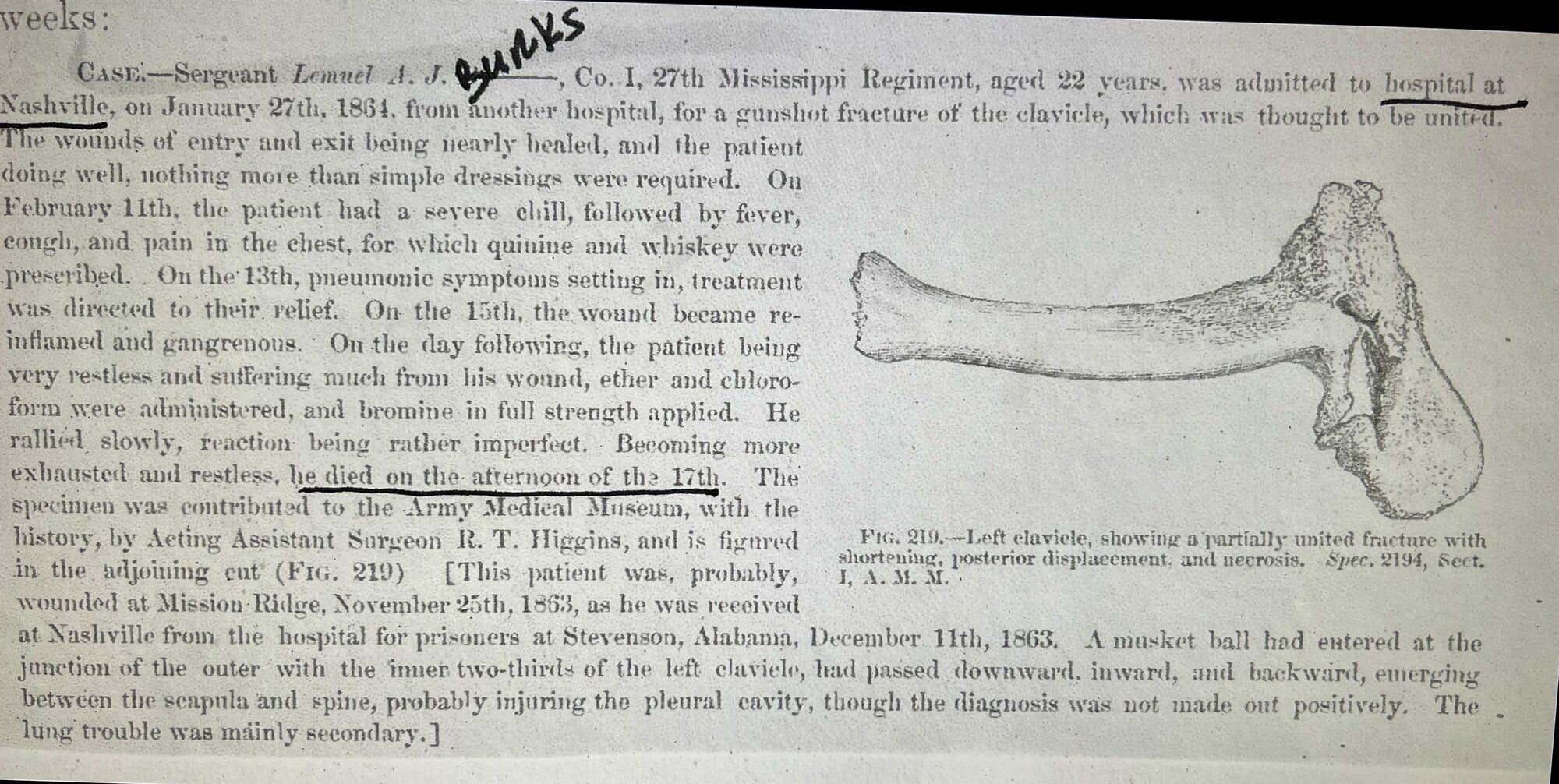
image_50412801.jpeg
 
Welcome from the Researching Civil War Records and Ancestry forum. I see Lemuel enlisted at Buena Vista, Mississippi. Were the rest of your family living in Chickasaw County also? I have folks from around there, some of whom served in the 2nd MS cavalry (though possible not the same unit since there is a state and a CSA 2nd MS cavalry if I remember correctly).
 
The medical museum staff in Silver Spring are pretty sure it is from one of the volumes of "Medical and Surgical History of the War of the Rebellion."
I guess you have the link to those? If not, here is the link I believe I found on a post by @John Hartwell
It makes for interesting (although often very, very sad) reading if you are curious about medical treatment in the war.

 
Last edited:
A look at the Census records for 1830 through 1860 showed that their father owned an increasing number of slaves -- 18 at the beginning of the war. I had heard rumors that there was some slaveholding among some of my families in the South, but to see the males and females and their ages tallied on 1860 Census Schedule 2 came to me as a shock.
Owning 18 slaves puts your family way above the average of most Southern slave owners.

But I understand your shock.

I just finished reading a study of a late War Union raid into my county.
An entire chapter of appendix pages document testimonies from the (1870's) Post War United States Southern Claims Commission.
(Civilians testifying about what the Union confiscated from their property back in 1864, and how much the US Government owed them).


I was also shocked when I saw many family and local names swearing they were Unionist from the start of the War.
I don't believe any of these relatives !
Gawd, most of these families provided multiple sons to the Confederate cause.

But, when one starts to research their ancestry, they should be prepared to uncover some facts that they might not have expected.
 
Last edited:
Mostly Yankees (Wisconsin, Michigan, Mass.) on Dad's side, but Mom's is mostly Southern families, which I am paying attention to these days and I am finding a bunch of connections to the Confederacy, which of course is no surprise. In looking at the siblings of my second great-grandmother, six of her seven brothers served the CSA in one capacity or the other: three in the 2nd Miss. Cavalry, one in the 20th Regiment, Graham's Infantry, one in the 27th Miss. Infantry and the very youngest (Rufus Henry Burks, born 1849) shown as having served in the Harris Regiment of the Mississippi Militia, or so it says on his tombstone in Austin, Texas.
I took a particular interest in my ggg Uncle Lemuel Burks, Sgt., Co. I, 27th Mississippi Infantry after learning that his death from gangrene was unusual enough to merit his damaged clavicle being removed upon his death by the acting assistant surgeon at the Union hospital in Nashville and sent, with notes, to the Army Medical Museum. Upon my inquiry, staff there are currently searching to see if it is still in the collections. Uncle Lem had taken a musket ball through the clavicle and out the back at Missionary Ridge, and appeared to be healing well. But in mid-Febuary, he developed an infection that proved fatal on the 17th.
Why did six of the seven boys serve the Confederate military, I wondered. (The eldest did not; he was a minister.) A look at the Census records for 1830 through 1860 showed that their father owned an increasing number of slaves -- 18 at the beginning of the war. I had heard rumors that there was some slaveholding among some of my families in the South, but to see the males and females and their ages tallied on 1860 Census Schedule 2 came to me as a shock.
Here is the entry on Uncle Lem. The medical museum staff in Silver Spring are pretty sure it is from one of the volumes of "Medical and Surgical History of the War of the Rebellion."

View attachment 483054


You never know what kinds of ghosts you will find rattlin' around in the closet, I've found a few.
 
7th Miss.: One thing I learned recently from reading Bruce Levine's "Fall of the House of Dixie" was that a person who owned 20 or more slaves was termed a "planter" by the Census Bureau.
I've looked at many actual (pre War) US Census records.

Many men that owned far less than twenty slaves were listed as "planters".
Such descriptions in an official census lead me to believe there was really no distinction between "planter" & "farmer".

Just my conclusion.
 
I got a nice email this afternoon from Dr. Kristen Pearlstein confirming that my ggg uncle's clavicle is no longer in the collections of the National Museum of Health and Medicine. But she forwarded the actual case citation from the "Medical and Surgical History of the War of the Rebellion" as well as scans of Dr. Higgins' original hand-written note that accompanied the clavicle. There is simply no record of the removal of the artifact -- the "deaccessioning" in museum speak -- from the museum, but nearly half the specimens in inventory shortly after the war are gone. As I told my extended family, I hope it was in a wheelbarrow load of bone fragments quietly buried somewhere on the grounds long ago, and that one of the lusty lads who did the digging said afterward, in an Irish brogue, "Surely there's a pint for the trouble that's in it."
 
So, so true. Family history, like any history, is a messy business. But fascinating.
It is messy. I once was tracing down a distant relative on my father's side of the family and found out that he possibly had served in Fielding Hurst's 6th West Tennessee Cavalry Regiment, by any measure one of the most despicable Union "Tory" units raised in Tennessee. I suppose it you look long and hard enough, you're always going to find some skeletons.
 
I suppose it you look long and hard enough, you're always going to find some skeletons.
Yep.

There are skeletons in every family.
Both North & South.

In my above comment, what shocked me the most ... was the fact many of these relatives that were testifying that they had supported the Union ... were the same folks that had spent quite a bit of money with New Orleans tailors. ( making sure their son's officer uniforms complied with CSA Regulations).

However, not all "changed their tune":
Some relatives remained defiant toward the USA until the 1900's.
The ones screaming about their Union loyalty seem to be only interested in getting a dollar or two from the US Government.

Yeah, I can say that.
I'm talking about a few folks in my own family.

Once again, family research may change everything one grew up hearing from their Parents & Grandparents.
 
My 3G from New Orleans was married to lady from Lancaster County, PA. There is no family lore on how this happened. I often wonder how they felt towards their family in PA and visa versus.
Where did they live after the war? Was he in a regiment that fought in PA? There are stories of deserters of both armies being sheltered by locals and falling in love with the family's daughter. A young man from a North Carolina regiment did that at Gettysburg I believe. Not everyone is cut out for war, but love generally wins over all of us. I think that's a great family story 😉
 

Learn About Us
About CivilWarTalk
Contact the Webmaster
Meet the Staff
Link to CivilWarTalk
Join Our Community
Register
Browse Forums
View Today's Discussions
Search the Forum
Get Help
FAQ
Student Guide
Forum Rules & Etiquette
Copyright / DMCA

     Contact Us CivilwarTalk on Facebook CivilWarTalk on YouTube CivilWarTalk on Twitter RSS Feed

Bringing the American Civil War and More to Life.
© 1999 - , CIVILWARTALK, LLC - Site Version 10.0

SlaveryTalk.com - SecessionTalk.com - CivilWarTalk.com - ReconstructionTalk.com
Back
Top