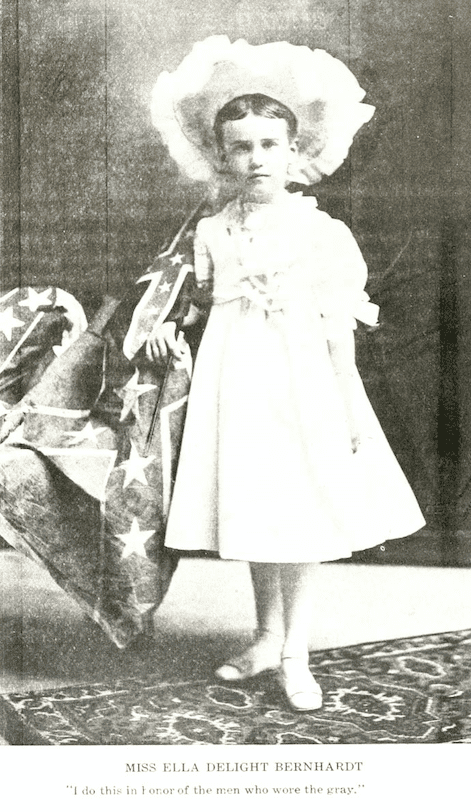
Miss Ella Delight Bernhardt

Mike Serpa

Lt. Colonel
Joined
Jan 24, 2013
She unveiled the Monument to the Confederate Soldiers from Caldwell County on June 3, 1910, at Lenoir, N.C.
EDB.png

qiebv.png

Reminscences of Caldwell County, N. C. in the Great War of 1861-65
https://archive.org/stream/reminscencesofca00harp#page/n7/mode/2up
 
"Dell" Bernhardt was born in 1903. She attended Agnes Scott College and married Thomas Henry Wilson in 1926. She died at Chapel Hill in 1984.
 
Last edited:
She unveiled the Monument to the Confederate Soldiers from Caldwell County on June 3, 1910, at Lenoir, N.C.
View attachment 116608
View attachment 116609
Reminscences of Caldwell County, N. C. in the Great War of 1861-65
https://archive.org/stream/reminscencesofca00harp#page/n7/mode/2up
The first pic is confusing because I distinctly recall @jgoodguy stating that the CBF was not displayed in the South after the war until the Civil Rights battles of the post WW2 era. He was sure of it.
 
What a great name! " Ella Delight ' . You can't beat that name with a stick or a frilly parasol. It makes you hope she was a cheerful kind of child and grew into one of those women who was pleasant, rain, shine or ugly gossip. With that name, you'd feel a little cheated if she did not.
 
The first pic is confusing because I distinctly recall @jgoodguy stating that the CBF was not displayed in the South after the war until the Civil Rights battles of the post WW2 era. He was sure of it.

Expired Image Removed

It was confined almost exclusively to events and venues, like the OP monument dedication in North Carolina, that dealt with veterans and memorial events. And as the veterans gradually passed away over the years, it was seen less and less. The modern useage of the CBF as generic political/cultural symbol of the South as a whole, really began with its adoption in the late 1940s by the States' Rights Democratic Party, popularly known as the Dixiecrats, that split off from the national Democratic Party. (Image above from the 1948 Dixiecrat national convention in Birmingham.) From the Encyclopedia of Alabama:

The more immediate impetus for the movement, however, included President Harry Truman's civil rights program, introduced in February 1948; the civil rights plank in the national Democratic Party's 1948 presidential platform; and the unprecedented political mobilization of southern blacks in the wake of the U.S. Supreme Court decision in Smith v. Allwright in 1944. In this Texas case, the Court ruled the white primary law violated the Fifteenth Amendment and was therefore unconstitutional. The states of the Upper South acquiesced in the ruling, but the decision was a political bombshell in the Deep South. White legislators across the region sought ways to circumvent the ruling, and African Americans organized voter-registration campaigns. Across the South, more than a half million African Americans registered to vote in the 1946 Democratic Party primaries.
This transition from its previous use by veterans, for veterans' events, to a more generic regional political and cultural symbol, is discussed thoroughly in John Coski's book.
 
Last edited:
Ella appears to have been forsaken.

I don't say that lightly. She said " I do this for the men who wore gray ", which meant a lot.

It took until the early 1870's for Confederate dead to be exhumed and brought from Gettysburg, PA to Richmond, at least. It was awful. Families knew their sons, brothers, fathers and husbands had marched into those terrible days but were never heard from again and were frantic. In the shambles post battle heck, dead lay unburied for weeks- barest inches of dirt served as graves for those who could be buried.

There's thread in Ladies Tea on the efforts to exhume and bring The Gettysburg Dead, home. Funeral processions met the coffins, some down at Rocketts, wound through Richmond to Hollywood where another mass grave had been prepared. There was just no hope of individual identification despite some incredible efforts made at doing so. Finances were a major impediment. Money raised went to exhuming and transporting the fallen ( although why the government could not have stepped in is beyond me ) .

I'm sorry, and am certain as a point of pride their flag, and probably flags from known regiments were in evidence. From reading accounts the color black predominated these processions. Defy anyone to read the non-embellished ( especially for Victorians ) newspaper accounts of bringing home the Gettysburg Dead- men who had fallen with their regiments, wearing gray, without crying. I sure did. I'm sincerely, honestly not taking sides or making a commentary on any flag or date or on the Confederacy in bringing The Gettysburg Dead into Ella Delight's conversation. It's just what struck me, that's all. " The men who wore gray ". I seem to remember the thread did not attract a ton of interest which is fine. It's there, which is what matters. Thank you, Ella.
 

Learn About Us
About CivilWarTalk
Contact the Webmaster
Meet the Staff
Link to CivilWarTalk
Join Our Community
Register
Browse Forums
View Today's Discussions
Search the Forum
Get Help
FAQ
Student Guide
Forum Rules & Etiquette
Copyright / DMCA

     Contact Us CivilwarTalk on Facebook CivilWarTalk on YouTube CivilWarTalk on Twitter RSS Feed

Bringing the American Civil War and More to Life.
© 1999 - , CIVILWARTALK, LLC - Site Version 10.0

SlaveryTalk.com - SecessionTalk.com - CivilWarTalk.com - ReconstructionTalk.com
Back
Top