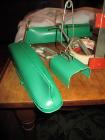
Minor mystery solved

I typed Lindberg Lines in Google, and a site with all the old kits came up. There is another one called Model cars, which actually has models of everything from dozens of different manufacturers, it's on there too. Once you've typed in LL, make your choice basically.
Great, thanks!
 
Lindburg huh, OK, I'll be showing my years now. She was originally a PYRO kit going back to the late 50's
Correct me if I am wrong but ss a blockade runner the model has a HUGE fault. She has side wheels. Her steam plant was removed and then she went into the blockade running buisness.

An especally sad fact about her, When she was Captured, a Union Officer by the name of Lt Lea (or Lee) was a casualty, The Confederate Officer who assisted in the operation and was on shore in Galveston, Major Lea (or Lee) ,, Father killing Son.
 
Last edited:
Lavinia (ex-Harriet Lane) was still a sidewheel steamer when she made her single run through the blockade from Galveston to Havana, in April/May 1864. She was otherwise much changed in appearance, though.

Expired Image Removed
An honor guard stands at the grave of Lt. Commander Edward Lea. Lea's stone (right) carries his dying words, "my father is here." January 8, 2011.
 
One of my birthday gifts this year was a plastic model kit, advertised as a blockade runner.
Send us a picture of the finished product.

Expired Image Removed

This is the image off the box. Now, there are a couple of odd things about it... one of which is that it appears to be flying a Revolutionary War flag, and also that on the box it was labeled as both a "Confederate Blockade Runner" and a "Union Steam Frigate."

The mystery was resolved when I opened the box and discovered that there were three sets of decals, including a Coast Guard flag... it's actually the Harriet Lane! Which did function (relatively briefly) as a blockade runner after her capture at Galveston, and had been a Union navy gunboat (although "frigate" is still a stretch).

I had been a little concerned, because as a "steam frigate" or a "blockade runner," it didn't seem to look the part; but as the Harriet Lane, it looks reasonably accurate. I don't know if she was ever photographed, but the various illustrations I've seen of her seem to indicate that it's a decent model of her.
 
Model Expo produces a solid hull wooden kit of the Harriet Lane.
p2760b.jpg

http://www.modelexpo-online.com/product.asp?ITEMNO=MS2010
 
My turn to be ignorant.

A revenue cutter could be any ship or boat that ran around making sure that inbound cargo ships went through the proper procedures; that is, it wasn't something like a sloop or ketch. It was not specifically designed as a revenue cutter. Any boat/ship/tub could be a revenue cutter.

Right? Or wrong?
 
Ole, correct. A "cutter" can be a specific type of sailing vessel (which is where the name comes from), but by the 19th century Treasury vessels were generally known as cutters, as they still are today.

Modern U.S. Coast Guard Cutter Harriet Lane:
Expired Image Removed
 
Expired Image Removed

The original Roger B. Taney kit was also marketed as by Pyro as "The Independence War Schooner," one of the first ships of the Texas Navy in the 1830s. This is reasonable, as Independence was originally a U.S. revenue cutter of that same class. However, when Lindberg re-released the kit, they garbled the name and made it a "War of Independence Schooner." Do'oh!

4ba91de650915_147076n.jpg
 
Last edited:
Ole, correct. A "cutter" can be a specific type of sailing vessel (which is where the name comes from), but by the 19th century Treasury vessels were generally known as cutters, as they still are today.

Ironically the Revenue Cutter Service almost never used actual cutters, single-masted sailing craft (I say almost to cover my stern, but I'm not aware of any at all). The service was modeled, by Alexander Hamilton, our first Secretary of the Treasury, on the British customs which did use cutters. He got Congress to authorize a "revenue cutter service"; but the actual vessels were mainly schooners, the common American type. As Andy said, "cutter" became a generic for any vessel in the service or its successor, the US Coast Guard.
 
Very interesting thread.... as a kid was more interested in WW2 tank and plane models... other than ships, there wasn't that much civil war related available out there....

A old family friend.. that was most active during the civil war centennial era.. that collected anything and everything.. a couple years ago gave me a large molded plastic model of the CSS Alabama... untouched still in the original box from the 1950-60 era... Looks to have a billion parts to it.....lol... He cut out the image off the top of the box and framed it...lol.... otherwise the kit is fully intact in the remainder of the box.... maybe one day when time allows during the winter months might try to tackle it....lol.... Hadnt thought about it in a couple years till I read this thread.....
 
From what I've read, when the Confederates captured the Harriet Lane they found a substantial amount of green paint in her supply lockers and promptly changed her appearance.
 
From what I've read, when the Confederates captured the Harriet Lane they found a substantial amount of green paint in her supply lockers and promptly changed her appearance.

I have not come across that, but it's possible. There are a number of modern images that show her green, but I honestly never thought much about it. She was changed substantially in appearance, but it didn't make much of a difference, given that the U.S. Navy was appalled by her capture, and fairly obsessed with getting her back. They really were fixated on her. They repeatedly tried bombarding her from long range, with little success, until in early February 1863 the Confederates had her towed up the bay and out of sight so repairs and modifications could be made. Renamed Lavinia, she eventually ran out of Galveston with two other ships in a rain squall at the end of April 1864, and successfully reached Havana. She remained there until the end of the war.
 
Last edited:
I'd read where the haze grey /white upperworks paint jobs on blockade runners was meant to exploit the cover of fog during certain times of the year.

Yesterday (Christmas) there was a fog advisory along the New Jersey coast, with visibility 75-100m tops along the intercoastal waterway. I can see where a grey/white ship would completely disappear into that sort of soup.
 
I'd read where the haze grey /white upperworks paint jobs on blockade runners was meant to exploit the cover of fog during certain times of the year.

Haze gray, as it's called now, proved to be the best all-around color for blending into the background across all conditions of weather and light. They figured that out largely by trial-and-error during the ACW, and many U.S. blockading vessels were painted the same way.

Heavy fog and overcast here in Galveston yesterday, sunny but still with fog today. Typical for this time of year. Cold front comes through tomorrow evening that should knock down the fog right quick.
 

Learn About Us
About CivilWarTalk
Contact the Webmaster
Meet the Staff
Link to CivilWarTalk
Join Our Community
Register
Browse Forums
View Today's Discussions
Search the Forum
Get Help
FAQ
Student Guide
Forum Rules & Etiquette
Copyright / DMCA

     Contact Us CivilwarTalk on Facebook CivilWarTalk on YouTube CivilWarTalk on Twitter RSS Feed

Bringing the American Civil War and More to Life.
© 1999 - , CIVILWARTALK, LLC - Site Version 10.0

SlaveryTalk.com - SecessionTalk.com - CivilWarTalk.com - ReconstructionTalk.com
Back
Top