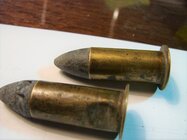
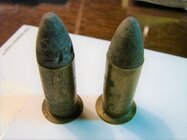
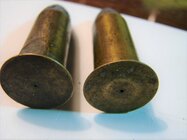
Just found these inside a 1861 Dated Portable Officers Desk. They are approx. 1.85" X .544"...and with their distincitive bases..think they might be .54 Cal Maynard. (Photos attached)...Any help would be appreciated.
They are Maynard's. I believe .50 caliber which would be 1.72" long and .525" diameter. M&M #169 or T&T # 78 if you have access to the cartridge books. The two sizes would have been .35 & .50 by Maynard. Often .36 or .37 in the South
I just "miked" them again...still 1.87" in length and .54" width...did they make any larger size Maynards? and just another "dumb" question..is the wide base only found on Maynards? thanks for all your imput..
They came in 35, 50 & 52 cal. The what I call Maynard dime on the base is a Maynard design and not on any other carbine bullet. We call them the Maynard Dime as they sound like a dime when you find one with a metal detector.
Richard, I just went through "Round Ball to Rimfire Pt.4". Only list .35 & .50. I know the South used .36 or .37 as the 35 so maybe your 52 is the 50. Now "Civil War Projectiles II" by McKee & Mason does list a .51 Maynard at .52 and a .54 Maynard at .557 . Were there a Confederate made carbines that took the larger diameters?
MAYNARD ARMS COMPANY
INVENTORY AS OF OCTOBER I. 1860
Caliber Length Type Quantity
.50 20 inch Sporting 459
.50 20 inch Military 676
.50 26 inch Sporting 142
.50 26 inch Military 160
.35 20 inch Sporting 1.326
.35 20 inch Military 425
.35 26 inch Military 13
Total 3.201
Dr. Maynard seemed to think he was making .50 and .35 caliber guns.
This inventory can be found in several of John AcCauleys excellent works on Carbines, and specifically Maynards. Most of this inventory was purchased by Southern states.