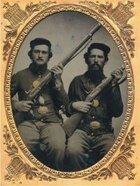
Lorenz Rifle

MattlMaier89

Private
Joined
Mar 13, 2016
I have heard a few things about the Lorenz rifle, namely that a). it was the third most common small arm used during the Civil War and b). that it was not nearly as well received as either the Springfield 1861 or the P53 Enfield due in large part to quality control issues rising from a lack of interchangeability in parts due to them being hand fitted, and also that many firms did work of dubious quality when reboring the barrels to accept the .58 caliber ammunition in common use on both sides. However, I do take these with a grain of salt as I have not yet read any historically verified sources on many of the small arms used during the conflict. Just how common was the Lorenz rifle among Union and Confederate forces? And what did the troops who used them think of them?
 
You find this article of interest:

http://weaponsman.com/?p=18348

Lore of the Lorenz

union_riflemen_with_lorenzes_fleming_collection-227x300.jpg


Union Riflemen with two of the 300,000+ Lorenzes that saw service on both sides. Matthew Fleming collection via Civil War Times.
 

Attachments

  • union_riflemen_with_lorenzes_fleming_collection-227x300.jpg
    union_riflemen_with_lorenzes_fleming_collection-227x300.jpg
    20.8 KB · Views: 136
I can tell you that there were serious issues with the Lorenz, there are quite a few accounts of soldiers abandoning their weapons and exchanging them for Enfields, Springfields or other long arms.

In addition to the above, a very good friend of mine purchased a Lorenz that was picked up off the battlefield in Williamsburg, VA, in great outward condition, but when you put a ramrod down the barrel, find that lead collected in a barrel flaw. Finding this blockage gave us the reason for a perfectly good rifled musket being abandoned within the Union lines at Williamsburg.

Additionally, I have a Lorenz attributed to the 12th VA Inf., that has the lock virtually blown out of the stock as a result of the same barrel anomaly. During my 20+ years of collecting I have seen more Lorenz rifled muskets at shows, with blown locks. than any other musket.
 
Interesting comment on the Lorenz blowing the locks off the arm. That would have to be a bolster failure, for to blow the lock off the arm, the bolster would have to be blown off the barrel. My personal experience in 55+ years of collecting ACW arms is such that I have never seen an example of this phenomenon! The only bolsters I have seen blown off, where the lock was also blown off, were smokeless powder loads in muzzle loaders which detonated like a hand grenade. They not only virtually vaporized the breech of the barrel they also blew the locks off the arm, too.
J.
 
Interesting comment on the Lorenz blowing the locks off the arm. That would have to be a bolster failure, for to blow the lock off the arm, the bolster would have to be blown off the barrel. My personal experience in 55+ years of collecting ACW arms is such that I have never seen an example of this phenomenon! The only bolsters I have seen blown off, where the lock was also blown off, were smokeless powder loads in muzzle loaders which detonated like a hand grenade. They not only virtually vaporized the breech of the barrel they also blew the locks off the arm, too.
J.
I assume back pressure from a clogged bore, but if one looks at enough Lorenz muskets you will find at least a third have cracks all around the wood surrounding the lock. I attribute this to improper rifling during the machining process, somewhere, I read that many Lorenz muskets had this problem and lead would build up, once this occurs, the soldier is SOL. I used to collect Lorenz muskets and I know that I had three with this defect out of 8, I now only have two, the 12th VA and a killer piece I got from Dave Taylor about 10 years ago, I was going to reenact with it, but decided it was too nice.
 
A) Yes, technically they are considered the third most used longarm of the Civil War era. Roughly 225,000 were imported by the North and some 80,000 to 100,000 by the South. However, there were approximately 625,000 M1816 muskets produced prior to the war. Obviously not all of them saw even the slightest usage during the Civil War, but in all probability there were at least as many M1816s in service throughout the war as there were Muster 1854 rifle-muskets.
B) Reviews were mixed from troops. Don Dixon, our resident Austrian expert can clarify on these points, but generally speaking troops were untrained as to how to properly aim with Austrian arms, domestically produced ammunition was improperly sized for originally bored M1854 rifle-muskets and/or powder charges were too much. Thirdly, attempts to bore mostly commercially made Lorenz rifle-muskets were not entirely successful and further complicated issues with improperly sized ammunition. The fact that M1854s are hand made is a moot point as the vast majority of P1853s imported for the war were all hand made as well.

Cheers,
Garrett
 
A reason for the complaints you will sometimes read about the Austrian Model 1854 (Lorenz) is that many of them were heavily used in earlier European wars by the Austrians fighting in Italy prior to being sold off as surplus when newer models replaced them. Read what Leander Stillwell of the 61st IL had to say about his 1854 Austrian rifle in his memoirs (Story of a Common Soldier of Army Life in the Civil War 1861-1865), as he was apparently quite pleased with his Lorenz. I believe he refers to it a "wicked good shooter."

Conversely, the vast majorities of Enfield rifles (while also hand made) were either newly manufactured on commercial contract or otherwise not heavily used, if at all. Still, you would have to say opinions varied on the serviceability of the Austrian rifles...they were a mixed lot. And some were obviously better than others.
 
Last edited:
I have heard a few things about the Lorenz rifle, namely that a). it was the third most common small arm used during the Civil War and b). that it was not nearly as well received as either the Springfield 1861 or the P53 Enfield due in large part to quality control issues rising from a lack of interchangeability in parts due to them being hand fitted, and also that many firms did work of dubious quality when reboring the barrels to accept the .58 caliber ammunition in common use on both sides. However, I do take these with a grain of salt as I have not yet read any historically verified sources on many of the small arms used during the conflict. Just how common was the Lorenz rifle among Union and Confederate forces? And what did the troops who used them think of them?

The Muster 1854 System Lorenz rifle was the third most commonly used firearm over the duration of the Civil War. Well in excess of 200,000 were imported by the Federals. MAJ Huse purchased 100,000 for the Confederates, with somewhat more than 80,000 having made it through the blockade. Other suppliers provided additional numbers to the Confederates, but documentation is unclear. So far, I can document that at least 550 Federal regiments were armed with some number of them at some point in time during the War. Additional numbers were used by home guard units who saw combat. Confederate regimental numbers are more difficult to pin down due to the lack of records. But, in 1863-5 a third or more of the Army of Tennessee was armed with Muster 1854 System Lorenz rifles.

The only interchangeable muzzle loading rifle muskets were Springfields, and imported London Armoury made Enfields. ALL other rifle muskets were the product of artisanal technology which used parts hand and machine made to semi-standard gauges.

Some of the ".54" to .58 caliber conversion work did not meet standard. But, MAJ Hagner and CPT Crisptin at the New York Ordnance Office accepted bored out arms -- .59 and .60 caliber -- at a reduced price which should have been rejected. The question is, was the Federal Army so desperate for anything that went bang that they had to accept them or was Hagner corrupt. As an old Federal criminal investigator I would dearly love to have a shot at Hagner's financial records.

Among the larger problems were:

The Federal .54 caliber ammunition at .537 inches was seriously undersized for the ,547 inch bore of the Muster 1854 rifle. Despite this, the Federal Ordnance Department blindly and stupidly insisted that U.S. standard .54 caliber ammunition could be used in Muster 1854 rifles. This resulted in accuracy problems.

Fixed sighted firearms are designed to shoot a standard bullet at a standard velocity, and the sights are graduated for that standard bullet and velocity. If you change the cartridge, the sights no longer match the cartridge. By issuing Muster 1854 rifles with Federal ammunition without changing out the sights on the rifles, the Federal Ordnance Department guaranteed that the sights would not be calibrated to the cartridges they were issuing.

Neither the Federals nor the Confederates EVER translated the Austrian manual for the Muster 1854 rifle. The manual provided explanations for all of the problems complained of by the troops. The manual, for example, explained that the breech of the rifle required very careful cleaning because it was slightly relieved to permit the bullet to slug up and then be squeezed down in a variation of the progressive rifling concept. Never having read the manual, and never having been taught how to properly clean their rifles, the troops complained that the weapons fouled at the breech. They may also have collected lead at the breech since they had not been designed by Ritter von Lorenz to be fired with Minie balls. Firearms are designed as a system, and you screw with it at your peril. When the U.S. Army changed the powder load in 5.56 mm ammunition during the Viet Nam War without adequate testing, M-16 rifles literaly tore themselves apart. But, the officials who made that decision no doubt got suitably meritorious gongs for their "service."

Marksmanship training on both sides was essentially non-existent. Being a "farmer" or a "hunter" by itself does not produce the skill set necessary to shoot military firearms at militarily useful distances under the pressure of combat. A similar situation is true of modern troops who confuse the possession of a penis and testicles with an ability to shoot. Federal units that actually trained with their Austrian rifles generally liked them.

Much of this has been covered in prior posts. The search function is your friend.

Regards,
Don Dixon
 
I have always wondered if many of the complaints about foreign muskets was due to the fact that they were foreign. The American Party, better known as the Know Nothings, was a serious third party in the 1850s. The American Party wanted to limit immigration and even ban naturalized citizens and Catholics from holding political office. Maybe because the issued arm was made in Europe, the soldiers were more critical and looked for reasons to complain. Of course, the Enfield was an exception.
 
I have always wondered if many of the complaints about foreign muskets was due to the fact that they were foreign. The American Party, better known as the Know Nothings, was a serious third party in the 1850s. The American Party wanted to limit immigration and even ban naturalized citizens and Catholics from holding political office. Maybe because the issued arm was made in Europe, the soldiers were more critical and looked for reasons to complain. Of course, the Enfield was an exception.
I would think that the common soldier was more concerned with his immediate surroundings and how his weapon performed, how his accouterments and brogans felt on his person during a 17 mile march, how the uniform and headgear fit..........I don't think they were concerned about the manufacturing company or country. I would actually say that since Europe was looked to and copied militarily, that soldiers would give those accouterments and weapons the benefit of the doubt.
 
US arms were generally of higher quality than their counterparts from the continent. Add in that many of those European arms had seen hard use prior to their arrival in the US and it becomes somewhat understandable.

The Lorenz ran the gamut from new to 20 years old or more.
 
US arms were generally of higher quality than their counterparts from the continent. Add in that many of those European arms had seen hard use prior to their arrival in the US and it becomes somewhat understandable.

The Lorenz ran the gamut from new to 20 years old or more.

Not disagreeing with your basic point, but wasn't the Lorenz rifle only standardized by the Austrians in 1854? "20 years old" in the 1860s would be impossible.

My understanding is the initial batches purchased as surplus from Austrian Army stocks were available because the Austrians were switching from the existing design with iron barrels to a modified version with steel barrels, and these weapons - a few years old at most - were generally regarded as well made and reliable (although not with truly interchangeable parts, since they were not made on the equivalent of the Springfield and similar standards of production.)

However, the version of the Lorenz made by Austrian manufacturers specifically for the arms trade in 1861-63 tended to be of much more varied quality, including caliber, and these are among the weapons that were seen as second-rate.

Best,
 
Last edited:
The Lorenz Rifle was used by the Austrians. But they were very unreliable. It was a gamble to purchase one, because some were superior to the Enfield, and some were poor quality, especially in later purchases.

"
The third most widely used weapon of the Civil War was the Lorenz Rifle. This rifle was invented in 1854 by Austrian lieutenant Joseph Lorenz. This rifle had first seen action in the Second Italian War of Independence.

The Lorenz rifle was similar in design to the Enfield rifle-musket. It used a percussion lock, was similar in length, and had three barrel bands, like the Springfield and Enfield. The Lorenz rifle was originally .54 caliber. A large number were bored out to .58 caliber so that they could use the same ammunition as the Springfield and Enfield rifle-muskets.

The quality of Lorenz rifles during the Civil War was not consistent. Some were considered to be of the finest quality, and were sometimes praised as being superior to the Enfield. Others, especially those in later purchases, were described as horrible in both design and condition. The bored out versions were not consistent in caliber, ranging from .57 to .59. Many of these poorer quality weapons were swapped out on the battlefield for Enfield rifle-muskets whenever one became available.

The Union purchased 226,924 Lorenz rifles, and the Confederacy bought as many as 100,000.[4]"

 
US arms were generally of higher quality than their counterparts from the continent.

Hopefully it isn't too off topic, but I think it depends what you're looking for. Springfields were mainly mass produced, and allowed for interchangeable parts. These made the Springfields more consistent. The model 1853 Enfields on the other hand were less consistent. Some were made with poor metallurgy, some were superior to the Springfield. They were hand made, so it really depended on the skill of the maker.

Here's an interesting excerpt:

"The Springfield were really good guns and virtually all rifled muskets were accurate out to 500 yrds. Tests conducted by the Confederates in both the Army of Northern Virginia and the Army of Tennessee led them to (independently conclude) that the Enfield was more accurate at longer ranges (500 to 1000) yards. Hence the Enfield (particularly the shorter 2 band 33" model) was saved for the sharpshooter battalions."
 
The Lorenz Rifle was used by the Austrians. But they were very unreliable. It was a gamble to purchase one, because some were superior to the Enfield, and some were poor quality, especially in later purchases.

"
The third most widely used weapon of the Civil War was the Lorenz Rifle. This rifle was invented in 1854 by Austrian lieutenant Joseph Lorenz. This rifle had first seen action in the Second Italian War of Independence.

The Lorenz rifle was similar in design to the Enfield rifle-musket. It used a percussion lock, was similar in length, and had three barrel bands, like the Springfield and Enfield. The Lorenz rifle was originally .54 caliber. A large number were bored out to .58 caliber so that they could use the same ammunition as the Springfield and Enfield rifle-muskets.

The quality of Lorenz rifles during the Civil War was not consistent. Some were considered to be of the finest quality, and were sometimes praised as being superior to the Enfield. Others, especially those in later purchases, were described as horrible in both design and condition. The bored out versions were not consistent in caliber, ranging from .57 to .59. Many of these poorer quality weapons were swapped out on the battlefield for Enfield rifle-muskets whenever one became available.

The Union purchased 226,924 Lorenz rifles, and the Confederacy bought as many as 100,000.[4]"


"Very" unreliable seems an overstatement. Your own source states the case differently, for example.

Best,
 
  • Like
Reactions: Bee
I don't think you read the full post. I said it was a gamble, since the production quality was inconsistent. Especially the later purchases, tended to be very unreliable.

Which is pretty what was said in the previous post...

Quite a few of the European firearms manufactured for export and purchased in 1863, even some of the Birmingham- and Leige-made variants of the P53 Enfields were shoddy goods, based on what I've read. The late-war Austrian-made Lorenz' don't seem to be vastly out of line. US troops traded up from percussion M1822s and M1842s when good quality Enfields were available, but they turned in Enfields for M1855, M1861, and M1863 Springfields when those became available; even Richmond-made copies of the US standard models were preferred to Enfields at times.

The surplus weapons originally manufactured for the Austrian army were reported have been reliable weapons; the use of US-standard .54 ammunition appears to be one of the most significant issues, from what I've read.

Don Dixon's posts on this weapon seem pretty definitive.

Best,
 

Learn About Us
About CivilWarTalk
Contact the Webmaster
Meet the Staff
Link to CivilWarTalk
Join Our Community
Register
Browse Forums
View Today's Discussions
Search the Forum
Get Help
FAQ
Student Guide
Forum Rules & Etiquette
Copyright / DMCA

     Contact Us CivilwarTalk on Facebook CivilWarTalk on YouTube CivilWarTalk on Twitter RSS Feed

Bringing the American Civil War and More to Life.
© 1999 - , CIVILWARTALK, LLC - Site Version 10.0

SlaveryTalk.com - SecessionTalk.com - CivilWarTalk.com - ReconstructionTalk.com
Back
Top