
If Lee does not order Pickett to charge at Gettysburg, would it have been possible for the Confederates to win the battle. If they do win, and Lee asserts his dominance in the North after winning at Chancellorsville and Gettysburg, would the momentum have swung to the Confederates? Would if be possible for them to win the war?
-
Welcome to CivilWarTalk, a forum about the American Civil War! - Join today! It's fast, simple, and FREE!
You are using an out of date browser. It may not display this or other websites correctly.
You should upgrade or use an alternative browser.
You should upgrade or use an alternative browser.
Lee Doesn't Order Pickett's Charge
- Thread starter Sivart
- Start date

Stryker65
Captain
- Joined
- Jun 5, 2023
- Location
- William & Mary
There's no counter. "If Lee does not order Pickett to charge at Gettysburg" and instead...what? Attacks the left again? Attacks the right again? Retreats?
Apologies. I would think if the charge was not ordered, he would have been forced to retreat to a better position, or if he does attack, would that also be disastrous? In the case of a retreat, how would that affect the battle?There's no counter. "If Lee does not order Pickett to charge at Gettysburg" and instead...what? Attacks the left again? Attacks the right again? Retreats?

east_beast
Corporal
- Joined
- Jan 19, 2023
Win? No. For Lee to notch a strategic win in Gettysburg it would mean forcing Union retreat to continue his northern push. Given the terrain and the forces on the field that day, that simply wasn't going to happen without a hail Mary which led to the disastrous Pickett's Charge.
Avoid disaster? Yeah. He could've pulled back and not doubled down on a bad hand but Lee was what he was. When a hammer sees a nail there's only one thing to do. Lee saw an opposing force. There's only one thing to do - figure out how to attack.
Avoid disaster? Yeah. He could've pulled back and not doubled down on a bad hand but Lee was what he was. When a hammer sees a nail there's only one thing to do. Lee saw an opposing force. There's only one thing to do - figure out how to attack.
Stryker65
Captain
- Joined
- Jun 5, 2023
- Location
- William & Mary
Were he to attack any point in the Union line, it would be disastrous. The Union left now had the 6th Corps supporting it, the Union center was...as we know it to be, and the Union left had been heavily reinforced.Apologies. I would think if the charge was not ordered, he would have been forced to retreat to a better position, or if he does attack, would that also be disastrous? In the case of a retreat, how would that affect the battle?
Were he to retreat, it would not make any sense militarily, as Lee's army was not "broken" as it was after the charge. A retreat would cause loss of confidence in Lee, and (considering the rains to come) would be equally as disastrous as the actual retreat.
east_beast
Corporal
- Joined
- Jan 19, 2023
Can't agree with that. Not when plenty in the ranks knew they were holding a bad hand. Gotta know when to hold 'em and know when to fold 'em. You don't prove anything going all in on a bad hand. The poker analogy here isn't perfect since there was no chance of bluffing the Union into folding. They knew they were holding a winning hand.Were he to attack any point in the Union line, it would be disastrous. The Union left now had the 6th Corps supporting it, the Union center was...as we know it to be, and the Union left had been heavily reinforced.
Were he to retreat, it would not make any sense militarily, as Lee's army was not "broken" as it was after the charge. A retreat would cause loss of confidence in Lee, and (considering the rains to come) would be equally as disastrous as the actual retreat.
Stryker65
Captain
- Joined
- Jun 5, 2023
- Location
- William & Mary
Perhaps not, but they could sure bluff Meade into folding. At that July 2 conference he didn't seem that opposed to the idea of retreating.Can't agree with that. Not when plenty in the ranks knew they were holding a bad hand. Gotta know when to hold 'em and know when to fold 'em. You don't prove anything going all in on a bad hand. The poker analogy here isn't perfect since there was no chance of bluffing the Union into folding. They knew they were holding a winning hand.
Wizard of Cozz
Sergeant Major
- Joined
- Aug 20, 2021
This is so spot on. Reality is he couldn't retreat, and Meade's army wasn't broken. Maybe he could have fortified Seminary Ridge, and hoped that Meade would attack, but that would mean giving the Union the initiative, and after almost defeating them on day 2. Lee was in a very tough spot on day 3.Were he to attack any point in the Union line, it would be disastrous. The Union left now had the 6th Corps supporting it, the Union center was...as we know it to be, and the Union left had been heavily reinforced.
Were he to retreat, it would not make any sense militarily, as Lee's army was not "broken" as it was after the charge. A retreat would cause loss of confidence in Lee, and (considering the rains to come) would be equally as disastrous as the actual retreat.
Stryker65
Captain
- Joined
- Jun 5, 2023
- Location
- William & Mary
Wizard of Cozz
Sergeant Major
- Joined
- Aug 20, 2021
I agree, I think Meade would just wait Lee out, if Lee pulled back to seminary ridge. Lee's best move, may have been to move more troops to his left, to support Johnson at dawn, but instead Johnson gets suprised and driven out of his foothold on Culp's Hill. Once Johnson loses culp's hill, Lee probably should of pulled the entire 2nd corps around to the West of Gettysburg shortening his line. Meade only needed 2-3 brigades to defend the area, which tied up 2 of Lee's divisions. Moving around to the West would of been better than the alternative, though it's still not great options for him.Meade wasn't known particularly for attacking. He was an engineer, as @Joshism can attest to, and not a fight-fight-fighter like Hooker or Mower.

RedRover
1st Lieutenant
- Joined
- Dec 16, 2019
General Meade's army was as beaten up as Lee's by the evening of July 2. During the council of war that night, his subordinates' best estimate was there were about 58,000 still capable of rendering some service.
General Meade did not favor or suggest withdrawal on the night of the 2nd according to him and five of his corps commanders. He held the council of war to determine the condition of his army, so far as his corps commanders might report... and give their opinions of their position, etc. From General Meade's son, who served on his staff, notes the reports in the newspapers that Gen. Meade wanted to retreat were inventions. Also that the result of the council was rather a unanimous statement by the corps commanders that attacking the next day, or changing position, was not to advantage... but to remain and oppose any attack by Lee, etc.


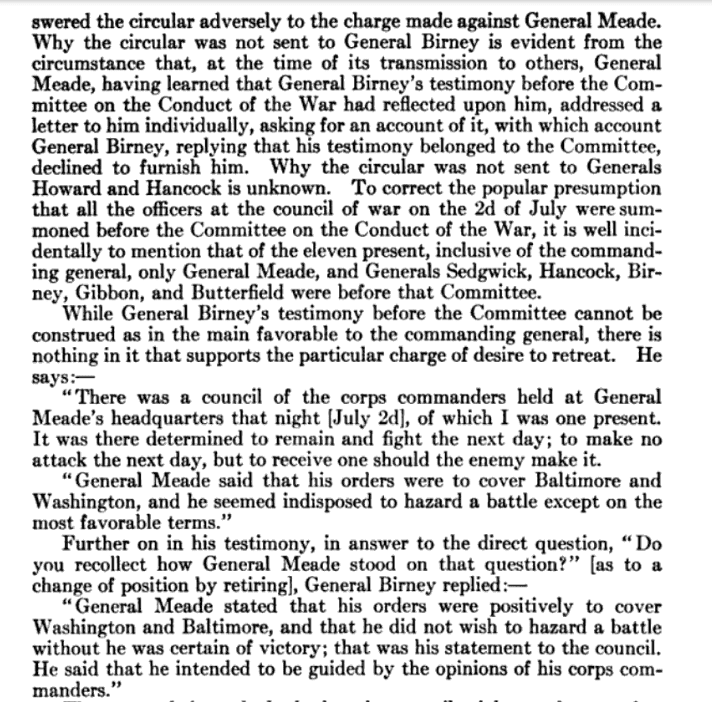


So, the immediate statement of Meade in the aftermath of the council of war was that for July 3 he would remain in his present position, come what may, but that he was yet too imperfectly advised of the actual condition of his army to decide upon offensive or defensive operations thereafter.
Immediately after the repulse of Pickett's-Pettigrew's charge on the afternoon of the 3rd, General Meade proceeded to the left of his army with the intention of launching it into an attack upon Lee's right... but this was found to be impracticable given the condition of the units and troops, etc. General Meade testified to the Congressional Committee on the conduct of the war...


General Meade did not favor or suggest withdrawal on the night of the 2nd according to him and five of his corps commanders. He held the council of war to determine the condition of his army, so far as his corps commanders might report... and give their opinions of their position, etc. From General Meade's son, who served on his staff, notes the reports in the newspapers that Gen. Meade wanted to retreat were inventions. Also that the result of the council was rather a unanimous statement by the corps commanders that attacking the next day, or changing position, was not to advantage... but to remain and oppose any attack by Lee, etc.
So, the immediate statement of Meade in the aftermath of the council of war was that for July 3 he would remain in his present position, come what may, but that he was yet too imperfectly advised of the actual condition of his army to decide upon offensive or defensive operations thereafter.
Immediately after the repulse of Pickett's-Pettigrew's charge on the afternoon of the 3rd, General Meade proceeded to the left of his army with the intention of launching it into an attack upon Lee's right... but this was found to be impracticable given the condition of the units and troops, etc. General Meade testified to the Congressional Committee on the conduct of the war...

13 IL Cav & 64 GA Inf
Captain
- Joined
- Jan 29, 2024
- Location
- Florida & Alabama (also GA & VA)
I love your expression relating to Lee's attitude, "When a hammer sees a nail..."Win? No. For Lee to notch a strategic win in Gettysburg it would mean forcing Union retreat to continue his northern push. Given the terrain and the forces on the field that day, that simply wasn't going to happen without a hail Mary which led to the disastrous Pickett's Charge.
Avoid disaster? Yeah. He could've pulled back and not doubled down on a bad hand but Lee was what he was. When a hammer sees a nail there's only one thing to do. Lee saw an opposing force. There's only one thing to do - figure out how to attack.

- Joined
- Jul 28, 2015
- Location
- New York City
There is the issue of timing. After the hard fought assaults on Day 2, Lee was convinced that a similar attack the following day would succeed given proper support. So under a scenario of no Pickett's Charge, it would likely mean that Lee had become soured on the results of Day 2 in its aftermath and had decided not to offer further battle at the present location. That leaves 3 alternatives: 1) concentrate the army including Ewell's wing in a defensive position along Seminary Ridge and await attack by Meade; 2) withdraw the army through the mountain passes back to Virginia; and 3) heed Longstreet's earlier advice to turn the federal left flank between it andIf Lee does not order Pickett to charge at Gettysburg, would it have been possible for the Confederates to win the battle
Washington and await attack at a more defensible position. The most likely option in that case is probably no. 2; it would conserve the gains of Day 1 and put the ANV in a defensive position, which was advocated by Longstreet all along. Of course, that presupposes that Meade would be the attacker soon thereafter. If not, and Meade chose to wait it out, the ANV could not sustain itself for long without a reliable supply of ammunition, food, and forage.

Josh The Lighthouse Guy
Major
- Joined
- Apr 30, 2012
- Location
- Jupiter, FL
After the hard fought assaults on Day 2, Lee was convinced that a similar attack the following day would succeed given proper support.
Essentially, Lee fell into the same "just one final hard push" fallacy on July 3, 1863 that Grant did June 3, 1864.

Desert Kid
1st Lieutenant
- Joined
- Dec 3, 2011
- Location
- Arizona
A crushing, striking blow to the center. Didn't work for either of them.Essentially, Lee fell into the same "just one final hard push" fallacy on July 3, 1863 that Grant did June 3, 1864.
13 IL Cav & 64 GA Inf
Captain
- Joined
- Jan 29, 2024
- Location
- Florida & Alabama (also GA & VA)
....but it's more painful to Lee than Grant since Lee could not replace losses and Grant could.A crushing, striking blow to the center. Didn't work for either of them.
- Joined
- Jul 28, 2015
- Location
- New York City
Although I would say that Grant's attack at Cold Harbor was more calculated than Lee's at Gettysburg. Grant understood that he had run out of room to conduct flanking maneuvers and was left with few options to continue the Overland Campaign. Rather than switch strategy by crossing the James River and striking the logistical lifelines to Richmond from the south (as did happen after the failure at Cold Harbor), Grant figured that one last effort to dislodge the ANV at Cold Harbor was worth taking and could shorten the war considerably.Essentially, Lee fell into the same "just one final hard push" fallacy on July 3, 1863 that Grant did June 3, 1864.

- Joined
- Apr 4, 2017
- Location
- Denver, CO
Once Stuart's cavalry had rejoined the Confederate army, a retreat back to Virginia was possible. Without the horrific results of July 3 the retreat is easier and the Confederate Army is much more dangerous. In a few days the news from Mississippi reaches the eastern states. Then its just speculation as to what happens next. The range of potential outcomes is enormous.There is the issue of timing. After the hard fought assaults on Day 2, Lee was convinced that a similar attack the following day would succeed given proper support. So under a scenario of no Pickett's Charge, it would likely mean that Lee had become soured on the results of Day 2 in its aftermath and had decided not to offer further battle at the present location. That leaves 3 alternatives: 1) concentrate the army including Ewell's wing in a defensive position along Seminary Ridge and await attack by Meade; 2) withdraw the army through the mountain passes back to Virginia; and 3) heed Longstreet's earlier advice to turn the federal left flank between it and
Washington and await attack at a more defensible position. The most likely option in that case is probably no. 2; it would conserve the gains of Day 1 and put the ANV in a defensive position, which was advocated by Longstreet all along. Of course, that presupposes that Meade would be the attacker soon thereafter. If not, and Meade chose to wait it out, the ANV could not sustain itself for long without a reliable supply of ammunition, food, and forage.
It puts Meade in a bit of a bad spot vis a vis pursuit as well, he still has 3 corps that are pretty mangled and Lee hasn't expended all his long range artillery ammunition. He'll have to be careful not to pursue closely enough that Lee gets another meeting engagement out of it.

Similar threads

- Replies
- 117
- Views
- 2K

- Replies
- 60
- Views
- 1K

- Replies
- 10
- Views
- 480
- Replies
- 11
- Views
- 215
- Replies
- 64
- Views
- 65
- Learn About Us
- ►About CivilWarTalk
- ►Contact the Webmaster
- ►Meet the Staff
- ►Link to CivilWarTalk
- Join Our Community
- ►Register
- ►Browse Forums
- ►View Today's Discussions
- ►Search the Forum
- Get Help
- ►FAQ
- ►Student Guide
- ►Forum Rules & Etiquette
- ►Copyright / DMCA
 Bringing the