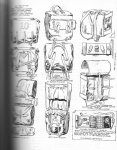
Knapsacks.

major bill

Brev. Brig. Gen'l
Forum Host
Joined
Aug 25, 2012
non-rigid
knap1.jpg

Semi-rigid

knap3.jpg

rigid
knap3.jpg

Knapsacks are one of the most hated but most needed piece of equipment. What soldier has not worn their pack until they were sure they were going to faint? You hate wearing it, but love the stuff in it when you use that stuff.

Huge number of knapsacks were made and issued during the Civil War. These came in two basic styles, Rigid and non-rigid with the semi-rigid being consider more of a non-ridge style. Rigid knapsacks had generally been replaced with the non-rigid types before the Civil War by the Army but lived on in the State militias. The rigid knapsacks looked better and most militia units did not engage in any field maneuvers that needed the comfort of a non-rigid knapsack. The correct Army term for the non-rigid knapsack used by the U.S. Army was U.S. Army Regulation Double-Bag Knapsack. Knapsacks were used through out the war and are seen at modern Civil War reenactments.

*edited for promotion purposes
 

Attachments
  • knap2.jpg
    knap2.jpg
    384.2 KB · Views: 455
Last edited by a moderator:
Confederate single bag knapsack made of a painted canvas material. Painted on the outside flap in white paint is "A CO. 25 REG. S.C."

With the item is a label that reads "ON LOAN, FOR DISPLAY, TO MCLEAN TOWN HALL FROM CAPT. J. CHURCH HATCH OF CO.C 76TH REGT. WHO ON AUG. 19, 1864 CAPTURED A STAND OF COLORS AND A CANVAS BAG FROM THE ENEMY. HE DISPLAYED GREAT BRAVERY IN THE ACT OF CROSSING THE REBEL WORKS AT THE BATTLE OF WELDON RAILROAD." The label looks to be from the 1890's or early 1900's. Captain Church is credited with capturing the colors of the 25th South Carolina in the Official Records and the 76th New York regimental history.

Captain J. Church Hatch was born in Groton, Tompkins County, New York. His Grandfather served in the American Revolution, three Uncles served in the War of 1812 and he lost a brother in a Confederate Prison camp in 1862.

Hatch enlisted as a Private in Company C, 76th New York on October 12, 1861 but was appointed Sergeant that same month. He rose to be a 2nd Lieutenant on October 16, 1862, 1st Lieutenant February 7, 1863 and Captain on January 26, 1864 but he had commanded his Company since November of 1862. Hatch was in all the battles of his regiment except Mine Run. "At the Weldon Railroad he captured the battle-flag of the Twenty-Fifth South Carolina Regiment, nearly losing his life. The flag was left in a cornfield twenty or twenty-five rods in front of the breastworks. He was bringing in the flag, with fifteen or twenty rebels, when he imprudently raised the color and was mistaken for a rebel. The Fifty-Sixth Pennsylvania, on the right of the Seventy-Sixth, prepared to open fire, which was prevented by one of the Seventy-Sixth calling out that it was Captain Hatch with prisoners. He was, for this brave act, mentioned in the report of the Brigade Commander. He was discharged by reason of expiration of time, October twentieth, 1864, and returned to his farm in McLean, N.Y." It was during this action that Captain Hatch also captured the knapsack offered here.

This exact item is pictured on page 202 of the Time-Life Books "ARMS AND EQUIPMENT OF THE CONFEDERACY."

31765_440x300.jpg
 
How I hated my pack (knapsack) all day as I carried it. How I loved the meal that I carried all day in my pack that night. A poncho in your pack is very heavy on a hot day, but real nice if it rains that night. I suspect Civil War soldiers had the exact same love/hate relationship with their knapsacks.
 
How I hated my pack (knapsack) all day as I carried it. How I loved the meal that I carried all day in my pack that night. A poncho in your pack is very heavy on a hot day, but real nice if it rains that night. I suspect Civil War soldiers had the exact same love/hate relationship with their knapsacks.
Times change...but it has always been a love-hate relationship between a soldier and THE PACK.
 
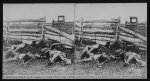
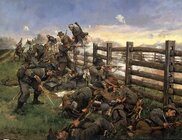
Gardner's stereo image of the dead along the Hagerstown Pike at Sharpsburg was a subject in Frassanito's book about Antietam. The dead soldier shown is still wearing his knapsack. This was all part of the author's attempt to identify the corpses that Gardner captured days after the battle.567a.jpg Keith Rocco based his painting "Eye to Eye Along the Hagerstown Turnpike" 1987 on Gardner's images825357eyetoeye.jpg
 
So there is no waist belt? Is all the weight carried on the shoulders? Is there a strap I see across the chest. I've seen that in photographs.
 
I could look this up, but I'll lazily ask instead. So how much did the packs weigh? I realize there is variation, but give me some ballparks.

And what is it with the blanket roll slung over the shoulder?
 
And what is it with the blanket roll slung over the shoulder?
There was a study done about weights that could be carried, but I don't want to go from memory so I hope someone knows where it is to quote it.

Because I did't reenact military enough to justify a knapsack, I always used a blanket roll. I liked the fact that you weren't carrying anything you didn't need--the blanket or gum blanket was your actual blanket--so it was lighter. The main drawback was there were no compartments, so everything was rolled up in there... somewhere. Pockets were necessary to keep items sorted for use during the day, like knife, pan, matches, etc. I found that tying a frying pan on the outside, sooty side out, worked nicely. Having an extra gum blanket or oilcloth folded up and able to be slipped off the top was helpful if it looked like rain.

Someone loaned me a knapsack for a federal impression and that thing was a puzzle to put on.Which straps fastened where? What buckled to what? Not sure if it was a hard or soft pack, but if one is more complicated than the other, maybe reenactors will recognize. It was as bad as learning how to stack arms.

Seems like the army had a brief love affair with blanket roles during the Spanish American War:

157px-Frederic_Remington_-_U._S._Soldier%2C_Spanish-American_War_-_Google_Art_Project.jpg

Frederic Remington
 
Always had my poncho. Learned it in the military. Took it to reenactments. It keeps the weather of and it's something to sleep in. Two covered four or five to crash under.
 
https://newrepublic.com/article/86592/fort-sumter-civil-war-soldiers-march-weight

How Much Did A Civil War Soldier Carry?
BY JAMES DOWNIE
April 11, 2011

After Fort Sumter was bombarded, the Union and Confederate armies started to experience the activity soldiers would come to know best: marching. A soldier could expect to cover at least fifteen miles per day when on the march, with forced marches occasionally covering up to thirty miles in a single day. And, like soldiers for centuries before them, the Union and Confederate fighters had to carry a load: in this case, their ammunition, tents and other personal necessities. Since older armies had marched similar distances on foot, the only way to compare marches throughout history is to ask "how heavy were Civil War soldiers' loads?"

You might think that the soldier's standard burden has become heavier over the centuries, but in the Winter 2010 issue of the Australian Army Journal, Lieutenant Rob Orr found that, since the beginning of recorded warfare, the weight of the foot soldier's load has remained roughly the same as a percentage of body weight. In fact, the American Civil War may have been a relative low point in average weights. The Union soldier's average load, for example, averaged between forty-four and fifty pounds, while the Confederate soldier's average load, because of limited supplies, could be anywhere between thirty and eighty pounds. By comparison, the average Roman legionnaire carried eighty pounds, and in Iraq and Afghanistan soldiers' average loads are between 100 and 120 pounds. Since the Roman weighed around the same as the average Civil War soldier, and the average modern American soldier weighs around twenty to thirty percent more than soldiers in previous centuries, Civil War soldiers were typically carrying ten to twenty five percent less of their body weight on a typical march.
 
Here's one of my son, this pic was taken after a firefight around a huge pot field in the Kandahar province of Afghanistan in late 2010 during Operation Dragon Strike. 101rst Airborne 1-75th Cavalry Regt. Weed and opium was the big cash crop over there; the Taliban were defending it. Note back pack he's wearing. Yes, the times sure have changed.
44883_1431552544077_6552621_n.jpg
39281_1431551464050_6367688_n.jpg
 
Here's one of my son, this pic was taken after a firefight around a huge pot field in the Kandahar province of Afghanistan in late 2010 during Operation Dragon Strike. 101rst Airborne 1-75th Cavalry Regt. Weed and opium was the big cash crop over there; the Taliban were defending it. Note back pack he's wearing. Yes, the times sure have changed.View attachment 121043 View attachment 121044
My buddy carried the rto back in the day. That sight was common of me of him. Sonethings never change. lol!
 
I would like to point out that the illustrations of knapsacks in the OP are the work of one of the best illustrators of military uniform and equippage, artist and reenactor George Woodbridge, shown below in the uniform of an American officer of Light Infantry during the Bicentennial when he was the commander of the Brigade of the American Revolution. He had a remarkable eye for detail and was a noted artist and illustrator, with work appearing in LIFE and many uniform plates published by the Society of Military Collectors and Historians but was probably best-known for his work in the 1960's for MAD Magazine!

woodbridge-003-jpg.jpg
 
MAD Magazine, great stuff if you grew up in the '60's like I did. The artists and the writers back then got away everything. And 35 cents was CHEAP.
 

Learn About Us
About CivilWarTalk
Contact the Webmaster
Meet the Staff
Link to CivilWarTalk
Join Our Community
Register
Browse Forums
View Today's Discussions
Search the Forum
Get Help
FAQ
Student Guide
Forum Rules & Etiquette
Copyright / DMCA

     Contact Us CivilwarTalk on Facebook CivilWarTalk on YouTube CivilWarTalk on Twitter RSS Feed

Bringing the American Civil War and More to Life.
© 1999 - , CIVILWARTALK, LLC - Site Version 10.0

SlaveryTalk.com - SecessionTalk.com - CivilWarTalk.com - ReconstructionTalk.com
Back
Top