
skb8721
Corporal
- Joined
- Sep 10, 2014
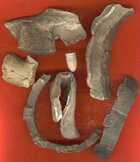
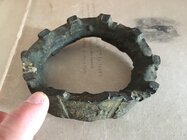
Someone asked me today to identify this artifact sitting on a bookshelf because they really didn't know what it was. (See below images.)
My immediate reaction was, "It looks like a sabot! Of the type fitted to a conical shell so that it will catch the groove of a rifled cannon and spin, to improve range and accuracy."
But . . . I confess I'm not certain it is a sabot.
I partly doubt my own conclusion because the artifact in question was found near an old salt mine where there is plenty of old rusting metal to be found if one looks.
On the other hand, there was a small artillery engagement known to have occurred about a half-mile away (as it's mentioned in the Official Records of the Union and Confederate Armies). However, the only projectiles known to have come from that "affair" (as it was classified) are one small cannonball and five or six pieces of grapeshot that have been dug up over the years.
What do you all think it is? (I'd say it's about 4 inches in diameter, by the way, but as you can see it's not exactly round, at least not anymore.)


My immediate reaction was, "It looks like a sabot! Of the type fitted to a conical shell so that it will catch the groove of a rifled cannon and spin, to improve range and accuracy."
But . . . I confess I'm not certain it is a sabot.
I partly doubt my own conclusion because the artifact in question was found near an old salt mine where there is plenty of old rusting metal to be found if one looks.
On the other hand, there was a small artillery engagement known to have occurred about a half-mile away (as it's mentioned in the Official Records of the Union and Confederate Armies). However, the only projectiles known to have come from that "affair" (as it was classified) are one small cannonball and five or six pieces of grapeshot that have been dug up over the years.
What do you all think it is? (I'd say it's about 4 inches in diameter, by the way, but as you can see it's not exactly round, at least not anymore.)




 Forum Host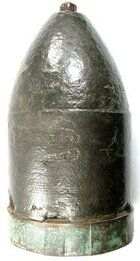


 Bringing the