
datameister
Private
- Joined
- Apr 29, 2018
- Location
- Westfield, IN
I will have two more videos about this. I appreciate everyone's feedback and questions. It really challenges one's research and concept of what happened.
CL


Thank you. I was thinking of putting that in the video about the buck and ball. There are a number of accounts from the wounded about it. Henry Schildt, being from Milwaukee and a German, was in Company F as the genealogy link confirms.Thank you for the informative video. FYI, I have a distant uncle who was wounded during the charge of the 6th Wisc. His name was Sergeant Henry Schildt of the 6th. He was wounded by a blast of buck and ball delivered by the 2nd Miss. https://www.genealogy.com/ftm/t/h/o/Velissa-Thomas-WA/WEBSITE-0001/UHP-0032.html
Outstanding Tom. Indeed, I was guilty of what we used to say in the Army of, "big hand...little map" disease in showing how the 42nd right-wing moved. Was Hall's other gun from Ulmer's section? I was under the impression that the 2nd gun was hauled off by hand by Ulmer.Like your first video, in my opinion you succeeded in capturing the essence of the unfolding action by the different regiments, which is the most important objective and not an easy task in itself. It leaves only a few minor points to mention.
I'm not sure much of the 42nd Mississippi moved south of the cut. Hall's guns could keep them at bay except for an annoying band near the cut, hidden from view by even the two left companies (G and C) of 147 NY that advanced a short distance to near the crest adjacent to the deepest part of the most western of the three cuts.
Hall actually left two guns behind, one of which lay in the path of 95 NY when it advanced northward from the pike. I suppose they hauled off that gun by hand when the fighting died down. Hall's other gun was left on the field and not reclaimed until after noon.
Considerable detailed information is available on the close encounter between the 6 WI and 2 MS, but we tend to forget the rather large number captured there from the right wing of 55 NC, nearly all of whom must have also fallen into the hands of 6 WI. That's because of the dearth of sources from 55 NC.
By the way, I was particularly intrigued with an impressive but little known painting of 14 BKLN at the cut, which is displayed at the NY Military Museum in Saratoga Springs. I've attached a photo, which regretfully has a lot of unavoidable glare, but it highlights the "red-legged devils" role, which is usually overlooked amid all the attention given to Dawes' 6 WI.
Dawes states that he split it up into two provisional companies and put them on the flanks. LT Harris, in command on the left claimed the 95th New York did not advance with the alacrity as reported by Dawes.Well done . Often the presence of the Brigade Guard is not mentioned . I wonder if these men stayed with the 6th Wisconsin throughout the battle or if they were released to their own regiments.
Outstanding Tom. Indeed, I was guilty of what we used to say in the Army of, "big hand...little map" disease in showing how the 42nd right-wing moved. Was Hall's other gun from Ulmer's section? I was under the impression that the 2nd gun was hauled off by hand by Ulmer.
There are so many interesting stories in this fight. LT Harris describes the Dawes / Blair interaction a little differently with Blair demanding Dawes surrender first, but he heard it second hand apparently. There is a report that when Blair discovered he surrendered to a Wisconsin regiment he exclaimed, "Thank God. I thought it was a New York regiment." Somehow, I can appreciate that sentiment.
One of the 55th North Carolina making his escape was the commander, Major Alfred Horatio Belo, co-founder of the Dallas Morning News.

Yes! I can't remember if I stumbled into it several years ago, but right now that area to the east along the cut is pretty thick with brush as you know.Seeing the left flank of the 6th Wisconsin in your video reminded me of my fruitless search for the right flank maker. I'm curious if you looked yourself.
Yes! I can't remember if I stumbled into it several years ago, but right now that area to the east along the cut is pretty thick with brush as you know.


OK, this is very interesting. I had not seen this. Here is what I recently saw. Thoughts?As it so happened, Lieutenant Colonel Dawes decided to take a riding tour of the scene of the carnage following Pickett's Charge on July 3rd. Dawes slowly worked his horse among the dead and wounded bodies on Cemetery Ridge. Just then, one of the wounded men in gray caught sight of Dawes, who was still in possession of the captured colors of the 2nd Mississippi from the fight at the Railroad Cut on July 1st. The wounded man cried out in a faint voice, "You have got our colors, let me see them." Hearing the man's appeal, Dawes moved toward the wounded Confederate. As he approached, he noted the man was badly, possibly mortally, wounded. He dismounted and knelt beside the wounded sergeant. "This man and I had quite an interview" recalled Dawes, during which time the Confederate sergeant identified himself as a color-bearer in the 2nd Mississippi Infantry. "The poor fellow was quite affected to see his colors," noted the 6th Wisconsin commander, "and I did all I could to comfort him." The men talked of the action on July 1st, after which Dawes had to leave. Although he later wrote that "I did all in my power to secure for him aid and attention," he noted with regret that "I do not know whether this sergeant survived his wound."[1] The unidentified sergeant must have been Color Sergeant Christopher Columbus Davis. Davis had been ill and missed the debacle at the Railroad Cut on July 1st.[2]
[1] Rufus R. Dawes, Service With the Sixth Wisconsin Volunteers (Dayton, Ohio: Morningside, 1996), pp. 160, 366-67.
[2] Davis, with the hidden colors, was taken prisoner at Gettysburg, took the Oath of Allegiance, and, as a "Galvanized Yankee," deserted the Federal army in June 1864 and made his way back to the 2nd Mississippi (if he still had the replacement set of colors carried at Pickett's Charge, whatever happened to them is lost to history). He was promoted to Ensign (1st Lieutenant), on 8/25/1864. Following the war, Dawes attempted to learn the identity of the man with whom he had spoken on July 3rd. Following a published newspaper appeal, D. J. Hill wrote back to Dawes that he had been a member of the 2nd Mississippi and had known Davis. He informed Dawes that Davis recovered from his wounds and survived the war, only to commit suicide a year or so after it ended. [Hill to Dawes, Sept. 12, 1893, Rufus Dawes Letters, McCain Library and Archives, University of Southern Mississippi]
True, but after the Confederates left the area without finding the hidden colors, Sergeant Evans apparently made it back to the 6th Wisconsin with the colors and delivered them to Dawes. He had them with him as he rode Cemetery Ridge on July 3rd.Harris always had one regret: "Oh, misery and shame, comrades forgive us, we left behind the rebel flag [of the 2nd Mississippi], that dearly bought prize." Left behind in the house, Sergeant Evans and the two young ladies hid the flag by cutting a hole in the bed-tick beneath the wounded sergeant, pushing in the banner and sewing up the rest. Outside, they heard rebel soldiers in the street as the Confederate army seized the town.
Herdegen, Lance J.. In the Bloody Railroad Cut at Gettysburg: The 6th Wisconsin of the Iron Brigade and its Famous Charge . Savas Beatie. Kindle Edition.
This is from Dawes.(From New York at Gettysburg, 1:736; 95 NY) "The success at the railroad cut was only temporary, and the brigade retired to a position near the Lutheran Seminary, the men of the Ninety-fifth assisting in dragging off the field a piece of artillery from which the gunners had been driven by the enemy."
Very interesting and great sources! I have to agree with you about how things developed. I saw in Hall's OR that Wainwright informed him one of his guns was still on the field and he recovered it before moving to Cemetery.Hall wrote to the Governor of Maine: "We were so reduced in horses that we were obliged to drag two guns off by hand." (Maine State Archives)
George F. Thomas, a member of the battery, recalled in 1888: "Our section, the right, was ordered to retire by prolong to cover retreat of the other four pieces, which we did in a hurry. Our next position was just in front of an old stone (barn), we did not stop there long, there was a board fence between us and the road (the other four pieces had left the field) and we were tearing away the fence to get through when three of the horses on my gun were shot and the gun was left a short time while we were tearing down the fence. ... One of our boys, Geo. E. Skillings by name, happened to be in or near the place where our gun was left, got a detail from a Wis. regiment and they pulled it off the field, I saw Skillings at our reunion Sept. 13 for the first time since the war." (H. H. Lyman Letters, Oswego County Historical Society, New York)
"Lieutenant Ulmer was directed to take his two guns of the right section, retire with them two hundred and fifty or three hundred yards ... They [the enemy] shot down horses and men, and he succeeded in getting the guns beyond their reach with the greatest difficulty. One gun was dragged off by hand, all the horses attached to it having been shot." ... [The horses on one of the other four guns were shot] "and the artillery-men were obliged to leave it temporarily." (Maine at Gettysburg)
Comment: From the above I conclude that the abandoned gun from Lieutenant Ulmer's section on the right was drawn off by a detachment of the 6th Wisconsin from near the pike after George E. Skillings brought it to their attention. That leaves a second abandoned gun from one of the other two sections that was apparently drawn off by the 95th New York.
Even after the two abandoned guns were drawn off by hand some distance (by the 6th Wisconsin and 95th New York respectively), one of those two guns was evidently left behind by Hall until after noon:
Wadsworth gave Hall "a peremptory order to lose no time in getting his battery into position on the heights near the town to cover the retiring of the First Corps. So that gun remained upon the field until, later, Captain Hall with his own men and horses took it off." (Maine at Gettysburg)


 Forum Host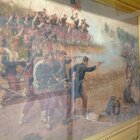

 Bringing the