Introducing Private Nathan Rine!

Moonshiner

Corporal
Joined
Mar 19, 2015
Location
Midwest
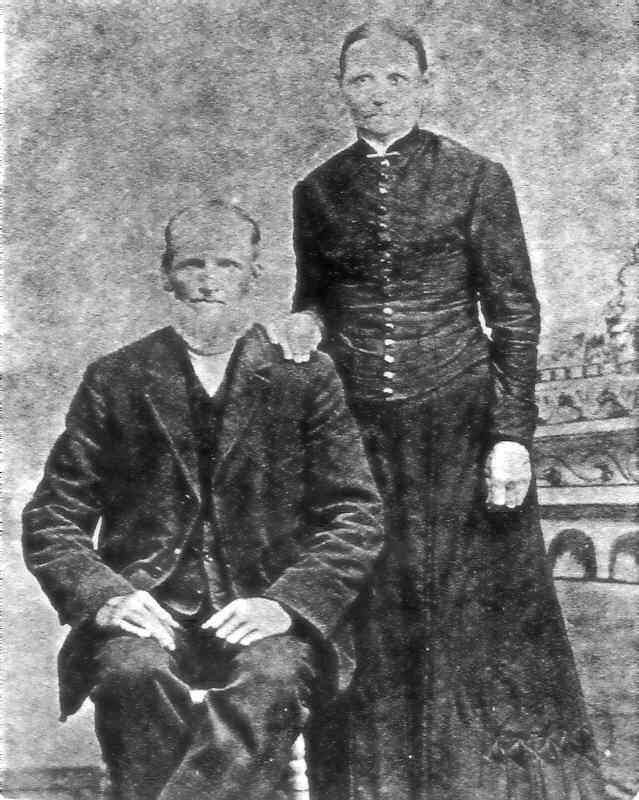
Let me introduce my Great-Great Grandfather, Nathan Rine - Who served in the Union as a Private in Company H, with the 126th Regiment of the Ohio Volunteer Infantry! He is pictured with my Great-Great Grandmother Sarah Nancy Weiker (photo dates to about 1880)

He was taken prisoner at the battle of Monocacy, Maryland on July 9, 1864. He was held in Lynchburg, Virginia where he was incarcerated about forty days, thereafter being held in the prison at Danville, Virginia for several weeks and finally taken to that notorious Libby prison, in the Confederate capital of Richmond. He was released after at the end of the war.

nwc1si.jpg


_______________________________________________________________


He is buried at Albright Cemetery (AKA Union Cemetery) in Seneca County, Ohio

2eqc3yq.jpg


2s61tnc.jpg


____________________________________________________

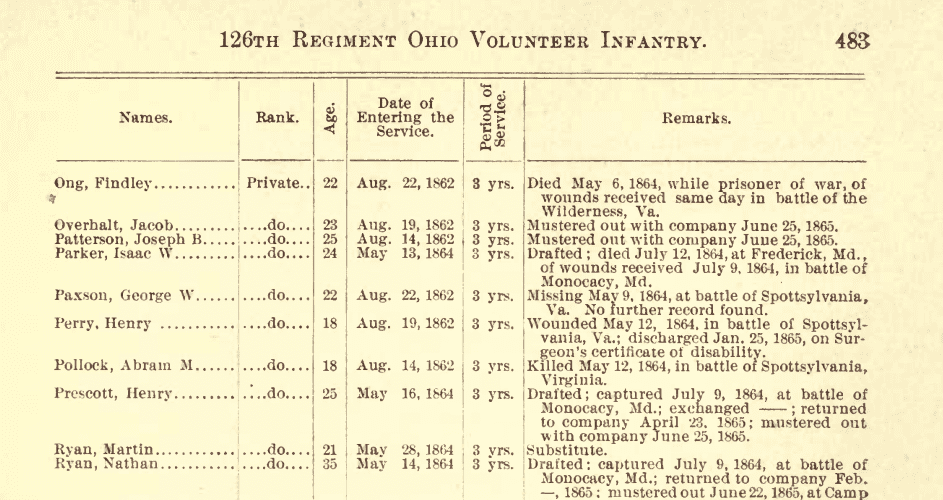
This was taken from some Ohio Volunteer Infantry register - As you see his last name was misspelled (he is the last entry shown).

28wi7io.png


_________________________________________________________________

If you have followed my first thread here, you know I was adopted. So finding this, from my biological side is extremely exciting!!

Here is a REAL ironic antidote... After a lifetime of wanting to visit the Gettysburg/Antietam area, we are going in May of this year. What is ironic is, about a month ago I decided to base centrally and booked a hotel in Frederick, Maryland - Less than 2 miles from where my G-G-Grandfather was taken prisoner at the Monocacy Battlefild on July 9, 1864..... That blows my mind.... Was it destiny calling that this all happened right before we go?
 
Let me introduce my Great-Great Grandfather, Nathan Rine - Who served in the Union as a Private in Company H, with the 126th Regiment of the Ohio Volunteer Infantry! He is pictured with my Great-Great Grandmother Sarah Nancy Weiker (photo dates to about 1880)

He was taken prisoner at the battle of Monocacy, Maryland on July 9, 1864. He was held in Lynchburg, Virginia where he was incarcerated about forty days, thereafter being held in the prison at Danville, Virginia for several weeks and finally taken to that notorious Libby prison, in the Confederate capital of Richmond. He was released after at the end of the war.

nwc1si.jpg


_______________________________________________________________


He is buried at Albright Cemetery (AKA Union Cemetery) in Seneca County, Ohio

2eqc3yq.jpg


2s61tnc.jpg


____________________________________________________

This was taken from some Ohio Volunteer Infantry register - As you see his last name was misspelled (he is the last entry shown).

28wi7io.png


_________________________________________________________________

If you have followed my first thread here, you know I was adopted. So finding this, from my biological side is extremely exciting!!

Here is a REAL ironic antidote... After a lifetime of wanting to visit the Gettysburg/Antietam area, we are going in May of this year. What is ironic is, about a month ago I decided to base centrally and booked a hotel in Frederick, Maryland - Less than 2 miles from where my G-G-Grandfather was taken prisoner at the Monocacy Battlefild on July 9, 1864..... That blows my mind.... Was it destiny calling that this all happened right before we go?

Congratulations ! Two of my east Tennessee Union ancestors died at the prison in Danvile. Thought this report might help in your research :


*************************************************************************************

Report of Lieut. Col. Aaron W. Ebright, One
hundred and Twenty-sixth Ohio Infantry.

HDQRS. 126TH REGT. OHIO VOLUNTEER INFANTRY,
August 27, 1864.
LIEUT.: In obedience to instructions, I have respectfully to
submit the following report of the part taken by this regiment in the
present campaign from May 4, 1864, to July 9, 1864:

I.

On the 3d day of May, 1864, the regiment, numbering 23
commissioned officers and 555 enlisted men present for duty, then lying
winter quarters at Brandy Station, Va., was ordered to be in readiness
to move at daylight on the following morning. At the appointed time I
moved with the brigade in direction of the Rapidan River, which stream
we reached and crossed without opposition at 4 p.m., and encamped for
the night a short distance from the southern bank. During the afternoon
of the succeeding day we marched into the Wilderness, meeting the
enemy about dark on the extreme right of the line and engaging him
until after night-fall. My regiment being in the second line of battle,
suffered but a loss of 2 enlisted men wounded. We lay on our arms
during the entire night, often disturbed by volleys fired from the
skirmish line. The following morning I was ordered into the front line
of battle. At daylight skirmishing was
commenced and constantly kept up. At 9 a.m. we charged upon the
enemy's breast-works, the brigade in two lines of battle. Although we
failed to drive the enemy we were not repulsed, but stubbornly held all
the ground charged over until late in the evening and until after a line
of breast-works had been prepared for us by the rear line, to which we
fell back as soon as completed. In this charge myself and Actg. Adjt.
Thomas J. Hyatt had our horses killed under us. Although this was the
first engagement of the campaign, any failure to drive the enemy could
not be attributed to lack of courage of either officers or men, all with
a very few exceptions behaving with much gallantry.

The brigade was now no longer the extreme right of the line, Gen.
Shaler's brigade, of the First Division, Sixth Army Corps, having been
ordered to the right to protect the flank. In this position we rested until
just before night-fall, when our skirmish line was suddenly driven in and
our position outflanked on the right, thus subjecting my regiment to a
severe fire from both front and rear. We held our position, however,
until Gen. Shaler's brigade, forming the extreme right, had given
away, allowing the enemy to get in our rear, and thereby subjecting us
to danger of capture, when we fell back by company successively as the
enemy closed in upon us. By this time the enemy, as well as ourselves,
had been thrown into confusion, and darkness having set in, friend could
not be distinguished from foe. The enemy, who had captured a number
of prisoners, was driven back by our partially rallied lines, but was not
pursued. In this day's fighting my regiment lost 1 officer and 22 enlisted
men killed, 7 officers and 129 enlisted men wounded, and 3 officers and
67 enlisted men missing.

II.

Having rested on our arms during the night after the battle of the 6th of
May until after midnight, we moved silently by the left flank along the
line of breast-works to a point near the Wilderness Tavern. Soon after
daylight we were attacked, but the enemy were driven off by a battery
near us. In this position we remained until 8.30 p.m., when we marched
in direction of Spotsylvania Court-House. The march during the night
was extremely tedious and slow, the men often dropping to sleep in the
road. After a march rendered very severe by excessive heat and dust,
we found the enemy in the evening in a strong position, and made
preparations to storm his works. After having been formed, apparently
for that purpose, we lay quietly until after dark, then moved forward,
and approached as near the enemy's works as possible without bringing
on an immediate engagement. In this position we remained during the
night. Early on the following morning skirmishing commended, and was
continued during the day without intermission. Soon after daylight we
constructed a line of breast-works and lay behind them during the day,
nothing occurring in our front but continued and heavy skirmishing. In
the evening four companies of my regiment were detailed to support the
skirmish line in an advance upon the enemy. By straggling shots and this
heavy skirmish my regiment sustained a loss of 1 officer and 2 enlisted
men killed and 6 enlisted men wounded. During the succeeding day, the
10th, we lay behind our works, momentarily expecting an attack.
Desperate fighting occurred a few hundred yards from our right, the
enemy evidently attempting to break our lines at that point. On the 11th
one company
was sent out on the skirmish line. My regiment lay this day near its
former position, having moved but a short distance to the left. This
afternoon it rained very heavily, continuing nearly all night. On the
morning of the 12th of May artillery firing between the enemy's
batteries and our own was very severe. About 9 a.m. we marched to the
left, where heavy fighting was in progress. The division having been
formed in position about noon, my regiment was detached from the
division and sent to support Brig.-Gen. Wheaton's brigade, of the
Second Division, Sixth Army Corps. Here I marched over several lines
of battle to the front line and within about 100 yards of the enemy's
works, where we engaged him until 50 rounds of ammunition were
expended, and until every fourth man had been killed or wounded, then
retiring to the rear in good order. This I consider the most severe
engagement in which my regiment participated during the present
campaign. Early in this engagement I was struck by a musket-ball on the
head, which glancing inflicted no serious injury. I was, however,
knocked down and render unfit for duty during the remainder of the
day. My regiment in this day's battle lost 16 enlisted men killed and 1
officer and 53 enlisted men wounded. The entire regiment was not
engaged at this place, part having been left on the skirmish line in front
of our former position.

May 13, the enemy having been driven from his works by yesterday's
fighting, we were ordered on a reconnaissance, and soon found the
enemy in force. In the evening we moved back to a position near the
battle-ground of the 12th, and rested during the night under orders to
move with the corps at daylight. In the morning of the 14th we moved
in direction of the Richmond and Fredericksburg turnpike, crossing the
River Ny in line of battle in the evening and securing a position on the
heights south of that stream, where we intrenched during the night.
During the 15th and 16th our position was unchanged. About sunset on
the 17th we received an order to put ourselves in readiness to move at
once. At dark we moved out and marched very show, but continually,
during the night, arriving at a point near the battle-ground of the 12th
soon after daylight the following morning. Soon after getting in position
the enemy opened on us with shot and shell, killing and wounding
several in the brigade, but fortunately for my regiment, it suffered no
loss. Having lain under artillery fire some hours, we returned to
yesterday's position without an engagement. On the 19th we moved
forward as far as possible without bringing on an engagement and
intrenched, having advanced about 2 miles. But little skirmishing
occurred during the day.

May 20, skirmishing was very brisk. About noon on the 21st we moved
to the right and a few hundred yards to the rear into a new line of works
parallel to those we left just being completed. A short time before sunset
a sharp skirmish took place, in which the enemy drove our skirmish line
into the line of works we had recently abandoned. At 10 p.m. we left
the works and marched for Guiney's Station.

III.

The march from Spotsylvania Court-House to the North Anna River was
not attended with any fighting, the regiment with the brigade acting as
guard to the trains. In this capacity we moved with the trains until the
evening, of the 25th, when, leaving them, we
crossed the North Anna and took a position behind a line of
breast-works. On the morning of the 26th we crossed the works and
marched forward across the Central railroad, but immediately
countermarched to the works again. During the night it rained very
heavily. At dusk in the evening we recrossed the North Anna, marching
with much difficulty over roads rendered almost impassable with mud
and water, arriving at Chesterfield Station at about 12 midnight. At 6
o'clock on the following morning we took up the line of march in
direction of Pamunkey, halting within a few miles of the river, and
remained in position during the night. At 12 m. on the 28th we crossed
the Pamunkey on pontoons and threw up breast-works on high ground
2 miles from the southern bank. At 3 p.m. on Sunday, the 29th, we
were ordered under arms, to be in readiness to support Gen.
Russell's division in a reconnaissance; lay during the night in the works.
Moved at daylight on the 30th in a northwestern direction, striking the
Hanover Court-House and Richmond road at the 17-mile post, following
this road 1 1/2 miles. The regiment moved with the corps to the
Totopotomoy, and formed in line of battle on the north side of that
stream. Remained in position in sight of the enemy until 12 m. on the
31st, when we moved across the stream to the front. The brigade was
here formed in two lines of battle, my regiment in the front line. Two
of my companies were on the skirmish line. At one time during the
afternoon the enemy drove the skirmish line back upon the line of battle,
but advanced no farther. In this skirmish I had 1 man wounded. In the
evening the remaining eight companies of my regiment were detailed for
picket duty. Soon after dark 100 of my picket detail returned and rested
near the rear line of battle.

IV.

At 1 a.m. June 1, leaving the picket out, we commenced the march for
Cold Harbor. Having reached a point near the enemy, after a march
rendered doubly severe by heat and dust, at 10.30 a.m., we rested a
short time and commenced work on a line of breast-works. Before they
were completed, however (our pickets having arrived in the mean time
much exhausted and hungry), the brigade was moved to the left and
formed in four lines of battle, preparatory to charging the enemy's
works. My regiment in this charge was placed on the right of the rear
line. Gen. Smith's troops having arrived, and all preparations having
been completed, we advanced with a yell upon the enemy, driving him
in confusion form his works, and capturing many prisoners. Although
having been placed in the rear line immediately on crossing the enemy's
works, by some mistake I found myself in the front, which position I
held during the night. In this charge I had but 1 officer and 9 enlisted
men wounded, and 2 enlisted men missing.

June 2, having reconstructed the enemy's works for our own protection,
my regiment remained in them until evening, then moved to the rear. I
had 2 men wounded this day.

From the 3d to the 11th the regiment took its regular turn in going to
the front without any unusual occurrences. On the 6th I had 1 officer
killed, shot through the head by a rebel sharpshooter. About 2 a.m. on
the 11th I moved with the brigade to the rear, halting at daylight and
remaining in the rear during the day. At night fall we moved to that part
of the front line occupied by the Second Army Corps, relieving the
troops there. The brigade was
here formed in two lines of battle, my regiment in front. Our front line
in this place was between 50 and 75 yards from the enemy. In this
position we lay until 10 p. m. of the 12th, when, leaving 150 men of
my regiment in the works, we commenced the movement in direction of
the Charles City Court-House. During the march from Cold Harbor to
the James River no occurrence of an unusual nature took place. The
Sixth Corps was the last to reach the James River, being in rear of the
army.*

I am, very respectfully, your obedient servant,

A. W. EBRIGHT,
Lieut. Col. 126th Ohio Volunteers.

Lieut. JOHN A. GUMP,
A. A. A. G., Second Brig., Third Div., Sixth Army Corps.

Source: Official Records
PAGE 747-67 OPERATIONS IN SE. VA. AND N. C. [CHAP. XLVIII.
[Series I. Vol. 36. Part I, Reports. Serial No. 67.]

************************************************************************************
 
That's great. Here is a short memoir by A.S. Roe, 9th N.Y. Heavy Artillery (fought as infantry at Monocacy). It tells of his experience in the battle, his capture, and his journey to the POW camp at Danville, Va. I don't know how near he might have been to your Nathan Rine on the battlefield, but very possibly, they were together in the same group of prisoners travelling through Richmond, to Danville. It can give you a good idea of what your ancestor experienced.

A.S. Roe, Monocacy to Danville, or at trip with the Confederates

Roe also wrote In a Rebel Prison, or Experiences in Danville, Va. that you might find interesting.

Good luck!

jno
Added: Correction, the first memoir cited above begins after Roe's capture at Monocacy. His account of the battle was a separate publication: Recollections of Monocacy (1883).
 
Last edited:
Congratulations ! Two of my east Tennessee Union ancestors died at the prison in Danvile. Thought this report might help in your research :


*************************************************************************************

Report of Lieut. Col. Aaron W. Ebright, One
hundred and Twenty-sixth Ohio Infantry.

HDQRS. 126TH REGT. OHIO VOLUNTEER INFANTRY,
August 27, 1864.
LIEUT.: In obedience to instructions, I have respectfully to
submit the following report of the part taken by this regiment in the
present campaign from May 4, 1864, to July 9, 1864:

I.

On the 3d day of May, 1864, the regiment, numbering 23
commissioned officers and 555 enlisted men present for duty, then lying
winter quarters at Brandy Station, Va., was ordered to be in readiness
to move at daylight on the following morning. At the appointed time I
moved with the brigade in direction of the Rapidan River, which stream
we reached and crossed without opposition at 4 p.m., and encamped for
the night a short distance from the southern bank. During the afternoon
of the succeeding day we marched into the Wilderness, meeting the
enemy about dark on the extreme right of the line and engaging him
until after night-fall. My regiment being in the second line of battle,
suffered but a loss of 2 enlisted men wounded. We lay on our arms
during the entire night, often disturbed by volleys fired from the
skirmish line. The following morning I was ordered into the front line
of battle. At daylight skirmishing was
commenced and constantly kept up. At 9 a.m. we charged upon the
enemy's breast-works, the brigade in two lines of battle. Although we
failed to drive the enemy we were not repulsed, but stubbornly held all
the ground charged over until late in the evening and until after a line
of breast-works had been prepared for us by the rear line, to which we
fell back as soon as completed. In this charge myself and Actg. Adjt.
Thomas J. Hyatt had our horses killed under us. Although this was the
first engagement of the campaign, any failure to drive the enemy could
not be attributed to lack of courage of either officers or men, all with
a very few exceptions behaving with much gallantry.

The brigade was now no longer the extreme right of the line, Gen.
Shaler's brigade, of the First Division, Sixth Army Corps, having been
ordered to the right to protect the flank. In this position we rested until
just before night-fall, when our skirmish line was suddenly driven in and
our position outflanked on the right, thus subjecting my regiment to a
severe fire from both front and rear. We held our position, however,
until Gen. Shaler's brigade, forming the extreme right, had given
away, allowing the enemy to get in our rear, and thereby subjecting us
to danger of capture, when we fell back by company successively as the
enemy closed in upon us. By this time the enemy, as well as ourselves,
had been thrown into confusion, and darkness having set in, friend could
not be distinguished from foe. The enemy, who had captured a number
of prisoners, was driven back by our partially rallied lines, but was not
pursued. In this day's fighting my regiment lost 1 officer and 22 enlisted
men killed, 7 officers and 129 enlisted men wounded, and 3 officers and
67 enlisted men missing.

II.

Having rested on our arms during the night after the battle of the 6th of
May until after midnight, we moved silently by the left flank along the
line of breast-works to a point near the Wilderness Tavern. Soon after
daylight we were attacked, but the enemy were driven off by a battery
near us. In this position we remained until 8.30 p.m., when we marched
in direction of Spotsylvania Court-House. The march during the night
was extremely tedious and slow, the men often dropping to sleep in the
road. After a march rendered very severe by excessive heat and dust,
we found the enemy in the evening in a strong position, and made
preparations to storm his works. After having been formed, apparently
for that purpose, we lay quietly until after dark, then moved forward,
and approached as near the enemy's works as possible without bringing
on an immediate engagement. In this position we remained during the
night. Early on the following morning skirmishing commended, and was
continued during the day without intermission. Soon after daylight we
constructed a line of breast-works and lay behind them during the day,
nothing occurring in our front but continued and heavy skirmishing. In
the evening four companies of my regiment were detailed to support the
skirmish line in an advance upon the enemy. By straggling shots and this
heavy skirmish my regiment sustained a loss of 1 officer and 2 enlisted
men killed and 6 enlisted men wounded. During the succeeding day, the
10th, we lay behind our works, momentarily expecting an attack.
Desperate fighting occurred a few hundred yards from our right, the
enemy evidently attempting to break our lines at that point. On the 11th
one company
was sent out on the skirmish line. My regiment lay this day near its
former position, having moved but a short distance to the left. This
afternoon it rained very heavily, continuing nearly all night. On the
morning of the 12th of May artillery firing between the enemy's
batteries and our own was very severe. About 9 a.m. we marched to the
left, where heavy fighting was in progress. The division having been
formed in position about noon, my regiment was detached from the
division and sent to support Brig.-Gen. Wheaton's brigade, of the
Second Division, Sixth Army Corps. Here I marched over several lines
of battle to the front line and within about 100 yards of the enemy's
works, where we engaged him until 50 rounds of ammunition were
expended, and until every fourth man had been killed or wounded, then
retiring to the rear in good order. This I consider the most severe
engagement in which my regiment participated during the present
campaign. Early in this engagement I was struck by a musket-ball on the
head, which glancing inflicted no serious injury. I was, however,
knocked down and render unfit for duty during the remainder of the
day. My regiment in this day's battle lost 16 enlisted men killed and 1
officer and 53 enlisted men wounded. The entire regiment was not
engaged at this place, part having been left on the skirmish line in front
of our former position.

May 13, the enemy having been driven from his works by yesterday's
fighting, we were ordered on a reconnaissance, and soon found the
enemy in force. In the evening we moved back to a position near the
battle-ground of the 12th, and rested during the night under orders to
move with the corps at daylight. In the morning of the 14th we moved
in direction of the Richmond and Fredericksburg turnpike, crossing the
River Ny in line of battle in the evening and securing a position on the
heights south of that stream, where we intrenched during the night.
During the 15th and 16th our position was unchanged. About sunset on
the 17th we received an order to put ourselves in readiness to move at
once. At dark we moved out and marched very show, but continually,
during the night, arriving at a point near the battle-ground of the 12th
soon after daylight the following morning. Soon after getting in position
the enemy opened on us with shot and shell, killing and wounding
several in the brigade, but fortunately for my regiment, it suffered no
loss. Having lain under artillery fire some hours, we returned to
yesterday's position without an engagement. On the 19th we moved
forward as far as possible without bringing on an engagement and
intrenched, having advanced about 2 miles. But little skirmishing
occurred during the day.

May 20, skirmishing was very brisk. About noon on the 21st we moved
to the right and a few hundred yards to the rear into a new line of works
parallel to those we left just being completed. A short time before sunset
a sharp skirmish took place, in which the enemy drove our skirmish line
into the line of works we had recently abandoned. At 10 p.m. we left
the works and marched for Guiney's Station.

III.

The march from Spotsylvania Court-House to the North Anna River was
not attended with any fighting, the regiment with the brigade acting as
guard to the trains. In this capacity we moved with the trains until the
evening, of the 25th, when, leaving them, we
crossed the North Anna and took a position behind a line of
breast-works. On the morning of the 26th we crossed the works and
marched forward across the Central railroad, but immediately
countermarched to the works again. During the night it rained very
heavily. At dusk in the evening we recrossed the North Anna, marching
with much difficulty over roads rendered almost impassable with mud
and water, arriving at Chesterfield Station at about 12 midnight. At 6
o'clock on the following morning we took up the line of march in
direction of Pamunkey, halting within a few miles of the river, and
remained in position during the night. At 12 m. on the 28th we crossed
the Pamunkey on pontoons and threw up breast-works on high ground
2 miles from the southern bank. At 3 p.m. on Sunday, the 29th, we
were ordered under arms, to be in readiness to support Gen.
Russell's division in a reconnaissance; lay during the night in the works.
Moved at daylight on the 30th in a northwestern direction, striking the
Hanover Court-House and Richmond road at the 17-mile post, following
this road 1 1/2 miles. The regiment moved with the corps to the
Totopotomoy, and formed in line of battle on the north side of that
stream. Remained in position in sight of the enemy until 12 m. on the
31st, when we moved across the stream to the front. The brigade was
here formed in two lines of battle, my regiment in the front line. Two
of my companies were on the skirmish line. At one time during the
afternoon the enemy drove the skirmish line back upon the line of battle,
but advanced no farther. In this skirmish I had 1 man wounded. In the
evening the remaining eight companies of my regiment were detailed for
picket duty. Soon after dark 100 of my picket detail returned and rested
near the rear line of battle.

IV.

At 1 a.m. June 1, leaving the picket out, we commenced the march for
Cold Harbor. Having reached a point near the enemy, after a march
rendered doubly severe by heat and dust, at 10.30 a.m., we rested a
short time and commenced work on a line of breast-works. Before they
were completed, however (our pickets having arrived in the mean time
much exhausted and hungry), the brigade was moved to the left and
formed in four lines of battle, preparatory to charging the enemy's
works. My regiment in this charge was placed on the right of the rear
line. Gen. Smith's troops having arrived, and all preparations having
been completed, we advanced with a yell upon the enemy, driving him
in confusion form his works, and capturing many prisoners. Although
having been placed in the rear line immediately on crossing the enemy's
works, by some mistake I found myself in the front, which position I
held during the night. In this charge I had but 1 officer and 9 enlisted
men wounded, and 2 enlisted men missing.

June 2, having reconstructed the enemy's works for our own protection,
my regiment remained in them until evening, then moved to the rear. I
had 2 men wounded this day.

From the 3d to the 11th the regiment took its regular turn in going to
the front without any unusual occurrences. On the 6th I had 1 officer
killed, shot through the head by a rebel sharpshooter. About 2 a.m. on
the 11th I moved with the brigade to the rear, halting at daylight and
remaining in the rear during the day. At night fall we moved to that part
of the front line occupied by the Second Army Corps, relieving the
troops there. The brigade was
here formed in two lines of battle, my regiment in front. Our front line
in this place was between 50 and 75 yards from the enemy. In this
position we lay until 10 p. m. of the 12th, when, leaving 150 men of
my regiment in the works, we commenced the movement in direction of
the Charles City Court-House. During the march from Cold Harbor to
the James River no occurrence of an unusual nature took place. The
Sixth Corps was the last to reach the James River, being in rear of the
army.*

I am, very respectfully, your obedient servant,

A. W. EBRIGHT,
Lieut. Col. 126th Ohio Volunteers.

Lieut. JOHN A. GUMP,
A. A. A. G., Second Brig., Third Div., Sixth Army Corps.

Source: Official Records
PAGE 747-67 OPERATIONS IN SE. VA. AND N. C. [CHAP. XLVIII.
[Series I. Vol. 36. Part I, Reports. Serial No. 67.]

************************************************************************************
That's great. Here is a short memoir by A.S. Roe, 9th N.Y. Heavy Artillery (fought as infantry at Monocacy). It tells of his experience in the battle, his capture, and his journey to the POW camp at Danville, Va. I don't know how near he might have been to your Nathan Rine on the battlefield, but very possibly, they were together in the same group of prisoners travelling through Richmond, to Danville. It can give you a good idea of what your ancestor experienced.

A.S. Roe, Monocacy to Danville, or at trip with the Confederates

Roe also wrote In a Rebel Prison, or Experiences in Danville, Va. that you might find interesting.

Good luck!

jno


Outstanding - Thanks for this information!!!!
 
As soon as I got the information, The first thing i did was go to Amazon and ordered the book "Desperate Engagement: How a Little-Known Civil War Battle Saved Washington, D.C., and Changed American History"

I had a Confederate relative there in the 53rd NC. He was a writer before and after the war (reportedly wrote the words to "Ballad of Tom Dooley") As a old man he wrote a poem about his war experiences. Here's what he wrote about Monocacy :

"We went to Frederick City, near which we met the Yanks, and routed them completely near Monocacy's
banks.
Then we in best of spirits did haste near Washington and scared old Abe so badly that from his home
he run.
I guess he thought he'd rather be back in Illinois, where he was a rail-splinter when he was but a
boy."
 
I hate to start a new thread, so I hope I can get help here.

Can anyone help me get more information on Nathan Rine? Like Birth/Death certificates, maybe even more photos... Anything would be so greatly appreciated!

This is what I know:

Nathan Rine (Last name has been spelled "Ryan" and "Rian"

Born: Apr. 18, 1831 in Ohio

Married: Sarah Nancy Weiker on December 21, 1854 in Seneca County. Ohio

Died: Dec. 28, 1909 Seneca County, Ohio

Civil War Service: Drafted May 14, 1864, Sandusky, Ohio from Seneca County. Entered on duty May 28 1864 as a Private in Company H, of the 126th regiment of the Ohio Volunteer Infantry. Was taken prisoner in the Battle of Monocracy under the command Colonel Lyman J, Jackson in Maryland on July 9 1864. Spelling of Nathan Rine's name on the 126th RegimentOhio Volunteer Infantry roster was "Ryan". He returned to his company in February, 1865. He mustered out on June 22, 1865 by order of the War Department. Nathan Rine returned to his family and farming. In 1877 he established his homestead, which today is the family farm near Green Springs Ohio. Seneca Co, Adams Twp.

The information I received reported that on his pension papers he signed his name Nathan RYANE,

Burial: Albright Cemetery (aka Union Cemetery) Seneca County, Ohio.
 
You're so lucky to have a photo! Full service records from Ohio are not online but I think pensions may be somewhere. I'll take a poke at it and see if anything pops up, but it looks like your friend did a nice job!
 
And another picture! Nathan is the white haired man on the left. Sarah Weiker is on the other end.

image.jpg


You have a lot of relatives on this branch, this was first made public by your cousin I believe.
 
Last edited:
Nathan Rine is really well researched - this wasn't credited but seems to be from the Centennial Biographical History of Ohio, which would make it public domain. Please excuse the random formatting.

.
CENTENNIAL BIOGRAPHICAL HISTORY. 141
NATHAN RINE.
We now take under review the career of one of the sterling pioneer
citizens of Seneca county, where he has practically passed his entire life
and where he has ever commanded unequivocal confidence and esteem.
The name which he bears has been prominently identified with the annals
of the county since the early days when the work of reclaiming the sylvan
wilds of this section of the state was inaugurated, and here lie is now
known as one of the large land-holders and successful farmers of the
county. He rendered valiant service to the Union cause during the war
of the Rebellion, enduring the privations and sufferings of the southern
prison pens, and during his etire life has manifested the same loyalty of
spirit that led him to follow the old flagon many a battle-field. Thus
it may be seen that he is peculiarly worthy of representation in a work
of this character, his character, services and long residence in the county
making him thus eligible.
Mr. Rine is a native of Adams township. this county, having been
born on tlie.pioneer farm of his father, on Wolf creek, four miles west
of the present city of Tiffin, on the i8th of April, 183r. His father,

142 CENTENNIAL BIOGRAPHICAL HISTORY.
Jacob Rine, was born in Pennsylvania, on the 17th of April, 1796, being
the son of Jacob. Sr., who was a soldier in a Pennsylvania regiment
during the war of the Revolution. This hero of the war of independ-
ence came from the old Keystone state to Seneca county, Ohio, after his
son and namesake had located here, and the former purchased a tract of
eighty acres in Adams township, where he passed the greater portion of
his remaining life, having been in Indiana for a few years. He died in
his ninety-fifth year, honored as one of the patriarchs of the community.
The maiden name of our subject's mother was Elizabeth Drake, and
she was born in Pennsylvania. By her marriage to Jacob Rine she
became the mother of nine children, namely : Margaret, who became
the wife of Peter Weaver and who is now deceased; Abraham, Joel and
John, who died in youth ;. Elizabeth, also deceased; Nathan, the subject
of this sketch : Mary, the wife of Monro J. Kistler, of Adams town-
ship: Fletcher, a resident of Sandusky county ; and Alvin, a resident of
IN! issouri.
Jacob Rine, father of our subject, was reared in Pennsylvania,
where he learned the tailor's trade in his youth, never following the
same after coming to Ohio. He emigrated to the wilds of Seneca county
in the early '20S and purchased eighty acres of government land in
Adams township, where he remained a few years. In 1833 he removed
to Wood county, where he purchased and improved a farm and where
he maintained his home until the death of his wife, in 1840. He then
came again to Adams township, and here he eventually consummated
a second marriage, Mary A. Steele becoming his wife. She died about
two years later and his third marriage was to Miss Catherine Dunn,
who survived him several years, his death occurring at the age of sixty
years. It may be consistently noted in the connection that his brother
Abraham, who was born in Pennsylvania, in 1800, came on foot from
that state to Seneca county, Ohio, in the early days, here entering claim
to forty acres of government land, then returning on foot to his old home,
whence he was accompanied by his brother Jacob on his final return to
Ohio. Both secured land in Adams township, and here Abraham Rine
erected a log cabin, which was their first home. He continued to reside

CENTENNIAL BIOGRAPHICAL HISTORY. t 43
in this township the greater portion of the time thereafter until his death,
in 1884. He was one of the influential men of the community, was
successful in his efforts and was recognized for his intellectuality and
sterling character. He served for many years as justice of the peace
and was incumbent of other local offices, while he was a devoted mem-
ber of the United Brethren church.
Nathan Rine, the immediate subject of this sketch, was born and
reared on the farm, and was early called upon to assume individual
responsibilities, since he began to work for a recompense of board and
clothes when but eleven years of age, his educational advantages being
such as were afforded in a somewhat desultory attendance in the pioneer
schools. He continued to work by the month, on various farms, until
he had attained the age of twenty years, when he began an apprentice-
ship at the cooper trade, to which he devoted his attention for five years.
Thereafter he farmed on rented land for many years, in Adams township.
Finally, in 1877, he purchased his present homestead, of one hundred
and fifty-seven acres, where he has since continued to reside, while
he has added to his holdings until he now has a fine landed estate of
three hundred and ninety-seven acres, well improved and devoted to
general farming and stock-raisinc, 6 stockraising.
At this juncture we will advert to the military career of Mr. Rine,
the same entitling him to perpetual honor. In May, 1863, he enlisted
as a private in Company H, One Hundred and Twenty-sixth Ohio
Voluneer Infantry, for a term of three years or until the close of the
war. He proceeded to the front with his regiment, his first engage-
ment being in the vicinity of Petersburg. At Monocacy he was taken
prisoner and was thence transferred to Lynchburg, where he was incar-
cerated about forty days, thereafter being held in the prison at Danville
for several weeks and finally taken to that notorious pen, Libby prison,
in the Confederate capital, the city of Richmond, being there confined
for another forty days, enduring the hardships which made the place
odiously historic. While at Danville he was kept on a (Het of one-half
pound of corn meal a day for a period of forty-four days. After
languishing in Libby prison fOr the time noted his exchange was finally

144 CENTENNIAL BIOGRAPHICAL HISTORY.
effected, his incarceration having been about ten months in duration,
and he then went to Baltimore, whence he was sent to Camp Chase.
Ohio, where he was granted a ninety-days furlough, which lie passed
at home, then returning. to Camp Chase, where he remained until the
close of the war, receiving his honorable discharge. He is prominent
and popular member of the Grand Army of the Republic, being identified
with Potter Post, at Green Spring.
On the asst of December, 1854, Mr: Rine was united in marriage
to Miss Sarah Weiker, who was born in Pennsylvania, and of this
union nine children have been born: Monroe J., a resident of Browns-
town, Illinois; John D., of the same place; Fletcher A., a farmer of
Green Spring township; Frank J., of Bowling Green, Ohio; Nancy J.,
wife of John Eiry, of Green Spring; Isaac E., a farmer of Adams
township; Clara and William, who remain at the parental home; and
Minnie, who is deceased.
In his political adherency Mr. Rine is stanchly arrayed in support
of the Democratic party and its principles, and his religious faith is that
of the Christian Union church, of which Mrs. Rine also is a member,
both Leing devoted and active workers in the church in Adams township.
He has served for many years as a member of its board of trustees, and
for several years past has also been. an elder in the church.

Three more pictures, also from the Centennial Biographical History.

image.jpg

image.jpg

image.jpg


Personal description at enrollment: Height 5 feet 8 inches, light complexion, blue eyes, dark hair.

So now you can picture him as a Civil War soldier as a young guy!
 
Last edited:
Nathan Rine is really well researched - this wasn't credited but seems to be from the Centennial Biographical History of Ohio, which would make it public domain. Please excuse the random formatting.


Three more pictures, also from the Centennial Biographical History.

View attachment 62723
View attachment 62724
View attachment 62725

Personal description at enrollment: Height 5 feet 8 inches, light complexion, blue eyes, dark hair.

So now you can picture him as a Civil War soldier as a young guy!


Allie, you are amazing. The photos are amazing. I am overwhelmed right now. Seeing that knife is like a spiritual journey for me. Oh how I would love to have that, even to hold it..... Gosh what a find. Thank you so very much!!
 

Learn About Us
About CivilWarTalk
Contact the Webmaster
Meet the Staff
Link to CivilWarTalk
Join Our Community
Register
Browse Forums
View Today's Discussions
Search the Forum
Get Help
FAQ
Student Guide
Forum Rules & Etiquette
Copyright / DMCA

     Contact Us CivilwarTalk on Facebook CivilWarTalk on YouTube CivilWarTalk on Twitter RSS Feed

Bringing the American Civil War and More to Life.
© 1999 - , CIVILWARTALK, LLC - Site Version 10.0

SlaveryTalk.com - SecessionTalk.com - CivilWarTalk.com - ReconstructionTalk.com
Back
Top