Identify Canteen

major bill

Brev. Brig. Gen'l
Forum Host
Joined
Aug 25, 2012
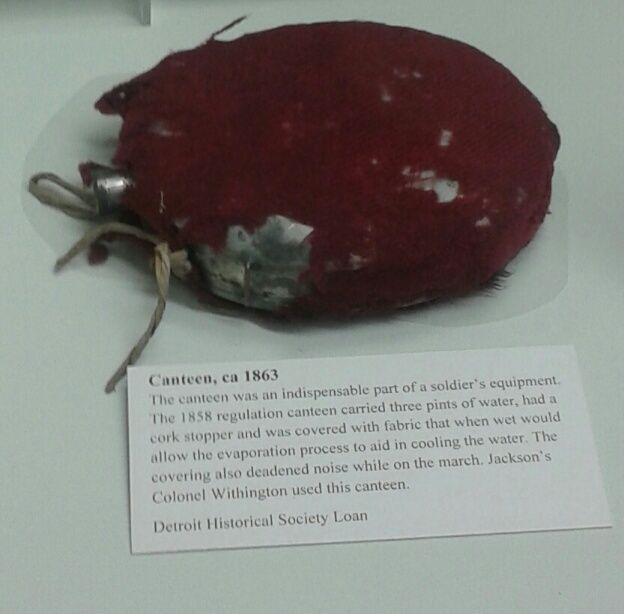
I saw this canteen in a museum today. It is odd because it is not round, but taller than it is wide and the cloth cover is red. Does anyone recognize this style of canteen? This belonged to an officer in the 1st Michigan Three Month Infantry Regiment. that regiment was issued canteens made in Detroit covered in red cloth. My issue is that the officer latter joined the 17th Michigan and I have to wonder if the date on the museum identification card is wrong and if it could be a 1861 issue Detroit made canteen. I would take it red is not a common color for Union canteen covers or am I wrong?
can.jpg
 
Who is Col. Withington??......I would suppose that some early war volunteers could have been given canteens of a unique nature (as a "gift" from the local community, etc)....I would suggest doing research into the units that you mentioned.....maybe you'll turn up some info!!.....Thanks for the post and pic!
 
General William H. Withington was in the pre war Jackson Greys as a cpl. and became Cpt. company commander of Company B of the First Michigan, Was wounded and taken prisoner at the First Battle of Bull Run. Exchanged and then was colonel of the 17th Michiagn Infantry. Became commander of the 2nd Brigade, 1st Division, Ninth Army Corps,. Brevet Brigadier General 1865.Medal of Honor for bravery.

When the First Michigan Three Month Volunteer Infantry Regiment was formed in April of 1861 the Michigan Militia Quartermaster had W.T. Tefft (25 Woodward Avenue, Detroit) make up canteens with red cloth (flannel) covered canteens In Photographs the loose cloth covers were puckered at the canteen neck, but I cannot tell from the photographs if the canteens were round or not.I think it is possible that this canteen was one of those made in Detorit by W.T.Tefft.
 
Last edited:
A kind of distorted blow up of a photograph of the 1st Michigan Three Month Infantry. This is the red cloth covered canteen made in Detroit. Note although the photograph is poor, it appears the canteen is taller than it is wide. Also note the neck of the canteen is rather short, much like the one I posted.

can can 2.jpg
 
A copy of a photo from the book My Dear Wife, The Civil War Letters of W. H. Withington. I plan to write to the museum and see if they will let me take some good photographs, but I have my doubts they will open the case for me as the case is sealed with many screws and it would be work to open the case.

can can 3.jpg
 
The images were taken at an angle so a bit difficult to determine if the canteen is actually slightly elongated or not. A straight on photo would greatly help... Early war units or state quartermasters were not uncommon to contract with local merchants to produce canteens... The variations thereof can be many. Not that many of these survived since they were typically used up... Issues with shoddy workmanship with a host of different contracted makers resulted in standardization of QM regs and pattern standards resulted in more uniform designs of those that came later.. Also later contracted goods were required to have the makers name on them... (know who to blame if defective)... One can find a wide array of cover materials... majority of surviving examples tend to be found with dark blue, tannish, grey covers of jean cloth, uniform cloth scraps, old wool blanket cloth.. Some contracts specified the cover material... many didn't.. and used what fabric was available... Some surviving canteens are thought to have field replacement covers. I also caution folks that many of the dyes used during that time can and do sometimes fade drastically. Many canteens were placed on display over the years and exposure faded the fabric... what may have originally been grey or blue... commonly will fade out to a tan.. greenish... or orangeish hue amongst others....

Many museums have a photo data base of all their artifacts for record... many will also take them to offer researchers and historians... so not be handling the original artifact repeatedly each time the next guy comes in wanting to see it..
 
Thank you Albert Sailhorst and Frederic 14Va for your input. I went to the Ella Sharp Art and History Museum to view a photograph of William H. Withington in his pre war Jackson Greys uniform to try to made out what was embossed on his cross belt plate and to get a better view of his tall bearskin which in most copies of his photograph is hard to see. in detail. I was surprised to find on display his odd canteen and the odd jacket he wore when he was captured at the First Bull Run. You never know what you will find in a small art and history museum.
 
The small metal wire loop for a shoulder sling in your opening photo shows us it wasn't a federal issue canteen which lends credence to your idea that it was made locally in Detroit.
 
Like I said I know his first regiment was issued Detroit made canteens with red cloth covers. He should have worn out his canteen cover by the time he joined the 17th Michigan. I have to wonder if he bought a better canteen and left this one in storage.
 

Learn About Us
About CivilWarTalk
Contact the Webmaster
Meet the Staff
Link to CivilWarTalk
Join Our Community
Register
Browse Forums
View Today's Discussions
Search the Forum
Get Help
FAQ
Student Guide
Forum Rules & Etiquette
Copyright / DMCA

     Contact Us CivilwarTalk on Facebook CivilWarTalk on YouTube CivilWarTalk on Twitter RSS Feed

Bringing the American Civil War and More to Life.
© 1999 - , CIVILWARTALK, LLC - Site Version 10.0

SlaveryTalk.com - SecessionTalk.com - CivilWarTalk.com - ReconstructionTalk.com
Back
Top