For the OP to consider on his "London Warranted" lock---
We tend to think that the early American gun making industry as one where the gunsmith did it all, who made the lock, stock and barrel. After years serving as an apprentice where he learned how to make everything, once he demonstrated his competence in his craft, he would be free to call himself a gunsmith and open his own shop where he sold his hand-built completed rifle. This is one reason why we have different styles or schools of gun building that was demonstrated so well in the "Golden Age" (roughly 1770's-1820's), of early American gun building. The system the British used was different. They tended to have manufactures that specialize in making only the various components such as the locks or barrels and a third party would buy their components and assemble a gun from the various suppliers. Perhaps the most difficult item to make for a muzzle loading firearm is the lock, where you have very tight tolerances between the various parts, the metal has to be tempered properly, and the springs must be in balance with each other, (this is especially true for a flintlock system). It's not unusual to find an English made lock on an American made firearm. The English exported their gun components to America by the barrel full, and some of their locks in particular enjoyed a good reputation for their reliability, and our American gunsmiths would not hesitate to use an English lock on their otherwise American made gun.
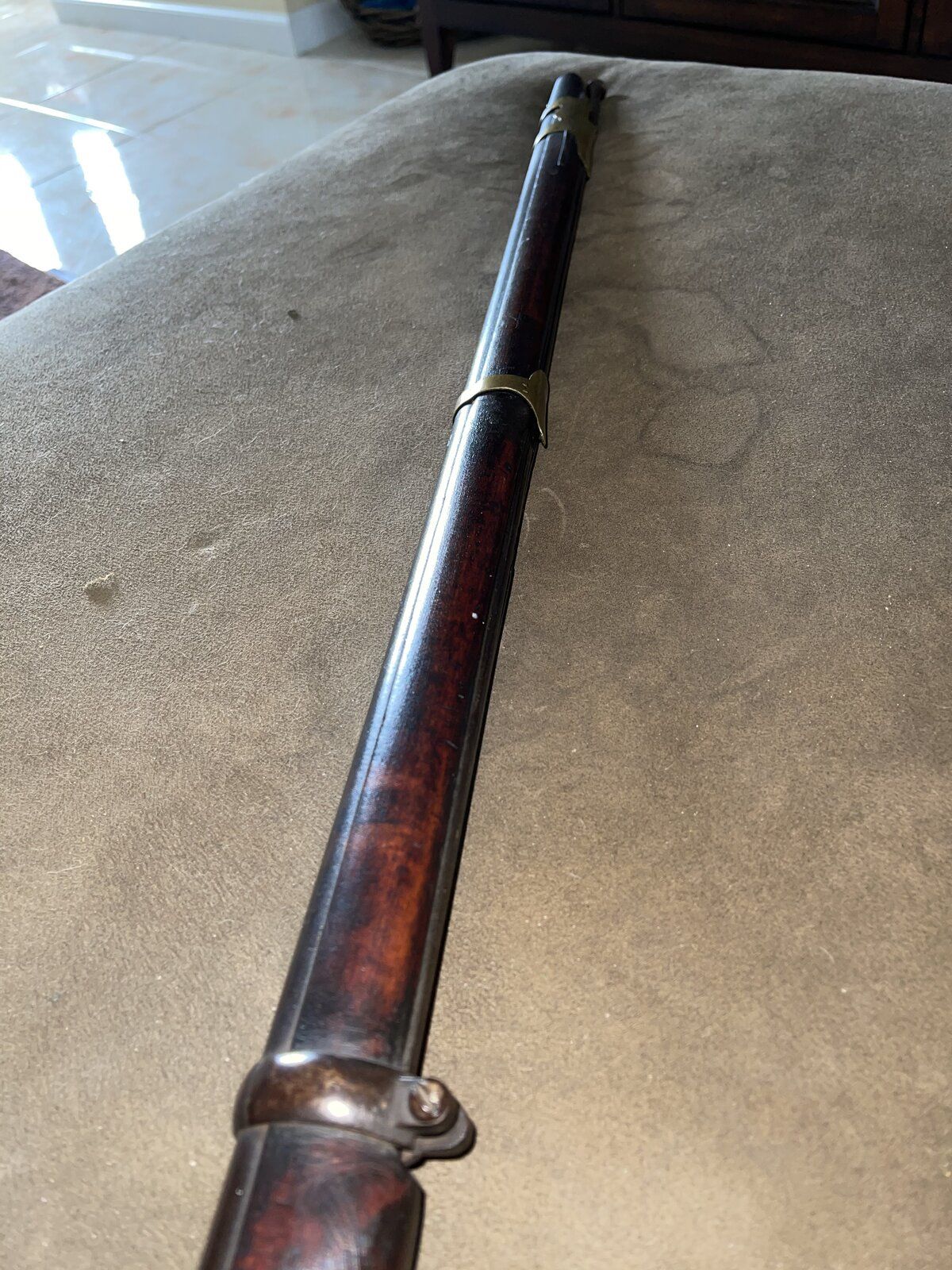
To be honest, I'm not sure what this gun started out as, but my guess is that in it's original configuration, it was a flintlock, and either a state contract made musket or a higher grade trade gun. It appears to me the percussion lock was added at a later time (the late 1830's as the earliest), when the musket was converted from flint to percussion and a percussion lock from England was purchased for that conversion. The lock looks to me as it doesn't quite fit into the original lock mortise and the lock plate has been slightly modified for it to do so. If I were to guess when the musket was made, I'd say in the early third of the 1800's, and perhaps later converted for militia use(?), or at the whim of the owner. No rear sight is seen, so I assume the musket is a smooth bore.
The square butt stock and brass butt plate, the long and fancy brass trigger guard and brass side plate give it a high grade trade musket look and I think are original to the gun. The two brass barrel bands give the musket a military look, especially the barrel band at the muzzle, which looks to be retained with a barrel band spring. I don't see the same type of spring attachment to the middle and lower barrel bands, so were these brass barrel bands a later addition? The "spud" attachment just in front of the bow on the trigger guard appears to be made of iron, and my guess is that it was a latter addition to the trigger guard for the purpose of being an anchor for a sling. However the are no such other attachments on the barrel bands for a sling that are visible, although there could be a hole in the forearm of the stock for that purpose which can't be seen in the provided pictures.
These are just my observations from from the provided pictures. By no means am I an expert on early American firearms. I'm more of a informed observer with an interest in these types of firearms and I could be partially correct in some of my observations, or totally wrong in everything I've said. I might have totally different observations regarding the gun if I had it in hand.
It does look to be a higher quality smooth-bore musket and if I were the OP, I would be pleased to have it as a family heirloom regardless of it's history.




 Forum Host


 Bringing the